Some people would explain the extreme skinniness typically seen among high-fashion models in terms of a demand for skinniness on the part of the consumer [of fashion imagery/merchandize]. If this is true, then given that high-fashion models have the highest status among female models, it would appear that the aforementioned demand is especially great and characterizes a substantial proportion of the population, especially young women. This issue needs to be formally addressed.
Let us address a study by Rand and Wright, which evaluated continuity and change in the evaluation of ideal and acceptable body sizes across a wide age span.(1) Salient results from this study are described below, and the paper can be downloaded in pdf format by clicking here.
Rand and Wright evaluated body size preference in a U.S. sample of “303 fourth and fifth-grade elementary school children, 427 high school adolescents, 261 young adult university students, and 326 middle-age adults.” Between three-fourths to four-fifths of the participants in the 4 groups were white. The body size preference was evaluated for 9 series: babies, young boys and girls (ages 6-10), young adult males and females (ages 16-25), middle-aged men and women (ages 35-45) and older men and women (ages 55-65).
The participants were given a series of line drawings -- as in the example of young women shown below -- and asked to circle all figures they considered to be socially acceptable as well as indicate the figure that they found ideal.
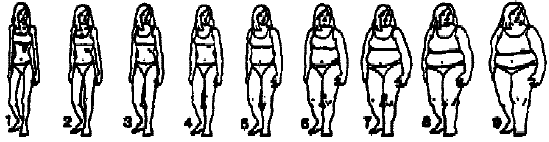
Fig 1. Line drawings of young women (ages 16-25).
Most relevant to this site are the figure ratings of the young women (ages 16-25) series by high school and university students. The table below indicates the proportion of each of the four groups that found line drawings 1-9 socially acceptable for the young women series. It is very clear that only a very small minority of people considered body size 1 socially acceptable, and fewer still would consider it ideal. Now, body size 1 is the typical figure of high-fashion models; some high-fashion models would be 1.5 on this scale and very few would be higher still on this scale.
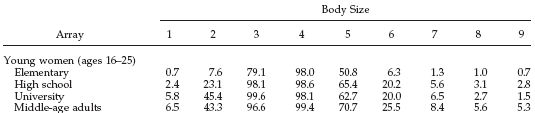
Table 1: Percentage of elementary school children (N = 303), high school adolescents (N = 427), university young adults (N = 261), and middle-age adults (N = 326) rating each body size in Fig 1 socially acceptable.
The table below shows the mean ideal body size in each array, by subject group.
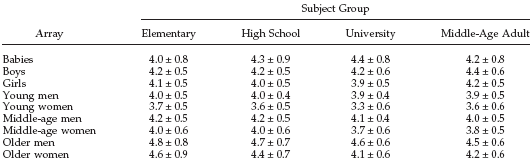
Table 2: Mean ideal body size in each array, by subject group.
The participants overwhelmingly considered the mid-range figures as both socially acceptable and ideal. “Of the 36 mean ratings (9 arrays × 4 groups), 75% (27) indicated a midrange preference for ideal body size (4.0–4.8). The smallest mean ideal body size was 3.3 and the largest was 4.8.”
The results above should be intuitive to most people, a number of whom would be surprised that a study set out to formally demonstrate what in their estimation should be common knowledge. Indeed, anyone who insists that there is a substantial preference for skinny female physiques in the general population, especially among young women, had better cite comparable data and explain away the results above.
Data such as above show that it is absurd to claim that the skinniness of high-fashion models is a response to public demand, especially that of young women, which translates to better sales of fashion merchandize. Whereas top-notch fashion designers will cater to the rich, many of them will also market merchandize to middle class people. Therefore, if public preferences are taken into account to maximize sales, it would make sense to have high-fashion models with a physique in the 3-4 range on the scale shown in Fig 1, but this is not seen. The authors wrote:
Based on the results of this study, we question why the fashion industry and media select as ideal, models who would be considered too thin by most people. The midrange of body sizes within which the ideal is selected by subjects in the present study is rarely used as models. When they do appear, it is not in standard magazines but in catalogues like Lane Bryant, a publication targeted for larger women! (Male fashion models have thinner body sizes than those the subjects selected as ideal, but differences are not as extreme). Even a 30-min exposure to models with normal body sizes can improve how women evaluate themselves (Myers & Biocca, 1992). From a marketing as well as mental health perspective, it would seem advantageous to promote use of midrange rather than very thin body sizes for fashion models.
Guess what? Those who have come to this article without going through the other parts of this site should understand that the typical skinniness of high-fashion models is part of a package of looks -- including youth and masculinization -- that makes them approximate the looks of adolescent boys, and the reason for such looks is that the top-ranks of the fashion business are dominated by male homosexual fashion designers. As to why the looks of fashion models then do not undermine sales, I will repeat an analogy that I have mentioned previously:
Imagine that all companies manufacturing soap use unattractive models to sell soap. Will people stop using soap or even reduce their use of soap as a result? Obviously not. Clearly, if one is selling necessities and highly desirable items, then one has a broad license as to what kind of models one can use. It is important to be well-dressed and even if unattractive women are ubiquitously used to model designer clothing, women are not going to stop desiring such clothing or patronizing fashion designers.
If this study were repeated in non-European cultures, the mean preferred level of body fat in young women would be higher in some cultures, but then women in these cultures are naturally more prone to obesity, and so many of the upper class women in these cultures are overweight/obese that excess body fat becomes a sign of higher social status. It is not necessary to address the relevant genetic differences here, but I will do so if someone raises the issue of body fat preference being largely or entirely conditioned by culture.
References:
- Rand, C. S. W., and Wright, B. A., Continuity and change in the evaluation of ideal and acceptable body sizes across a wide age span., Int J Eat Disord, 28, 90 (2000).
Comments
Interesting study.
But doesn't such a study by its nature bias people toward accepting the middle range of bodies? Perhaps one should study people's reaction to a subset of the drawings, and see to what extent, if any, the preferred and socially acceptable lists are sifted toward the skew of the subset.
Also, photographs of real people, or manipulated images based on one photo of one real person, would be easier to correlate to real people and real BMIs/weights/fat %s than are line drawings.
How would you know that certain groups are "naturally" more prone to obesity than Europeans? Obesity levels differ between racial groups in the United States but how does this difference equal a genetic predisposition to obesity? I think desired body fat levels have changed throughout western history. Thin is in now but it wasn't always so. Many of sex symbols of the past were chubby or even fat. People like Lillian Russel and Theda Bara were the idolized "it girls" of their eras. No one would think very much of them now a days but back then they were hot stuff.
Lillian Russell
Theda Bara
> Many of sex symbols of the past were chubby or even fat.
And how do you know that they were "fat" ?
You are judging them against today's standards.
What a genius, this Danielle guy.
Der Wanderer, I'm a female. Lillian Russell weighed over 200 pounds at one point in her career and she was about 180 at her peak. She was overweight by medical standards. Theda Bara just looks fat.
It doesn't take a genius to see that these two women were not skinny or even average. All it takes is two eyes. I am sure the general population back in the day would describe these women as chubby or fat but the difference between now and then is that it wasn't a bad thing to be fat. My point was that beauty standards have evolved and they aren't as static as Eric would portray them to be. Maybe you should work on your reading comprehension. Genius.
> She was overweight by medical standards.
Oh, "by medical standards"
How sweet...
What's your beef with Erik, then?
Who put the likes of Alessandra Ambrosius on a pedestal?
Hint: it wasn't the Medical Establishment
> My point was that beauty standards have evolved and they aren’t as static as Eric would portray them to be.
Who "evolved" them?
Darwinian evolution?
Hegelian metaphysics?
The pointing finger of God?
No. Normal people, like Erik.
You're a reactionary opposing change, drop your useless crusade.
DWPittelli: The line drawings above look worse than what they did in the actual images used for the study. The line drawings by their very nature should not bias people to select the middle range as optimal. I have also cited studies that have used photographs of actual people and their manipulations, and the conclusions are similar.
Danielle: Indirect evidence for ethnic differences in proneness to obesity can be observed by differences in the prevalence of obesity after adjusting for various demographic/socioeconomic correlates in multiethnic societies. Anyway, there are known genetic differences between ethnic groups with respect to the likelihood of packing on excess body fat, an example of which is documented here (scroll down to the section on obesity).
Regarding your reference to past standards in Western societies, the fundamental flaw in your approach is using some famous examples to infer the general preference of the population. A similar assessment of contemporary Western societies would suggest that most Westerners prefer the typical thinness and masculinization of high-fashion models given that these women occupy the highest status among models, make a lot of money and are portrayed very admirably in advertisements. The reality is revealed in controlled laboratory studies, one example of which is the study discussed in the article above. These studies reveal that Westerners overwhelmingly prefer, in women, above average femininity and body fat levels higher than what is typically observed in high-fashion models.
The problem is that there are no comparable controlled laboratory studies from the era your pictures date to. An additional problem is that back then few women would be willing to expose themselves in the risqué dresses worn by Theda Bara, i.e., a woman with sub-optimal looks could end up popular with men because of the dearth of women with closer to optimal looks that were willing to expose themselves in a similar manner. Yet another problem is that the likes of Lillian Russell were admired for non-looks factors such as singing and acting. Even in the current era, you can observe a number of women that initially came to the limelight for reasons apart from looks and ended up being admired by many men because they looked better than most of their peers, not because they were very good looking per se (e.g., Anna Kournikova). In other words, you have not established that “desired body fat levels have changed throughout western history.”
I am not insisting that there has been no change, but your examples remind me of the social constructionist argument coming from feminist circles, and it is very inadequate.
Der Wanderer, I don't really think that my statements were difficult to decipher. Lillian Russel was obese by medical standards so its not just my opinion that she was fat.
My "beef" with Eric is that he tries to present his opinions as fact. I believe that most people would find the supermodels more attractive than the porn girls Eric compares them to. I also think that he is racist, homophobic and sexist.
The people at Victoria's Secret may have put Alessandra in their shows and commercials but the general public has put her on a pedestal. If the beauty of Alessandra had isolated appreciation in gay circles then she wouldn't be as popular as she is now. Are you saying that the public is so vapid that they will admire someone who is clearly unnattractive because gay men tell them to?
I know that beauty standards have changed that was my point. You haven't really challenged anything I said though you think you have. You are an idiot.
Eric, I don't think genetic differences are the sole explanation for obesity levels in non-white populations. African American females have the highest rates of obesity in women but African males have lower obesity rates than Mexican American men.
I think the sex symbols of a culture are a pretty good example of what people find attractive in that culture. I don't think an assessment of contemporary western culture would suggest that there is a preference for the extreme thinness seen in high fashion models. You don't seem to understand that most high fashion models are virtually unknown to the general population. Gemma Ward's popularity is not equivalent to the past poularity of Theda Bara. You would have to evaluate the looks of popular actors and celebrities.
I don't think that it is a coincidence that the most popular VS models are typically heavier than most high fashion models. They are closer to America's current preferred body fat levels than most of their high fashion counterparts.
There were other very popular silent screen actresses that wore things that were just as revealing as Theda Bara's costumes. Annette Kellermann was a major silent film star who appeared nude in one of the most expensive films of that decade. Other very popular silent film stars like Fay Wray, and Gloria Swanson did risque or nude scenes. Old Hollywood was not as repressed as people think it was before the Hays code was instituted in 1934.
I think the ideals of beauty are greatly influenced by culture. I think that youth is highly correlated with beauty in all cultures but everything else seems to be heavily culturally influenced.
> Eric, I don’t think genetic differences are the sole explanation for
> obesity levels in non-white populations. African American females have
> the highest rates of obesity in women but African males have lower
> obesity rates than Mexican American men.
I think that there's a fallacy lurking up there...
http://www.fallacyfiles.org/
Try to find out which one.
Hint #1: All (so-called) non-whites aren't equal
Hint #2: Apples & Oranges
In fact, there's more to it than just "Apples & Oranges"
This genius is mixing up several issues like:
- Nationality
- Ethnicity
- Genetics
- Politics
- Culture
- Gender
What a genius, this Danielle guy ...
Der Führer, I meant to write African AMERICAN males have a lower incidence of obesity than Mexican American men. I assumed that my source (American Obesity Association) was using the term "mexican american" to describe americans of predominant mexican "indian" ancestry. I am not confused like you appear to be. Here is a link to the source: http://obesity1.tempdomainname.com/subs/fastfacts/Obesity_Minority_Pop.shtml.
sorry but you shouldn't post things like "don't click here unless you are 18"
Kassi: I didn’t post the ad titled, “don’t click here unless you are 18.” The ads that you see are computer generated, and whereas I could block specific ads, I don’t select the ads that are displayed.
Danielle: Don’t accuse me of presenting my opinions as facts. The article above discusses a peer-reviewed journal paper. This site cites hundreds of studies, and several of them argue against your contention that supermodels would generally be found better looking that the attractive feminine women I have been showing. How many studies have you cited to support your comments? Typically zero.
Any reasonable person who looks at how heavily the homosexuals promote manly women like Alessandra, how the likes of Alessandra look like in the absence of posing tricks and the assistance of make-up and digital artists, and how few feminine beauties are seen in the limelight will realize that the public hasn’t put Alessandra Ambrosio on a pedestal, the homosexuals have. My argument isn’t that the public is admiring Alessandra because the gays are telling them to. The public doesn’t admire Alessandra’s looks, period. One hasn’t shown that most people admire Alessandra’s looks unless one has presented her next to feminine beauties and still obtained a favorable response from most people.
I agree that beauty standards are influenced by culture and, once again, I am not arguing that there has been no change in beauty standards, but you have failed to make your case for reasons that I have already mentioned.
I haven’t argued that genetic differences solely explain differences in obesity proneness across ethnicities. Besides, the extent of sexual dimorphism involving the prevalence of excess body fat can vary across populations for biological reasons.
Are sex symbols a good example of what people find attractive in the culture? Not necessarily. Take 1990s sex symbol Pamela Anderson: bleached brunette, masculine, fake breasts, broad shoulders, wide rib cage (see pictures here and here). Pamela Anderson was lucky to run into a bisexual Editor-in-chief of a major publication (Playboy) who shot her to stardom utilizing posing tricks/deception. Again, unless you have Pamela contrasted with feminine beauties and most people agree that she is hot, you will not have made your case, but you won’t be able to do this according to evidence from controlled laboratory studies.
VS models will naturally be heavier than high-fashion models in general because of the requirements of lingerie modeling, but you still observe the homosexuals tolerate the minimum femininity that gets the job done, preferring to use masculinized models with breast implants to non-overweight models with naturally prominent breasts (since they will tend to be feminine elsewhere, too).
LOL!! Did I make wittle Ewica angwy?
None of your cited material argues that the women in your attractive women section would be found better looking than Victoria's Secret supermodels. The skanks in your "attractive" women section are average to butt ugly so most people would not find them better looking than VS models. The only way for you to prove that most heteros would find your skanks better looking is to survey a sizeable group of them and ask them to comparatively rate the attractiveness of these groups of women. You would have to current images of the VS girls at the lingerie show instead of old images of them at high fashion shows or in editorials.
I don't need to cite any peer reviewed journals or studies because most of my arguments do not require scientific data to back them up.
Any reasonable person can see that one video showcasing the Victoria’s secret girls does not prove that homosexuals are heavily promoting them. If you can prove that homosexuals are responsible for hiring these models for Victoria's Secret then you will have some proof to back up you statements. Victoria's Secret is a business and the public always has the option of rejecting their products and/or the models they use to promote them.
I am not the one with the website dedicated to promoting "feminine beauty" and exposing the mental illness of the dastardly fashion pederasts. You would bolster your arguments by comparing the looks of popular sex symbols with your nude skanks in a controlled laboratory study. I don't have tome to look up a bunch of sources or to do any studies.
I don't see why "the homosexuals" would need to hire women who look like your nude skanks for the VS show. The models they have now do their jobs very well.
I am 5' and 1/4" and technically I am 40lbs overweight according to medical charts. However as my thyroid doctor put it, when i gained the weight i certainly did it in the right "places" and that i have and never will be fat. just because her weight was stated at 180 doesnt mean she is "fat" according to medical standards, the pics speak for themselves, she was clearly a curvy woman, but by no means fat! even a doctor would tell you that! i dont see any rolls anywhere on this woman. Gods forbid she actually have some boobs and hips?! all of you calling her anything close to fat are stupid!
Look again. Without that industrial-strength corset and massive skirt her figure would not be nearly so flattering.
So this study proves that fashion models are not seen as having the ideal body size image by the wide majority of people. So that puts the blame for promoting their image on the fashion designers, it's not news that fashion designers dictate the trends in what's beautiful and what's not, I am saying they are mistaken because most of their visions are artistic and too demanding, that's why anorexia exists. I am not saying that fat is beautiful, I am on a Seattle HCG diet myself because I want to look good but those girls are unaesthetically thin.
Actually, if you use your eyes, she is practically naked in one of those pictures and looks fantastic. Looks like you need a new set of eyes and possibly even a brain, there is no corset present in that picture! Sorry your vision seems to be going out, you need to see a doctor, asap!
You are rude and overbearing and aggressive, Danielle, you have also not proved your point and Eric has.