Shortly ago, I came across a good study(1, pdf) that I should have had ran into an year ago, but strangely missed it. It clarifies an argument that I have been making by mostly contrasting Europeans with non-Europeans. This study has shown the existence of an aesthetic preference for placement along the overall ancestral-to-derived discriminant within an European population (Italians), and it employs the proper way of measuring face shape.
The idea is simple. If you have a sample of men and women, their face shapes can be described by measuring the locations of corresponding landmarks on the face. This will allow one to compute the average face shape within each sex and describe how sex differences alter face shape. If each individual is rated for attractiveness, then there is also a numerical assessment of attractiveness. This allows one to examine to what extent attractiveness is related to averageness and femininity. Another well-documented correlate of beauty is a specific type of asymmetry, fluctuating asymmetry, which is the random deviation from bilateral symmetry, but are there other correlates of beauty that can be discovered by the use of proper methodology to describe shape?
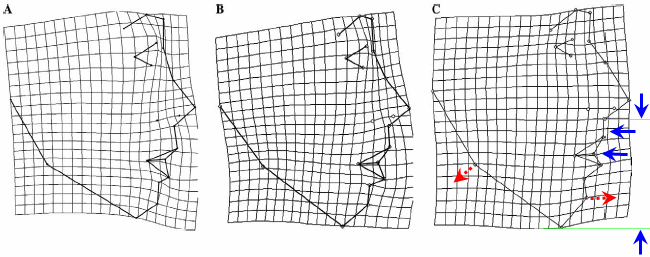
The authors, Valenzano et al.,(1) reported that both averageness and above average femininity were correlates of beauty in women, as has been well documented. However, they found a component of attractiveness that was related to neither of these factors, and it is shown below where the blue arrows mark the regions that shrink and the red arrows mark the regions that expand along the lines of increasing attractiveness.
In the diagram below, the figure on the left (A) shows the outline (thin plate spline to be more precise) of the average attractive face with shape difference exaggerated 5 times from the male-female average, figure B shows the hyperfeminine face (50% shift from the male-female average in the direction of the female, and the difference is shown exaggerated 5 times), and figure C shows the difference between figures A and B.
Fig. 1. Thin plate splines showing average attractive face (A), hyperfeminine face (50% shift from the male-female average in the direction of the female, B) and the difference between these two shapes (C). A and B are shown with 5-fold exaggeration of the actual difference from the male-female average of the population.(1)
The authors noted:
Our study confirms a contribution of sexual dimorphism to female facial attractiveness, but also highlights that attractiveness is not coincident with exaggeration of sexual dimorphism, but is associated with a specific pattern of shape variation, particularly in the jaw. The biological meaning of this pattern remains to be investigated.
I do not know whether they are reluctant to mention the biological meaning of the pattern or really don’t know what it means. If they don’t know the meaning, the following comparisons should help.
Fig. 2. First row shows a gorilla. Second row shows central African women. Third row shows the outline of the average African-American woman(2) (left) and a 3D scan of the average Chinese woman.(3) Fourth row shows the average Italian woman(1) (left) and a 3D scan of the average English woman.(4)
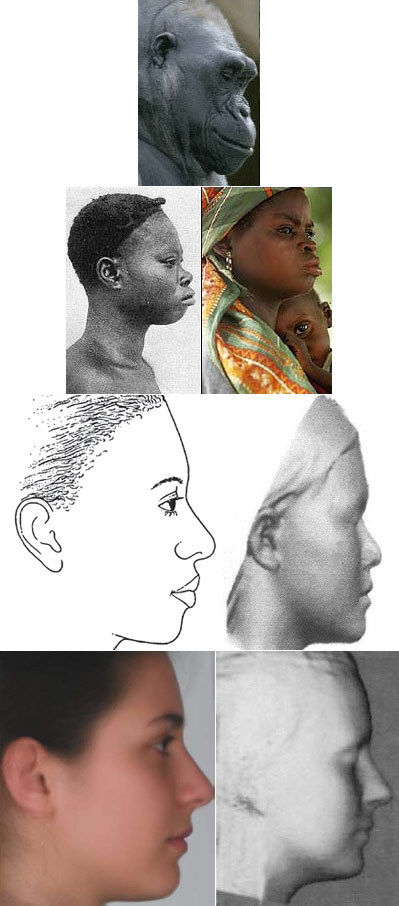
From the ape to the Northern European, the lower thirds of the face (bottom of the nose to the chin) reduces in proportion to face length, especially the length from the top of the nose to the chin, the jaw and mouth become less protruding and the chin becomes better developed. Note that apes do not have a true chin, whereas the central Africans shown have a chin, but it isn’t clear because of the extent to which their mouths are protruding.
So the authors found a component of attractiveness relating to the front of the jaw that is along the ancestral-to-derived discriminant. The other part of the jaw affected, the gonial region, is apparently related to a preference for a more defined jawline, and conceptualizing it as related to the ancestral-to-derived discriminant is not straightforward. The leftmost red arrow in Fig. 1 is coming out from a point (gonion) that is shifted to the left in more ancestral forms because of larger jaw size, and this does not lend itself to a defined jawline because the gonial region would usually have some fatty tissue to hide the jawline. If the gonion is shifted to the right to some extent then there is a possibility of ending up with a defined jawline.
The following image shows a woman (actual picture in the middle) whose face was modified (left and right) along this component of attractiveness (affecting mainly the jaw).
Fig. 3. Actual image of a woman in the study (middle) and its modification along a component of attractiveness not related to femininity or averageness; the left and right images are 20% shifts in opposite directions.
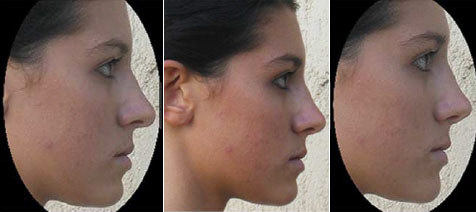
In most cases the right shift as shown in Fig. 3 was rated more attractive, and it corresponds to a smaller but more pointed chin, a more defined jaw angle and a less prominent mouth.
In Fig. 3, in all images shown, the woman looks white/European. If the woman in Fig. 3 sought surgery to make her face shift toward the right, it could not be said that she is trying to look white/European because she already looks white/European. Yet, if I point out that non-Europeans prefer overall facial features among their co-ethnics that are somewhat shifted toward the more overall derived end of the ancestral-to-derived discriminant or seek aesthetic plastic surgery along this direction, then a number of people take it to mean that the implication is a preference for white/European features. No, the preference is for somewhat more overall derived facial features compared to the average of one's ethnic group, and it also exists among Europeans.
References
- Valenzano, D. R., Mennucci, A., Tartarelli, G., and Cellerino, A., Shape analysis of female facial attractiveness, Vision Res, 46, 1282 (2006).
- Porter, J. P., and Olson, K. L., Anthropometric facial analysis of the African American woman, Arch Facial Plast Surg, 3, 191 (2001).
- Aung, S. C., Foo, C. L., and Lee, S. T., Three dimensional laser scan assessment of the Oriental nose with a new classification of Oriental nasal types, Br J Plast Surg, 53, 109 (2000).
- Moss, J. P., Linney, A. D., and Lowey, M. N., The use of three-dimensional techniques in facial esthetics, Semin Orthod, 1, 94 (1995).
Comments
I'm not sure if this study mentions it, but do they address how prognathistic differences are rated among humans?
Also, those jaws in those african women look rather anomalous. I think that's a typicaly pseudo-deformity.
Oh, just forget I said anything here. Let's just finish up our conversation on the other post.
Submitted by Admin on Thu, 12/13/2007 - 14:48
"Yet, if I point out that non-Europeans prefer overall facial features among their co-ethnics that are somewhat shifted toward the more overall derived end of the ancestral-to-derived discriminant or seek aesthetic plastic surgery along this direction, then a number of people take it to mean that the implication is a preference for white/European features. No, the preference is for somewhat more overall derived facial features compared to the average of one's ethnic group, and it also exists among Europeans."
Possibly because you mentioned europeans have more overall derived features.
A preference for placement along the ancestral-to-derived discriminant in an European population
Submitted by Admin on Thu, 12/13/2007 - 14:48
''Yet, if I point out that non-Europeans prefer overall facial features among their co-ethnics that are somewhat shifted toward the more overall derived end of the ancestral-to-derived discriminant or seek aesthetic plastic surgery along this direction, then a number of people take it to mean that the implication is a preference for white/European features. No, the preference is for somewhat more overall derived facial features compared to the average of one's ethnic group, and it also exists among Europeans.''
Yes I agree with the above statement. Also to add a shift towards or in the direction of europeanization is not the same as a shift TO europeanization or to european looks (talking specifics)
You are such a bunch of sick disgusting racists. Probably some ugly ass skinheads. You can't post a picture of a unattractive middle aged black women who happens to be frowning and put her next to a picture of a beautiful white women. There are beautiful black women and ugly white women, and no those black women don't ahve to be mixed there are beautiful women who are all blacked. I would say mixed in general is attractive, doesn't have to be mixed with European per se. Because of colonialism Europeans have gone out and mixed with a lot of people, but I have seen mixed race people of many backgrounds who are gorgeous as well as non mixed people. You all are so full of shit it amazes me. Are tall blondes from Sweden attractive sure many of them are but there are other attractive women in the world too. You say you are fighting the fashion industries views of beauty and yet you actually seem to agree with them 95 percent. And different people have different preferences in looks and they are not all wrong for disagreeing with the sig heiling morons who run this site. I also love how you're examples of attractive woman mostly come from porn, porn star is really your ideal of femininity grow up and remember porn stars can't cook worth a damn probably can't even operate a microwave. It cracks me up that at the end of the day you white pride fools like to sit around beating off to exploited white girls being filmed by a bunch of Jewish pornographers.
Tayler, I really don't think the promoter of this page can be accused of racism. The purposes of this page are clarified by the author. He is probably an American of Northern European descent who finds Northern Europeans more appealing and analyzes them because their looks are overrepresented among high fashion models. That's a fact. He finds that ethnicity has to be considered when talking beauty, for most people find other people of their own ethnicity more appealing (that's a fact too - otherwise we wouldn't have so many ethnicities on the planet right now). And he defends that ethnicity is important when identifying feminity in women of different races because they have different facial and body measures. Which is a fact too.
I am not a Northern European and I don't feel offended by this site. It's true that some of the things said here seem to me very specific of American society to me, like women getting cosmetic surgery to have a double lid or such things. I suppose that's normal in a society where the leading classes have this kind of look. In Spain, where I come from, many women get cosmetic surgery to make their naturally rounded eyes look "Asian" (Spaniards may have "too" rounded eyes compared to other Europeans, so rounded eyes are not valuable because everybody has them), or to make their lips look African or they try to tan whatever it takes if they have very light skin. But I suppose those are just current trends influenced by fashion and those weren't beauty standards here 100 years ago.
But the point of this site is to discriminate feminine beauty from non-feminine standards promoted by high fashion designers. And I don't see what's wrong about that.
I don't see anything wrong either in showing pictures of real African women to talk about beauty standards. I think it's much more racist promoting Beyonce Knowles or Rihanna or Hale Berry as beauty standards and telling black women they have to look like them, because these women are only partly African. The same goes for Naomi Campbell, who may look a little bit darker, but she was born to a biracial mother and an Asian father. In Spain there are many real African immigrants from Nigeria or Senegal and they look much more like the pictures on this site than like those (African)-American beauties.
I don't know your ethnicity, but I am a West-Mediterranean or Atlanto-Mediterranean and I think it's natural that I feel more attracted to men from my own ethnicity and it happens to be so. Sometimes, I also find men of other races or ethnicities attractive, but not so often. It probably happens the same to you and it happens to Erik too. I wouldn't call that racism. Sure there are people commenting on this site who are racist or at least obsessed with arguing that women from their own countries are the most beautiful, but I don't think the purpose of this site is comparing different races (that would be pointless), but comparing (Northern-) European women among them to see what makes them more or less feminine. Non feminine traits seem to dominate high fashion catwalks and Erik offers an alternative to them, that is more feminine models. Is that so bad?
About porn stars... What does beauty have to do with cooking? And anyway, I suppose porn stars have to cook their own meals when they come home, just like prostitutes or teachers or physicians.