Here is a news item that has gotten some attention in the mainstream media. Australian researcher Phillippa Diedrichs conducted a study that found that using very thin women models does not increase the likelihood of women buying the advertised product compared to using women within a healthy weight range. The study involved making a series of advertisements for underwear, a haircare product and a party dress, modeled by a size-8 woman and a roughly size-12 woman. See an example below.
The heavier woman is on the heavier side of most Westerner’s optimal preferences, but the fashion industry is reluctant to even use women in the lower part of the healthy medical weight range, such as the models within the attractive women section of this site.
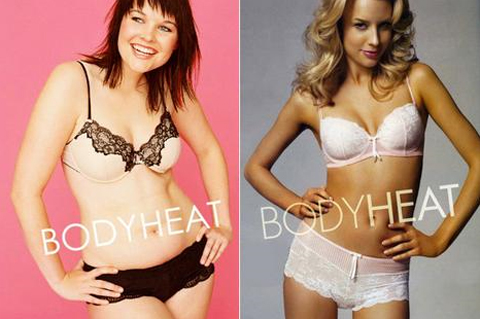
400 young adult study participants were no more likely to buy the products advertized with either choice of model, but women ages 18-25 felt better about their own bodies after watching the images of the heavier models than those who watched the thinner models.
So basically, Diedrichs is attacking the notion that thinness sells by showing that it doesn’t compared to using women models with a healthy body weight. No surprise here, especially when necessities are being marketed since this allows advertisers some leeway in their choice of models. As I have said, people who are unable or unwilling to make soap on their own are not going to stop buying soap if all companies selling soap use imagery of butchered animal guts to sell their product. High quality designer wear is highly desirable and the likelihood of people buying clothes should not be affected over a wide range of models’ looks. Whereas haute couture is best marketed using imagery suggesting exclusivity, feminine beauty is a more exclusive look compared to the adolescent-boy look, and if one insists that the adolescent-boy look is the best type of exclusive look for female models, then he had better explain why.
The research does not seem to have been published yet, but links to media coverage of the research can be found at Phillippa Diedrichs’ homepage. When the study is published, I will post it here.
The coverage of this issue in the mainstream media does not address some important issues that have been addressed within this site. Firstly, there is a large body of research showing that women and men overwhelmingly judge women’s attractiveness in a similar manner and most optimally prefer a subset of the medically healthy body weight range in models, this subset lying in the lower part of the healthy body weight range. Secondly, whereas the general find is that using very thin women in advertising makes women feel worse about their bodies, some studies have shown that women feel better after viewing thinner women. The circumstances underlying these different outcomes have been discussed here.
The clear inference is that the typical thinness of fashion models cannot be explained by marketing and sales considerations. There is a large body of evidence in this regard documented within this site.
Here is a quote doing the rounds.
Fashion editors maintain that they must use thin models because clothing companies supply samples in small sizes – the same reason why you only see Chihuahuas in dog fashion parade.
Well, at least this acknowledges that fashion editors are not to blame much as some clowns would have us blame Anna Wintour and her ilk. The blame rests with gentlemen from the lavender crowd.
Comments
Not surprising. A super sexy model can be very intimidating. A consumer can almost feel that they don't deserve to wear the underwear because its obviously only for someone with a perfect body. Even in the male world its like that. The hoity-toity underwear from calvin klen still has the washboard abs models on the front, but Fruit of the Loom puts less idealistic males on their product. Its kind of nice to see regular guys for once....well not regular guys, they're still more handsome and fit than me, but compared to the supermuscular adonis with no body hair its more real-world.
fashion is not soap...
high fashion doesnt work like the clothes u can simply buy at Kmart...
theres a whole pshycological aspect to it...
people who buy high fashion feel better by buying stuff thats marketed in a more fantastic way than a more realistic way...its part of the "magic" or "experience" of wearing expensive clothes...
people dont need high fashion like they need soap...
they can just buy clothes to cover themselves up...like many people do...
but people who go for "labels" dont buy with that mentality...
theyre in for the whole "trip" ,and that includes the marketing of the brand
high fashion is not for everybody to understand...
its like abstract art...
some people get it...some people dont...
some preffer those paintings of flowers and landscapes...
and wonder why some artists paint such "ugly" stuff...
those type of people will never understand...
I prefer normal women like the dove commercial and not skinny women.
I am glad to hear they have finally come to this conclusion, I was getting tired to see perfect bodies on every ad. Of course a more normal looking body sells better, the one buying the products is able to picture himself wearing those clothes. A good advertising campaign combined with a unique promotional items can make wonders!
The fact that you think the typical very thin female bodies that are represented in mainstream ads are "perfect" says a ton about the effects of mental conditioning that the mainstream media outputs, sadly. They in truth are far from perfect.
I am a straight man and I find absolutely nothing attractive about any of the Victoria Secret models much less any fashion model. They are underweight and do not have very feminine bodies.
You would do well understanding that most straight men don't find them attractive either and trying to work your way of that mental conditioning you have fallen victim to.
You are 100% right Paul, they are not attractive or perfect, just sad, too thin, sickly and undernourished as far as both most straigt men and women are concernced. And since many of us are buying these products and we are from the "general public" why should we have to cater to the demands of gay designers and their unrealistic death-causing demands?? When we the women are the ones to wear the clothes they design?? They are presuambly desinging it for us to wear and not for gay men!! So they shouldn't be allowed to enforce their views on us- any more than a straight designer should be allowed to enforce his opinions on what the gay population would like to wear!!
But we're not allowed to express the truth becuase it's not PC!! Would even straight men accept a woman with breasts to come as a model for their clothes if that was at the whim of some straight male designer!? Of Course not.
Why then should women have to accept men or women who look a lot like men and look as if they're dying (sometimes they have died) to come model our clothes?! What also proves Eric's point is GPG recently using a male model to model womens' clothes!! As written about by the Daily Mirror and featured on 1st page of this site.
You're 100% right Paul and you too Eric. Good luck with getting through to ppl who are brainwashed by PC though, at the expense of reality.