A formal criticism of Stephen Marquardt’s Phi (Golden ratio) mask is about to be published. The electronic version was posted online a few days ago. Here is the article in its entirety. It is written for a scientific/medical audience, but its contents have been discussed in a more layperson-friendly manner at this site before.
Stephen Marquardt has never published the validity of his mask in a peer-reviewed journal though some papers have favorably reviewed it. Strictly speaking, the criticism in the following article should not be considered definitive since time must be given to Marquardt or others to critique it, and others are more than welcome to try.
In a way, I feel sorry for Marquardt since he has worked on his Phi mask for decades, is very strongly devoted to it and seems to have had an epiphany after coming up with it. I have never experienced such a moment and would not want to find out what it feels like to have a cherished idea thoroughly refuted.
Anyway, a shortcoming of the following article is that it cites a study about the thinness of fashion models using a mid-1990s sample (average BMI 17.57), but it should have been added that fashion models have gotten thinner since then, the current preference among fashion designers being for models with a BMI in the neighborhood of 16.
Marquardt’s Phi Mask: Pitfalls of Relying on Fashion Models and the Golden Ratio to Describe a Beautiful Face
Aesthetic Plastic Surgery
DOI 10.1007/s00266-007-9080-z (pdf link)
Electronic publication, ahead of print; Jan 4, 2008
Erik Holland
Background
Stephen Marquardt has derived a mask from the golden ratio that he claims represents the “ideal” facial archetype. Many have found his mask convincing, including cosmetic surgeons. However, Marquardt’s mask is associated with numerous problems. The method used to examine goodness of fit with the proportions in the mask is faulty. The mask is ill-suited for non-European populations, especially sub-Saharan Africans and East Asians. The mask also appears to approximate the face shape of masculinized European women. Given that the general public strongly and overwhelmingly prefers above average facial femininity in women, white women seeking aesthetic facial surgery would be ill-advised to aim toward a better fit with Marquardt’s mask. This article aims to show the proper way of assessing goodness of fit with Marquardt’s mask, to address the shape of the mask as it pertains to masculinity-femininity, and to discuss the broader issue of an objective assessment of facial attractiveness.
Methods
Generalized Procrustes analysis is used to show how goodness of fit with Marquardt’s mask can be assessed. Thin-plate spline analysis is used to illustrate visually how sample faces, including northwestern European averages, differ from Marquardt’s mask.
Results
Marquardt’s mask best describes the facial proportions of masculinized white women as seen in fashion models.
Conclusions
Marquardt’s mask does not appear to describe “ideal” face shape even for white women because its proportions are inconsistent with the optimal preferences of most people, especially with regard to femininity.Keywords
Aesthetics - Golden ratio - Phi mask - Procrustes analysis - Stephen Marquardt - Thin-plate splines
The nature of beauty is an intriguing topic. It is tempting to describe beauty in terms of a simple, recurring theme such as the golden ratio. Dividing a line segment into two parts such that the ratio of these parts equals the ratio of the larger part and the line segment gives us the golden ratio (Phi).
A number of attempts have been made to describe “ideal” facial proportions in terms of the golden ratio [14,17,30,34]. However, several studies have not found any relationship between facial attractiveness and compliance with golden ratio proportions [20,22,27,33,38] or evidence of any special aesthetic preference for the golden ratio among humans [6]. Stephen Marquardt [19] has tortuously derived supposedly “ideal” facial proportions from the golden ratio. Marquardt’s Phi mask has been favorably reviewed by some authors [1,14,16]. Kim [16] reported that Marquardt’s mask is convenient for facial analytics, and Bashour [1] has claimed that Marquardt’s mask is a suitable tool for developing an objective system to assess facial beauty. However, Marquardt’s mask is associated with a number of problems.
A preliminary examination of Marquardt’s mask does not suggest that it describes “ideal” face shape. Figure 1 shows the front and side views of the mask with most internal lines in the original mask erased so as not to obscure overall face shape. The mask appears to trace best the outline of an individual with European ancestry. Marquardt claims that his mask applies equally well to attractive individuals across geographic populations. However, in W.W. Howells’ data set involving 57 linear craniofacial interlandmark distances, the proportion of global variation between populations was 24% for the first principal component of shape variation and 33% for the second principal component [32]. Large as these values are, because a correlation structure underlying shape variation across populations also exists, the face shape differences across continental populations are striking. Therefore, how can an “ideal” face shape be conceived across populations as distinct as Norwegians, Tanzanians and the Chinese?
Using the ratio of the basion-prosthion length to the basion-nasion length as an index of prognathism, Hanihara [11] reported that the mean of this index was 94.9 ± 3.45 for Norwegians, 104.1 ± 4.45 for Tanzanians, and 96.6 ± 4.01 for northern Chinese. Similarly, when the ratio of the simotic subtense to the simotic chord was used as an index of the prominence of the nasals, the result was 52.0 ± 10.20 for Norwegians, 30.3 ± 6.49 for Tanzanians, and 34.8 ± 12.13 for northern Chinese [11]. Well-separated population means make it difficult to conceive the “ideal” Homo sapiens face.
Fig. 1. The outline of Marquardt’s mask. See the complete version at http://www.beautyanalysis.com/
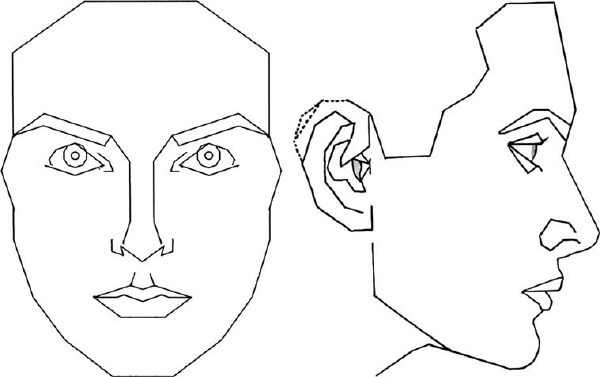
Even among individuals of European ancestry, the mask outline does not appear to describe a typical man or woman. With reference to face shape variation resulting from masculinization and feminization [12,31], the outline of Marquardt’s mask appears to be that of a masculinized woman, as evident from the eminent supra-orbital ridges, low-set eyebrows, strong nasoglabellar curvature, cheekbone placement high on the face, retracted mandibular symphysis, and a prominent and squared chin.
By Marquardt’s own admission, his mask describes a woman’s shape. Therefore, the masculine element is curious given that a strong preference for facial femininity has been described in the general population. For instance, in a metaanalysis of the effect of facial femininity on attractiveness ratings, the effect size correlation was r = 0.64, with a standard deviation of 0.39 and a 95% confidence interval of 0.51 to 0.74 [29].
Marquardt’s mask curiously leans toward a Class 2 profile. A Class 1 profile is reported as the most attractive [4,7,15,18,26], and minor deviations from a Class 1 profile are assigned higher ratings among individuals of European ancestry if they lean toward the Class 3 type rather than the Class 2 type [4,5,15,21,26]. Additionally, Marquardt’s mask is inconsistent with the optimal preferences of white North Americans regarding soft tissue nasion placement [23] and earlobe proportions [24]. Therefore, for a number of reasons, as a first approximation, it is difficult to see Marquardt’s mask as a descriptor of “ideal” facial proportions.
There also is a problem with the method Marquardt recommends for comparing a given face with the mask. He instructs that before the mask is superimposed on a person’s photo to assess goodness of fit, the distance between the lips and the midpupil level should be equalized for the front view, and the inferior irion-lip distance should be equalized for the side view. Bashour [1] has carried out the superimposition by equalizing interpupillary distance. However, when control is used for face size, neither of these distances or other conceivable measures such as face length or face breadth are constant for all people, even when applied to only one specific ethnic group. Therefore, how can goodness of fit be assessed?
To compare shapes, control must be used for three factors: location, size, and rotational effects. A standard procedure is to use Procrustes analysis [2,25], which proceeds as follows. Landmarks on the shapes to be compared are identified, and their Cartesian coordinates are measured. Then, the centroid of each shape, which is the center of mass of a physical system with unit mass at its landmarks, is computed. The centroid size of each shape, which is the sum of squared distances of a shape’s landmarks around its centroid, also is computed.
After this, each shape is scaled to unit centroid size. Subsequently, the shapes to be compared are aligned with respect to centroid position and rotated so that the sum of squared distances between corresponding landmarks is minimized. Now the shapes can be compared, as in computation of the Riemannian distance (0 ≤ ρ ≤ π/2) between the shapes. The shape differences can be visualized by using thin-plate spline analysis [10].
This article aims to use the geometric morphometric methods of generalized Procrustes analysis and thin-plate spline analysis to illustrate how goodness of fit can be assessed with Marquardt’s mask, where it stands with respect to masculinity-femininity, and how valid Marquardt’s claims are. It also aims to address the issue of an objective evaluation of facial beauty.
Methods
The landmarks used are shown in Fig. 2. If a point approximately homologous to a landmark on Marquardt’s mask lay along a curve, making it difficult to pinpoint, then the y coordinate was defined at the point of intersection of surface tangents corresponding to the angular outline of Marquardt’s mask. A better method exists [3], but because few such semi-landmarks exist, this article is well served by the aforementioned approximation. The choice of the landmarks is based on a need to focus on masculinity-femininity and the limitations of a paper by Hennessy et al. [12].
Fig. 2. Landmarks used to compare face shapes

Hennessy et al. [12] provided front and profile views of a very masculine northwestern European male average, a northwestern European male-female (population) average, and a very feminine northwestern European female average. The masculine and feminine extremes provided by the authors exaggerated the average male-average female shape difference threefold. These averages were produced via geometric morphometric methods, as opposed to the typical composite made by blending faces with interpupillary distance equalized, and hence were suitable for this article.
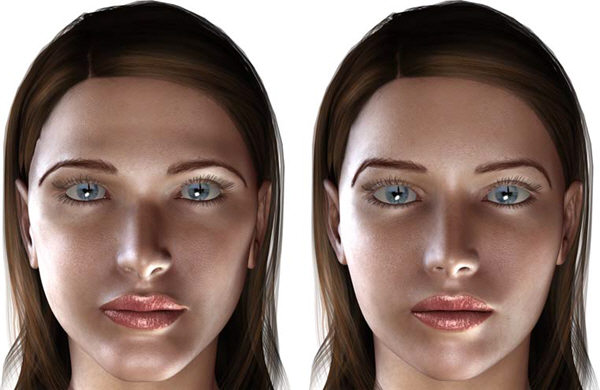
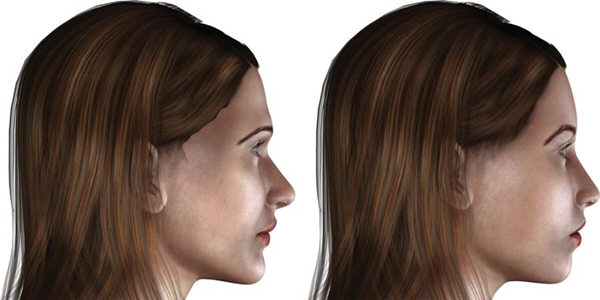
To facilitate a better understanding of Marquardt’s mask, a three-dimensional (3D) face roughly corresponding to it was generated using Poser (http://www.e-frontier.com/) and Victoria 4 from DAZ3D (http://www.daz3d.com/) and contrasted with a more feminine face (Figs. 3 and 4). Generalized Procrustes analysis and thin-plate spline analysis were carried out using the Shapes package [9] for the R software environment for statistical computing and graphics (http://www.r-project.org/).
Fig. 3. Rough three-dimensional approximation of Marquardt’s mask in front view (left) and a more feminine face
Fig. 4. Rough three-dimensional approximation of Marquardt’s mask in side view (left) and a more feminine face
Results
Tables 1 and 2 list the Riemannian distances between Marquardt’s mask and other faces. Table 1 shows that Marquardt’s mask is closest to its rough 3D approximation, which should not be surprising. Marquardt’s mask also appears to be closer to the masculine side of the population average for northwestern Europeans, but caution is required here because of the limited number of landmarks used and the large distances between all the northwestern European averages and Marquardt’s mask.
Table 1 Riemannian distances between Marquardt’s mask (front view) and other faces
1.
Very masculine northwestern European average man
0.085
2.
Northwestern European male-female average
0.109
3.
Very feminine northwestern European average woman
0.122
4.
Rough three dimensional approximation of Marquardt’s mask (Fig. 3, left)
0.050
5.
The face on the right in Fig. 3
0.128
Table 2 Riemannian distances between Marquardt’s mask (side view) and other faces
1.
Very masculine northwestern European average man
0.132
2.
Northwestern European male-female average
0.129
3.
Very feminine northwestern European average woman
0.148
4.
Rough three dimensional approximation of Marquardt’s mask (Fig. 4, left)
0.050
5.
The face on the right in Fig. 4
0.074
In Table 2, we again observe that Marquardt’s mask is closest to its rough 3D approximation. Marquardt’s mask also appears to be closer to the population average for northwestern Europeans than to the very masculine and very feminine shapes. Again, however, the large distances between all the northwestern European averages and Marquardt’s mask should be noted.
How Marquardt’s mask differs from the other faces can be visualized using thin-plate splines, whereby the deformation of a 2D grid in the background shows how Marquardt’s mask can be deformed to make it approach the other shapes. Figure 5 shows the thin-plate splines for the front view of the face, and Fig. 6 shows those for the side view of the face.
Fig. 5. Thin plate splines showing how Marquardt’s mask can be deformed to transform it to various faces addressed in Table 1
Fig. 6. Thin plate splines showing how Marquardt’s mask can be deformed to transform it to various faces addressed in Table 2

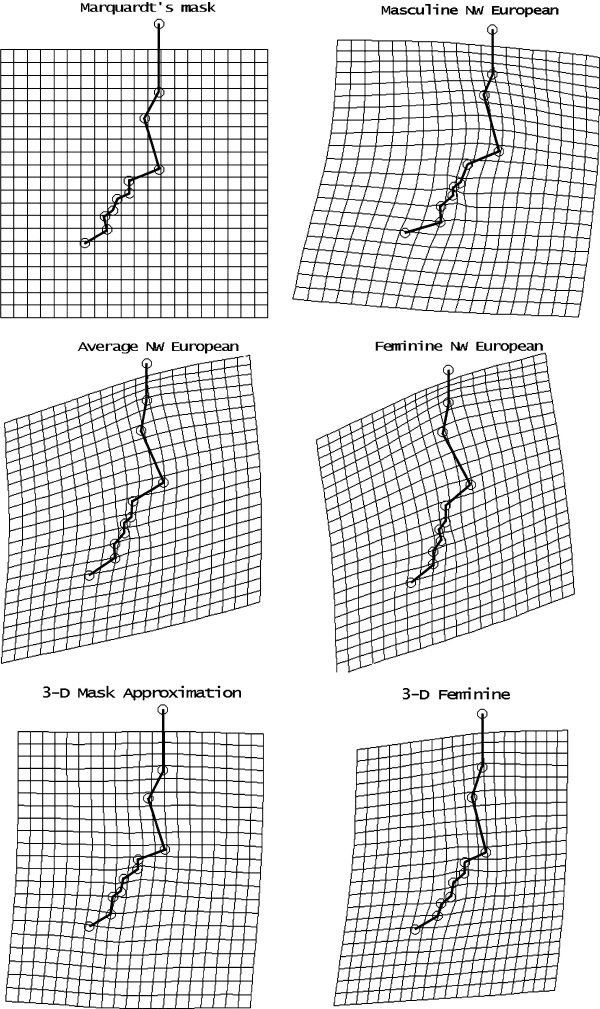
Figure 5 shows that some features of Marquardt’s mask are on the masculine side of the population average for northwestern Europeans, particularly the high placement of the cheekbones, the facial narrowing, and, to a lesser extent, the interexocanthion length and the width of the chin. The data from Hennessy et al. [12] show that the superior medial orbital margins are displaced inferiorly with increasing masculinization. The closest analogs in Marquardt’s mask are the low-set eyebrows (Fig. 1), clearly masculine in their placement. Figure 6 shows that the nasoglabellar curvature, the retraction of the mandibular symphysis, and the prominence of the chin in Marquardt’s mask are on the masculine side of the male-female northwestern European average. Figure 6 also shows that Marquardt’s mask leans toward a Class 2 profile compared with the average northwestern European profiles.
The thin-plate splines show, within the limits of the landmarks used, how the 3D approximation of the Phi mask can be fine-tuned to make it better match the mask’s proportions. The chin must be made more prominent in both the side and front views and slightly wider. Additionally, the prominence of the zygomatic arches must be increased. Although the eyebrows are not addressed in this article, the 3D approximation would need to have its eyebrows lowered as well. These changes are consistent with a slightly more masculine look and a more robust appearance of the cheekbones.
Discussion
Marquardt’s claims regarding his mask are not consistent with the extant literature on correlates of facial beauty, particularly regarding placement along the masculine-to-feminine discriminant, mandibular profile and soft tissue nasion placement. The masculine element in a mask supposedly describing the “ideal” female face is curious given how strongly above average femininity in women is preferred by most people [29]. But then, in coming up with his mask, Marquardt relied heavily on female fashion models as a reference standard of beauty. Therefore, a brief review examining the looks of female fashion models, henceforth “fashion models,” is pertinent.
Marquardt has shown that fashion models, on the average, have masculinized faces. Because sex hormones have a global effect, the masculinized faces of fashion models would be expected to correspond to masculinized physiques as well. Indeed, this is readily observed by a perusal of mainstream fashion magazines such as Elle and Vogue.
However, Tovee et al. [37] have described fashion models as “hourglass shaped” by virtue of a reported average circumferential waist-to-hip ratio of 0.7 and a circumferential bust-to-hip ratio of 0.99. An hourglass approximation applies to a front view, not a 3D view (i.e., the circumferential measurements should be viewed with caution). Given the typically small breasts of high-fashion models, the data of Tovee et al. [37] show that they have a larger rib cage for a given hip size than normal women and glamour models. A larger rib cage will stretch out the waist in front view, but the thinness of high-fashion models will translate to a small waist circumference, not much higher than that of shorter glamour models. A large rib cage is not consistent with an hourglass approximation because an hourglass has a narrow midsection. Therefore, Tovee et al.’s [37] conclusion is mistaken.
The typical thinness of fashion models also is noteworthy. Most individuals prefer women fleshier than fashion models [8,28]. In a sample of 300 fashion models, the average body mass index (BMI: weight divided by the square of the height) was 17.57 kg/m2 [37], whereas the optimum BMI of women rated by Western adults has been reported to be 2 to 3 kg/m2 higher [35,36]. In short, female fashion models obviously do not reflect the aesthetic preferences of the general public and should not be used to develop an aesthetic archetype.
A perusal of fashion models shows a preponderance of Nordic features. Therefore, it may have been better to compare Marquardt’s mask to Nordic facial norms instead of a population with a dominant Celtic element (northwestern Europeans). However, I am not aware of data on any Nordic population similar to the data provided by Hennessy et al. [12], and there is a significant Anglo-Saxon element in northwestern Europe, too. Additionally, because Marquardt claims that his mask applies to Homo sapiens, the differences among various northern European populations are not relevant to his argument.
It could be argued that Marquardt is mistaken in believing his mask describes the ideal proportions of a woman, and that instead, using objective methodology, he has come across a template for Homo sapiens modified into male and female forms as a result of sex differentiation. However, why are parts of Marquardt’s mask on the masculine side of the population average for northwestern Europeans? Additionally, why does this template most closely approximate, with some distortions, an outlier variety of Homo sapiens? For instance, a tendency for greater flattening of the nasal bones/midface to correlate with more protruding jaws has been clearly documented in humans, and northern Europeans, with the most prominent nasal bones and the most regressed jaws, are at an extreme of face shape [11]. How can a mask with prominent nasals and a regressed jaw describe the “ideal” face of Homo sapiens?
More importantly, how objective is Marquardt’s methodology? Using the golden ratio to describe facial beauty does not make the attempt objective. The human face presents a tremendous number of proportions, and with a hard enough look, some of them are bound to approximate the golden ratio. Marquardt’s methodology, detailed in his U.S. patents (nos. 5,659,625 and 5,867,588), is similar to that of a researcher carrying out a huge number of statistical tests on the data he possesses in the hope of coming across a statistically significant find, which, if found, cannot make the researcher confident that the find is of any real world significance. For instance, even after years of working on a 3D version of his mask, Marquardt has yet to come up with it, obviously because he has not come across an intuitive and simple way of putting together geometric structures derived from the golden ratio to form an aesthetically pleasing human face in 3D that resembles his 2D masks in front and side views. If it is possible to derive the outline of a beautiful face from the golden ratio, then Marquardt certainly has not achieved this.
The preceding discussion leads to the issue of an objective assessment of attractiveness. Can this be achieved? If a reference template or face outline representing the “ideal” existed, then geometric morphometric methods could be used to compare individual faces with it and to describe the discrepancies numerically and visualize them graphically. A detailed comparison would require the use of a sufficiently large number of landmarks. This could be cumbersome, especially in 3D comparisons (e.g., photogrammetry or laser surface scanning), and could pose a problem if homologous locations need to be identified for points lying along a curve. These points could not be considered true landmarks but rather semi-landmarks or sliding landmarks. However, geometric morphometric methods that deal with semi-landmarks [3] and interpolate pseudo-landmarks [13] between landmarks have been developed. In addition, assessment of Cartesian coordinates is not more cumbersome than Bashour’s [1] method. Therefore, an objective comparison can be made, but how is a reference standard objectively obtained in the first place?
Development of an aesthetic reference standard should start with well-documented correlates of beauty, namely, averageness, above average femininity in women, and low fluctuating asymmetry [29]. For example, development of an aesthetic female mask for a given ethnicity could involve assessing population norms for women, developing a mask with zero fluctuating asymmetry to reflect this average, feminizing it to varying degrees, and assessing a large and random sample of individuals from this ethnic group to determine what degree of above average feminization is regarded as the most appealing by most individuals. This modified average could be altered further on a computer by judges to obtain a more pleasing mask and the central tendency of the alteration noted. The final product would be a mask describing the face shape of a woman that most individuals of her ethnicity would find very attractive, which in reference to Kim’s [16] contention, would serve much better than Marquardt’s mask with respect to facial analytics. This method will not produce a reference standard based on a simple, recurring theme, but it remains to be shown that the latter is possible.
Conclusions
Stephen Marquardt has shown how misleading overenthusiasm for the golden ratio and a reliance on fashion models can be. His mask is unable even to describe aesthetically pleasing proportions for white women, especially because of its masculinization.
References
- Bashour M (2006) An objective system for measuring facial attractiveness. Plast Reconstr Surg 118:757-774, discussion 775-756
- Bookstein FL (1996) Biometrics, biomathematics and the morphometric synthesis. Bull Math Biol 58:313-365
- Bookstein FL (1996/1997) Landmark methods for forms without landmarks: Morphometrics of group differences in outline shape. Med Image Anal 1:225-243
- Cochrane SM, Cunningham SJ, Hunt NP (1997) Perceptions of facial appearance by orthodontists and the general public. J Clin Orthod 31:164-168
- Czarnecki ST, Nanda RS, Currier GF (1993) Perceptions of a balanced facial profile. Am J Orthod Dentofacial Orthop 104:180-187
- Davis ST (2007) Aesthetic preferences for the unity ratio resist the influence of color illusions. Am J Psychol 120:47-71
- De Smit A, Dermaut L (1984) Soft-tissue profile preference. Am J Orthod 86:67-73
- Dodd P: How thin is too thin? New survey reveals overwhelming global support for "too thin" fashion models debate. Neilsen Breaking News. Retrieved March 14, 2007 at http://www2.acnielsen.com/news/20070202.shtml
- Dryden IL, Mardia KV (1998) Statistical shape analysis. John Wiley, Chichester
- Duchon J (1977) Splines minimizing rotation-invariant seminorms in Sobolev spaces. In: Schempp W, Zeller K (eds) Constructive theory of functions of several variables: Lecture notes in mathematics. Vol 571. Springer, Berlin, pp. 85-100
- Hanihara T (2000) Frontal and facial flatness of major human populations. Am J Phys Anthropol 111:105-134
- Hennessy RJ, McLearie S, Kinsella A, Waddington JL (2005) Facial surface analysis by 3D laser scanning and geometric morphometrics in relation to sexual dimorphism in cerebral–craniofacial morphogenesis and cognitive function. J Anat 207:283-295
- Hutton TJ, Buxton BF, Hammond P, Potts HW (2003) Estimating average growth trajectories in shape–space using kernel smoothing. IEEE Trans Med Imaging 22:747-753
- Jefferson Y (2004) Facial beauty: Establishing a universal standard. Int J Orthod Milwaukee 15:9-22
- Johnston C, Hunt O, Burden D, Stevenson M, Hepper P (2005) The influence of mandibular prominence on facial attractiveness. Eur J Orthod 27:129-133
- Kim YH (2007) Easy facial analysis using the facial golden mask. J Craniofac Surg 18:643-649
- Levin EI (1978) Dental esthetics and the golden proportion. J Prosthet Dent 40:244-252
- Maple JR, Vig KW, Beck FM, Larsen PE, Shanker S (2005) A comparison of providers’ and consumers’ perceptions of facial-profile attractiveness. Am J Orthod Dentofacial Orthop 128:690-696, quiz 801
- Marquardt SR (2002) Dr. Stephen R. Marquardt on the Golden Decagon and human facial beauty. Interview by Dr. Gottlieb. J Clin Orthod 36:339-347
- Matoula S, Pancherz H (2006) Skeletofacial morphology of attractive and nonattractive faces. Angle Orthod 76:204-210
- Michiels G, Sather AH (1994) Determinants of facial attractiveness in a sample of white women. Int J Adult Orthodon Orthognath Surg 9:95-103
- Moss JP, Linney AD, Lowey MN (1995) The use of three-dimensional techniques in facial esthetics. Semin Orthod 1:94-104
- Mowlavi A, Meldrum DG, Wilhelmi BJ (2003) Implications for nasal recontouring: Nasion position preferences as determined by a survey of white North Americans. Aesthetic Plast Surg 27:438-445
- Mowlavi A, Meldrum DG, Wilhelmi BJ, Ghavami A, Zook EG (2003) The aesthetic earlobe: Classification of lobule ptosis on the basis of a survey of North American Caucasians. Plast Reconstr Surg 112:266-272, discussion 273-264
- O'Higgins P (2000) The study of morphological variation in the hominid fossil record: biology, landmarks and geometry. J Anat 197:103-120
- Orsini MG, Huang GJ, Kiyak HA, Ramsay DS, Bollen AM, Anderson NK, Giddong DB (2006) Methods to evaluate profile preferences for the anteroposterior position of the mandible. Am J Orthod Dentofacial Orthop 130:283-291
- Qualtrough AJ, Burke FJ (1994) A look at dental esthetics. Quintessence Int 25:7-14
- Rand CS, Wright BA (2000) Continuity and change in the evaluation of ideal and acceptable body sizes across a wide age span. Int J Eat Disord 28:90-100
- Rhodes G (2006) The evolutionary psychology of facial beauty. Annu Rev Psychol 57:199-226
- Ricketts RM (1982) Divine proportion in facial esthetics. Clin Plast Surg 9:401-422
- Rosas A, Bastir M (2002) Thin-plate spline analysis of allometry and sexual dimorphism in the human craniofacial complex. Am J Phys Anthropol 117:236-245
- Roseman CC, Weaver TD (2004) Multivariate apportionment of global human craniometric diversity. Am J Phys Anthropol 125:257-263
- Rosenstiel SF, Ward DH, Rashid RG (2000) Dentists' preferences of anterior tooth proportion: A Web-based study. J Prosthodont 9:123-136
- Seghers MJ, Longacre JJ, Destefano GA (1964) The golden proportion of beauty. Plast Reconstr Surg 34:382-386
- Swami V, Tovee MJ (2007) Perceptions of female body weight and shape among indigenous and urban Europeans. Scand J Psychol 48:43-50
- Tovee MJ, Cornelissen PL (2001) Female and male perceptions of female physical attractiveness in front view and profile. Br J Psychol 92(Part 2):391-402
- Tovee MJ, Mason SM, Emery JL, McCluskey SE, Cohen-Tovee EM (1997) Supermodels: Stick insects or hourglasses? Lancet 350:1474-1475
- Ward DH (2001) Proportional smile design using the recurring esthetic dental (red) proportion. Dent Clin North Am 45:143-154
Comments
Erik Holland,
I find the contentions about the Marquardt Mask lacking in contextual adhesiveness and also demonstrative of someone lacking background in artistic analysis.
Your refutation revolves around isolated preference studies. Although I have no issue with the findings of the studies you state, you can't string or patchwork pieces of information having to do with parts of the face, as you have done, to refute the whole. The whole context of golden ratio analysis relates to the WHOLE of something and how all the parts, as balanced, contribute to the 'gestalt' of the whole. His whole body of work as it is demonstrated in the mask can not be refuted via the isolated 'parts' (studies) you have introduced to do so.
With regard to Class 2 profile preferences you contend he builds into his female mask. You do NOT differentiate the salient aspect of a class 2 profile from a prominent anteriorly projected chin. Class 2 is when the lower lip protrudes beyond the upper lip. It is not only a matter of the chin being forward. Although the profile mask depicts a stronger chin for the female; one which might have more anterior projection, this does not classify it as a "Class 2" like profile. You would need to demonstrate the mask portrayed a lower lip position similar to a class 2 profile to keep congruent with the contention you have.
With regard to eyebrow position and shape, they are a function of how anteriorly projected the brow bone/upper orbital rim area of the brow bone is. More anterior projection in that region will have the brows PROJECT lower on a 2-D plane. What the mask is effectively 'saying' is that there is a preference for anterior projection to the female forehead. Something, with which the brows will project lower on the face. It is quite different from having a posteriorly inclined forehead or an under projected one, in which case, brow position is set higher. If you check some of your isolated studies, I'm sure you will find that..
With regard to your contention of the nasion "not" being set at mid pupil level on his mask, I question how you made that observation given that a straight horizontal line can be drawn to intersect the nasio frontal angle in that mask and cut right through mid-pupil level.
In essence none of your observations fit the context of how one would go about making the type of refutation you are trying to make. You contend: "Marquardt’s mask is shown to be inconsistent with what most people actually prefer." What most people "actually prefer" comes from studies having to do with (isolated) PARTS of things and has little bearing of what they would prefer when it comes to the WHOLE of things; ALL the parts of a face, evaluated together on the WHOLE FACE. So your 'summing up the parts' type argument here runs counter to the whole concept of evaluating the WHOLE; not by the sum of it's parts (or in your case the sum of parts from other places!) and that's why I find your stance disembodied.
In essence, his mask is an 'Eigen' diagram relating to what preferences would be to the whole face if viewed in entirety. It is based on what preferences are: SUBLIMINAL preferences for the type of faces one sees on models. It's hard to refute subliminal preferences with the type of conscious choice preferences you have cited to do so. Why? In essence, people DO prefer 'model' like faces on a subliminal level. If they did not, the type of model faces he has based his mask on would not be used in mass media which do indeed appeal to people on a subliminal level. If they did not, they would not be used to market fashion and beauty products. Model faces are those in which one 'part' might be isolated and shown as a non preference BUT for which the WHOLE 'works' which is precisely what golden ratio analysis is about.
Although I don't use his mask, many of my own independent findings (yes, also based on model faces) about ratio relationships of the parts relating back to the whole do cross reference with golden ratio geometry and aesthetic theory based on it and very much overlap with his assessments. I use them to assess whether or not a face can or can not be made 'beautiful' or 'like a model' as there are some 'core ratios' that if not present to the face, preclude the individual ever looking 'like a model' no matter how much plastic surgery they get in that attempt. Many of the ratios I have isolated, when used to design an 'ideal face'; the act of constructing or drawing one with the same ratios, fit perfectly into his mask.
Golden ratio relationships are used by ARTISTS to design something and very much can be found via an astute eye analyzing a work of art if you know how and where to look for those relationships. However, for the most part, those very relationships are best appreciated by the observer by LIKING the work of art on a 'gut' level or a subliminal level. The very act of producing a work of art of great visual appeal, eg. designing a face in the case of master sculptors or artists who did that involves 'hiding where the golden ratio is'. When it's there and in the 'right' places, you, the viewer, will have a favorable reaction (a liking) to the look of the WHOLE of the work.
Likewise with the human face, when the golden ratio relationships are there, you will have a favorable reaction to the face as a WHOLE and DESPITE a 'part' that you might not like if isolated in a study aimed at isolating parts and choosing preferences for those isolated parts.
Golden ratio design, especially regarding the human face is aimed at "delighting the eye", one of the very things that plastic surgeons have in their ideological thinking as NOT being the aim of what they do: 'To improve or make whole again but NOT to delight the eye'. So, it is no surprise to me that much of the way they go about analyzing a face would NOT incorporate a type of golden ratio analysis or 'Eigen face' mask of such that is predicated in 'delighting the eye' and hence no surprise to me that your article would be embraced by that audience.
If you wanted to refute his aesthetic theory that the mask fits "beautiful" faces what you would need to do is actually USE it demonstrate:
A: It fits "ugly" or "unattractive" faces just as well.
B: "beautiful" faces don't fit into it at all
Something you would need to do by actually using WHOLE faces as opposed to snippets of studies showing preferences for placement of isolated parts. You have not done that. Hence, I'm refuting your refutation of his findings.
How do you make a Romanian/Indian/Semitic nose fit into that mask? That's what I would like to know. I can't make it fit no matter how much I try.
Could they make a special model with an enlarged nose area just for them so their noses can be accomodated somehow? Or is the Semitic/Indian/gypsy nose type incompatible with the ideal feminine beauty?
Typical Nordic noses for reference (Swedish women);
Typical Indian noses;
Typical Semitic/gypsy noses on Romanians;
I think this is what any beauty mask is all about. Why try and race mix people into one racially homogenous fake soup when you have perfection already?
What happened to "diversity"? Diversity is apparently just a code word for race mixing so we can GET RID OF diversity. Hypocrisy? You bet. Race mixing is other people's gain and North Europeans' loss.
The girl above is Swedish, by the way.
I found this funny photo. It shows how women of different races fit perfectly within the ideal beauty mask...sort of..
First we have a white woman of Nordic type, so far so good. Then we have an asian woman and black woman, uhm..cough..cough.
Political correctness is sometimes bordering on the absurd. What this plate tells you is that white women do just fine on their own whereas asian and black women need white admixture in order to compete.
So it in fact promotes race mixing. Black and asian women cannot look truly good as long as their racial traits are pure. Well, what does that have to do with white people? We have nothing to gain from race mixing according to this mask. The white woman is an example of a racially pure white woman.
Did they try that mask on real black and asian women and said "what the heck, it doesn't fit them"? lol
Emily,
Your points make sense. I've noticed when individuals point to various ethnic women as beautiful, they invariably appear more 'European'. Halle Berry is a case in point. She is smaller boned and has finer facial features (I believe she had a nose job as well). She is also light coloured and clearly has white blood in her. Asians that are considered attractive tend to be light coloured with smaller noses, more 'oval' shaped faces, longer limbs and more 'round' eyes.
Similarly for Indians. The ones featured (Bollywood) are light skinned, have small noses and have a 'white' look to them (as if one parent was white).
I never thought of it too much before and simply assumed that I thought they were more attractive due to being white. However, I've noted recently that ethnic groups themselves will put these types of looks forward as examples of beauty and I was suprised. It seems to point to an ideal that is largely unacknowledged but nevertheless very real.
I live in an area with a large number of Asians and Persians. Many of them are attractive, but they are typically more 'European' looking...and certainly not representative. Travel the Toronto subway and you'll soon discover the average is not too great. That is not to say I think the average 'white' woman is great either but they are generally more appealing. I do enjoy the change in mood when a good-looking blond (natural) steps on the train...the haughty attitude of the 'good-looking' Persian/Asian (or even Italian) changes...they know the score even if they pretend otherwise.
If Blonds weren't on top, you wouldn't have so many 'colour-me-blonds' out there...nor would there be so many 'dumb-blond' jokes...
Just my two cents...
I am glad to see that you two, Apollyon and Emily are promoting racism and discrimination. It is very interesting to see unenlightened minds pretending that they have anything relevant to contribute. If you look at historical icons throughout the world you would notice that the perception that we have of beauty has dramatically changed. Not only regarding facial structure but also body types and even height. Caucasian features has not always been the desireable ones. Beauty is defined by those who hold the power. If all of the Asian or African countries would be the wealthiest, the most technologically advanced and had the highest standard of living than most European countries have, everyone would love to be Asian or African and have their features. Asian, Latin Americans and African countries are trying to mix and imitate European countries not because the European traits are more beautiful per se but because those traits represent high standard of living, wealth and power. Whomever is on the top is the most beautiful so you too better hope that none of the other countries ever reach that standard and make you feel unwanted and wish you were from a different race. As for me, as a French caucasian women I know better.
They are not the only ones on here promoting racism. However, Emily has said some pretty **cked up stuff.
I expected that response. If I'd indicated I considered Asians to be the most beautiful, I doubt I would have been called a racist.
I merely noted my own opinions...but they are supported by evidence. Not all will agree and I have clearly stated there are attractive women who are not white...but that those that are considered attractive by their own ethnic group, happen to approximate a more European look.
The claim that it is those in power that determine beauty is a standard response but not necessarily correct. During the Middle Ages, European slaves, particularly blondes (often Celtic) were hightly prized by the Muslims...who considered themselves vastly superior to the Europeans. The Vikings found a ready market in the Islamic world for their blond slaves.
Skin-tone is not necessarily representative of beauty. However, fine features are. Romans noted the beauty of the Celts, esp their women. They certainly did not consider them 'advanced' in any way. Japanese and Koreans often consider themselves as 'smarter' than whites, more sophisticated, etc (whether this is correct is another matter). Yet they wish to emulate white looks.
I do not think that the desire to have a smaller, Nordic nose has much to do with 'who is in power'. It is clearly a aesthetic ideal that is desired among many ethnic groups.
Calling me racist because I make these observations is unwarranted.
Incidentally, the word 'race', which is often used here, is incorrectly applied. Genetically there is really only one race. Humans are too close genetically to be broken into races (a 19th century concept that simply won't die). The differences really are 'skin-deep'. But, considering this is the point of this site, I think it is entirely reasonable to discuss these differences.
While my background is 'European', I am not Scandanavian. Nevertheless, it is well-known that this region of the world produces, on average, the most beautiful people. Scandanavians don't rule the world - the Anglos do.
- Apollyon
Apollyon,
Actually, all the Scandinavian countries are among the wealthiest and have the highest standard of living in the world, check the HDI if you would like to know which countries are in that list. It is interesting that you say Scandinavian countries produce the highest number of beautiful people since they are not the ones who rule the fashion industry nor have the highest number of top models. I am glad thou to see that you do know that race is a social construct and not a biological one. Muslims considered Europeans good for a bang but would never mix their race with white as they still considered themselves superior, whether they are or not is a different story.
Actually the fact that you mention that people of different races who are beautiful only are because they look whiter is not entirely true. Although they may well be mixed, is the mixture that gives them the edge. Most entirely “pure” white women are not considered the most beautiful either. Their too pale skin, the too straight hair, the lack of luscious lips, and curves where needed are not a desirable trait. Is the ones that are able to take the best traits from all races the ones that are considered beautiful. The narrow nose of the Anglos, the luscious lips of Blacks, the wavy thick hair of the Indians, smaller body structure of the Asians, etc, etc.
Why it is that it is that it is the white women getting the expensive fusion hair extensions, which by the way are really popular and cheap in Sweden, to have a thicker more voluminous hair?
Why is it the white women getting lip injections to emulate the thicker lips of the blacks?
Why is it the white women doing buttocks implants and lifts to have the nicely rounded buttocks of the black women?
Why is it the white women that is at the tanning salon trying to emulate the tan look of Latinas?
I could go on and on, the list is endless, just as black women would straighten their hair and use skin lighteners to look a little whiter and white women are doing the exact opposite. Why? Because everyone is searching for that happy medium which is a mix of all the best traits from all the races. Because not a single person of a single race has all the desirable features it is in the mix that is the key to perfection.
The truth is that in this darn age, there is nobody who is entirely of a pure race. Even if no mix is evident, there is still some, most likely couple of hundred years ago. Jews being a perfect example of that. Many Jews are considered white; however this was not so 2,000 years ago. Actually a group of scientists recreated what would have been an accurate historical picture of how Jesus would have looked like (whether he existed or not that is a different story) and the result was extremely far from him being white.
I know tons of people from different races who will fit Stephen’s mask of the “perfect” face, whether they are considered beautiful or not is a different story.
I agree that the Scandanavian countries are rich. But, we are debating in English afterall, and not in Swedish, Danish or Norwegian. My point being that it is the Anglos who dominate, starting with the British Empire.
As for your point about the Muslims viewing Europeans as 'good for a bang' but not for mixing: untrue. They produced children (which were considered Muslim). There is plenty of European blood in the Islamic world.
Although I did mention that 'looking whiter' appears to be one of the characteristics of beauty among different ethnic groups I did mention that skin-tone is not in itself a proper measure of beauty. Hence the social convention of tanning (or not depending upon the time period). It is more about facial features (and body structure)- of which the 'most appealing' are observed more often in Nordics than elsewhere. Finer noses are considered more attractive across the board, on average.
I would say hair fusions etc has more to do with a fashion standard (just as huge wigs were the standard among the upper classes in Europe in the 18th century). This does not invalidate my point about facial features.
Fuller lips...this may be influenced by wanting a more 'sexy' look, but i don't think white women want 'black lips'. Also, I think it is heavily media-driven as most of the women who get lip injections simply look weird.
Fuller buttocks are likely driven by women who have naturally flatter buttocks (i.e. less than ideal or 'masculanized'). I don't think they necessarily want a 'Latin' booty. Living in Toronto, I am exposed to numerous ethnic groups and I think the 'Latin' butt is over-emphasized (i.e. it's not half as great as they claim - they are often simply fat). Many Anglo girls have nice butts. I doubt those with nice butts want a 'lift'.
Regardless, the desire for these cosmetic changes has more to do with reaching an ideal than a desire to emulate different ethnic groups. This ideal is easily found in Europe.
I agree with you about the lack of 'purity' in 'races' (ethnicities). There has been a lot of mixing but the further north you go, the less apparent it is.
I also agree that many 'mixed races' produce good looking women and there are good looking women in any ethnic group. My point is that, on average, the Nordics have the edge.
Regarding Jews, 80% are 'Ashkenazi' which is European and the remainder are Mediterranean. Apparently the Ashkenazi are able to trace their ancestry back to a half dozen women in Jesus' time in about 40% of the cases (can't locate the references right now - going by memory). Point is they are relatively 'pure' in that intermarriage has been limited.
It is probable Jesus was light brown-skinned, with dark hair and eyes. He was likely tanned and relatively rugged, due to being a carpenter. There is compelling evidence that he existed. This is rarely disputed anymore. I should note he was described as not having 'beauty or majesty' and was indistinguishable from Peter and John, both ordinary fisherman (read: average looking). Not sure if this is relevant or not...
Apollyon,
There is no archelogical evidence that Jesus ever existed and the Bible is no evidence at all either. The fact is that we cannot trace anything to Jesus Christ and the fact is also that by today standards he would be considered black or mixed. Your Ayrian supremacy to attribute Nordic (blondes) to be the most beautiful is your lack of understanding of our evolutionary pattern. I am betting you are of a religious background so you would probably won’t understand. Going back to our history our 200,000 years of human existance caucasians have not always been considered the most beautiful. I would be more than glad to discuss how is that possible, but perhaps it wouldn’t be nice of me to burst your Nordic wanna be bubble. Afterall, you are not Nordic, therefore ugly. Your own words, not mine.
link | Submitted by Apollyon on Wed, 11/04/2009 - 14:48.
Although I did mention that 'looking whiter' appears to be one of the characteristics of beauty among different ethnic groups I did mention that skin-tone is not in itself a proper measure of beauty. Hence the social convention of tanning (or not depending upon the time period). It is more about facial features (and body structure)- of which the 'most appealing' are observed more often in Nordics than elsewhere. Finer noses are considered more attractive across the board, on average.
''Looking whiter''and ''looking white'' are not the same. A ''shift towards'' something is not the same as a ''shit to'' something. Fine facial features may be ''considered'' attractive across the board on average but the ''fact'' is not everyone is ''enamoured'' or ''bowled over'' by them. ''Nordic looks'' come across as non-threatening, earthly and not dangerous, a very safe looking type of beauty though beauty nonetheless which perhaps explains why thoose that desire it do so. The sad reality but reality nonetheless for thoose enamoured by ''nordic looks'' in there desire to comprehend why some (and there are many) are not ''swept away'' by thoose looks is very simply because there looks ''nordic beauty'' does not move the soul and beauty moves a soul. It really always has been and always will be as simple as that.
11/04/2009 - 13:15
by Apollyon link
''those that are considered attractive by their own ethnic group, happen to approximate a more European look''
The fact is not withstanding light hair/eye/skin (which could well be contributions of non-european but european-like in apperance tribes) the majority of light skinned people as far as south asia goes do not have european facial features by any stretch of the imagination and these looks are admired/desired despite there there lack of fine facial features. Yes they approximate a ''white'' look but they do not look ''European''. Facial features have more weight than just skin tone/ligh hair and eye coulour. The Kalash tribe is an example. Beautifull people (more so im my opinion than the nordics) but there ethnic features are not European. There would be no difficulty whatsoever from differentiating a Kalash:
http://pastmist.files.wordpress.com/2009/02/kalash-girl_.jpg
from a European:
http://www.beautifulhairstyles.com/short/pictures/shorthairstyles19.jpg
''During the Middle Ages, European slaves, particularly blondes (often Celtic) were hightly prized by the Muslims...who considered themselves vastly superior to the Europeans. The Vikings found a ready market in the Islamic world for their blond slaves''
Muslims is not a ''race''. There may be plenty of european blood in the islamic world but the fact is most ''muslims'' are perplexed as to why Europeans find ''blonde'' hair appealing/ desirable they cant get there head round it.
I absolutely agree with Apollyon, Just look at these European beauties!
Why are other races not as beautiful as Europeans?
Ugly Korean Go Ara (pure blood korean)
Ugly Indian Aishwarya Rai
Elle,
Regarding the existence of Jesus, what 'archeological evidence' would you require? There is written documentation - not simply biblical (Josephus for one). Documented evidence is quite compelling and few experts doubt that Jesus existed. As to his appearance, he likely would not be considered 'mixed or black'. He was Semitic and would likely have had 'swarthy' features...like most Semitic peoples.
In terms of my 'Aryan supremacy'...I never stated this. I believe I am generally familiar with human migratory patterns but if I am lacking please indicate where and how this invalidates my position.
I find it interesting that you are confident that caucasians were not the most desired 200,000 years ago. What evidence do you have given that recorded history is less than 5,000 years old? If you dismiss evidence of Jesus' existence I question what level of evidence you can provide that will support your position that caucasians were not the most desired prior to recorded history.
"Afterall, you are not Nordic, therefore ugly. Your own words, not mine."
I never said that. That is your misinterpretation. I stated that Nordics tend to be, on the average, the most attractive. I also stated I am not Scandanavian. I was born in Belfast actually. I also clearly stated that there are many attractive people in other ethnic groups. So, your inference is false.
Anon125,
Some good points. Not everyone will be 'bowled over' by Nordic features. I never disputed this. I myself tend to find Mediterranean features very appealing. My point is simply that, on average, Nordics tend to have the most attractive features.
Regarding your photos of Kalash girls, I disagree that they are more attractive than Nordics. Also, note that I did not say skin colour is a requirement for beauty, only that many people tend to prefer lighter skin.
I also never stated 'Muslim' is a 'race'. Please see my earlier post regarding 'race'. Islam is a religion that spans 50+ countries but originated in the Middle East (Arabs represent 13% of the total Muslim population). However, the idea that they do not find 'blond' attractive is clearly false since they have expressed a definite interest in blond women since the 7th century. Moreover, some Muslims, esp. Persian and Lebanese have blond hair and they are usually very proud of their blond hair.
There may be some that do not find blond hair the most appealing, but this is a minority.
Ignorant racist with half a brain is merely proving my point. He posts the ugliest white women he can find and then contrasts them with an Asian girl that has a smaller nose and rounder eyes than the average and with a Bollywood star that is as far removed from the average Indian women as day is to night.
''My point is simply that, on average, Nordics tend to have the most attractive features.''
Your point was confirmed.The fact that was pointed out was that an indicator of beauty is that beauty moves a soul.
''Regarding your photos of Kalash girls, I disagree that they are more attractive than Nordics. Also, note that I did not say skin colour is a requirement for beauty, only that many people tend to prefer lighter skin.''
I did state in brackets ''in my opinion''. I didnt disagree for a preference for lighter skin I merely pointed out that facial features have more weight than eye/hair/skin tone and pointed out the ethnic features of the kalash dont appear'european'.
''However, the idea that they do not find 'blond' attractive is clearly false since they have expressed a definite interest in blond women since the 7th century. Moreover, some Muslims, esp. Persian and Lebanese have blond hair and they are usually very proud of their blond hair.''
''There may be some that do not find blond hair the most appealing, but this is a minority.''
Expressing an interest in ''blonde women'' and expressing an interest in ''blonde hair'' are two different things. I stick by the point I made earlier. History shows there have been more than enough european tribes that migrated to south asia enough to have made a lasting impact on the physical appearance of the inhibitants so why havnt they? Where is this prized blonde hair in south asia except on afew if it is so desired why was it not worth fighting for? The reality is there for you to see.
''He was Semitic and would likely have had 'swarthy' features...like most Semitic peoples.''
The word''semites'' is used liberally for anyone who goes around calling themselves a''jew''. The fact is the purety of ancient semetic/Israelite race has died out so no one really know what the physical appearance of the ancient semites/Israelites looked like.
''I find it interesting that you are confident that caucasians were not the most desired 200,000 years ago''
Since the topic has shifted to a religious flavour just to point out the famous story of Prophet Joseph, Joseph like Jesus was of the israelite race and His beauty was considered heavenly. He was more handsome than all of the handsomest men put together. Would be very interesting to know what this race of people looked like.
OMG. Are you really serious? Are you familiar with the theory of evolution. And also we have recorded paintings and writings from longer than 10,000 BC. The Phoenician writing system was adapted from the Proto-Caananite script in around the 11th century BC, which in turn borrowed ideas from Egyptian hieroglyphics. You know what at that level of ignorance is better not to even engage in a discussion. And by the way there is no archeological evidence for Jesus Christ. Writings are far from archeological evidence and all of the writings regarding Jesus Christ were made after his alleged death. Not even the Gospel of Mark was written by Mark himself but is an anonymous gospel.
As for the blondes being the preferred trait that is far from truth. Blondes comprise one of the smallest minorities on earth. The hot blonde idea is an idea perpetuated by Hollywood in the early 60's with Marylin Monroe being one of the biggest icon. Brunettes and those with brown or darker hair has always been the preferred feature. Actually the best selling hair dye in the world is RED, not blonde. Google it if you want to. Everyone is entitle to their own opinions and tastes but please when providing remarks back them up with statistics not personal opinions.
Well, regardless of whether or not there is archeological evidence for these characters the truth is that they would have been extremely far from blonde nor caucasian for that matter. It is very interesting that Apollyon seem to think blondes are the preferred color, however statistics say the opposite. There is an interesting post in the Wall Street Journal about that. I just love when people try to express their opinion and make it seem like is an statistical fact. Lol.
http://online.wsj.com/public/article_print/SB111775919080749995-7_vyYj_m1aVSkUNYD9QyCcJUqOI_20060603.html
Just to add on to the point about Prophet Joseph whoever this race of people were that Prophet Jospeh belongd to they were able to produce such a handsome heavenly looking man as Jospeh that even all the handsome men put together could not compete against him, were clearly a race that had something to produce such beauty.
"Blondes comprise one of the smallest minorities on earth."
Exactly. Rarity doesn't make you desire something less, however. Actually, it works the other way around.
If diamonds were to be found everywhere and readily, would you treasure it more than if it is exceptionally rare?
Unattractiveness can be found everywhere
Japanese;
Beauty is much more rare, and if it manifests itself in a way that in itself is even rarer, such as in a North European girl, it is even more admired, simply because it is unattainable.
It is also envied for the very same reason.
Swedish girl;
Emily,
Besides the fact that you are extremely racist probably from the South of the US, lol, those Asian girls by default are not unattractive. Maybe in your twisted racist unenlighted mind they are. But rarety does not make something beautiful. The rarest animal in the world is far less from the most beautiful animal. Besides the fact that you are only expressing your opinion of beauty without any supporting data as expected from someone like you, you also forget the fact that Gentleman prefer blondes but marry brunettes (that's a book by Anita Loos if you didn't know that), why because the fantasy of the blonde which was perpetuated in the 60's has only been around for a couple of decades and is fading out. Brown and Red are the # 1 color hair dye in the US, welcome to reality sweetie. Lol. And by the way, you have never been to Sweden because all the maniquins in the Swedish stores in Stockholm are actually brunnettes and tan, goes to show how ignorant you are of what is really beautiful. Perhaps because you want the Swedish looks and don't have them is that you praise them so much. I should know because I am a blonde but dye my hair brown, indeed.
Apollyon,
You're a religious lunatic that believes the world was created in seven days and that Jesus and Mary were this blue eyed nordic gods born among arabs/africans. If they existed shouldn't they have looked like the black curly haired, dark eyed, dark skinned people that live in that region.
Aishwarya is india's representative, she is purely indian and of 100% indian parents so what makes you say she is not indian enough. What gives you the authority to say that? Maybe not to your brainwashed ignorant, uneducated mind but so is Sushmita Sen Miss Universe, Lara Dutta Miss Universe, Priyanka Chopra Miss World etc etc. Beauty pageants like Miss World and Miss Universe are dominated by latin, asian and indian winners, never Nordic!
I do agree that the fashion/catwalk is dominated by ugly 6 foot tall amazonian blondes with massive shoulders and no hips as Erik has said but they're all Nordic so it's really contradictory when you say that Europeans are more beautiful, errrmmmm where's the beauty?????
Emily,
You're a sick fat, ugly nordic woman with nothing better to do but sit and fart on the computer all day. No one is jealous or envious of Nordics looks, on the contrary it sounds like you're very desperate to put down other races in other to make yourself feel better. It's okay to say such things hidden behind the computer but if you said this in an asian country, you'd probably be lynched by asians, they're very proud of themselves and wouldn't want to be compared to a gai jin (japanese for white devil) or gwei lo (cantonese for white monster).
Emily, for someone repping the superiority of white people, you seem unable to use any kind of logic when comparing the looks of different races, time and time again posting pictures of models and very beautiful women in nightclubs and contrasting them with regular and below average women from other races. It's pointless and proves nothing. Why didn't you post these pictures for instance:
Let's see what's on the menu today:
Why don't you post any pics of asians that look like that? ^^^
AKA all Swedes look like supermodels:
Gingerbreadgirl,
I am glad to see that there are still people with common sense left in this world. I was about to suggest that myself. Emily only posts pictures of average people from other races but only compare them with supermodels from the Caucasian race, which does not equate. Why not compare supermodel against supermodel? Or average people vs average people. Her Aryan supremacy complex probably stems from living in some small town in the South of the US. People in Western Europe are far from that. Yes, there are countries such as Germany and Russia and a few others where racism is very prominent, that’s why they had leaders like Hitler and Stalin with many, many followers, but that is not the norm in cities like London, Paris, Madrid, Rome, Stockholm (yes, Swedish men are very fond of darker skinned women), Copenhagen, Oslo, etc, etc. I have heard countless of post of women like Emily who have finally gone out of their backyards and made a trip to Europe just to find out that when they walk into a nightclub in Paris or London, white men hit on black, white, Asian and Indian women just at the same rate. Interracial relationships are far more pronounced in Europe than they are in the US. Well there is a reason why France, my beautiful country, was the first Anglo country to abolish slavery, and it is even rumored that Thomas Jefferson married his slave in France after his wife passed away. Truth or not, the fact is that listening to people like Emily reminds me that there are still parts of the world where accepting diversity means eating tacos but hating Mexicans. I am Caucasian and I am blonde with green eyes and I do not have the kind of mentality that Emily has. As a matter of fact, many blonde women with serious careers do dye their hair darker just in order to be taken seriously. Maybe Emily is just so into the American Hollywood and fashion standard and can’t see anything further. Even French, English, Italian and countless of other European films do not follow the American blonde standard, still engrained in the average towners people’s mind. I live in NYC and here it is also much more like Europe in that sense. There is a reason why one of the hottest teenage stories (ah the times, I wish I was a teenager again, lol) portrays a brunette teenager with brown eyes, I am talking about Bella from Twilight, standards of beauty change overtime. The blonde hair blue eyes thing is dying, Hollywood is currently using as the fill in Bimbo characters who everyone laughs at. People are not laughing because they are jealous or want to have their looks people are laughing because some of people have stayed back in the past and forgot to travel with time like everyone else and still think, the standard of beauty is the bleach blonde Baywatch model. There is a reason why many people think Jessica Alba is one of the hottest girl and to be honest even if I fit the Nordic looks and have blonde hair and green eyes, I wouldn’t think it twice if I was giving the choice to be born again looking like Jessica Alba.
Gingerbread girl,
In fairness,if your going to say Emily is representing photos unfairly for comparison then you'd be well advised to do the same.
The girls in these photos 1,3 and 4 have circle eye lenses,possibly also eyelid glue so they're not fair and accurate representatives.
I'm not saying that to pick on Asians,as personally i do believe some Asians are beautiful,just for the sake of honesty and fairness.
You can find photos of natural attractive Asians who arn't "articially enhanced"
For those who dont know what circle lenses and eyelid glue are,heres some links
http://www.soompi.com/forums/lofiversion/index.php/t122581.html
http://images.google.com.au/imgres?imgurl=http://shenyuepop.com/wp-content/uploads/2008/03/26.jpg&imgrefurl=http://shenyuepop.com/2008/03/13/the-mistery-of-being-an-ulzzang/&usg=__ZzYHOq_GLe0VsC5gN52afDTDxtw=&h=450&w=360&sz=40&hl=en&start=2&um=1&tbnid=ZHJu1uW7_hkQBM:&tbnh=127&tbnw=102&prev=/images%3Fq%3Deyelid%2Bglue%26hl%3Den%26sa%3DN%26um%3D1
Personally,i find the looks of this girl very attractive.Shes got great natural look,beautiful eyes,great skin colouring etc

Mary,
I personally do not like to post pictures of women because I believe that by doing so we are only focusing on women's beauty as if we had nothing more than to offer and immediately implying that men from any race are beautiful if they have money and brains. So instead note men and women from different races. Also regarding your comment on Asian women, do you know that Lindsey Lohan and many other caucasian women have hair extensions and wear color contact enhancers. Look I am cacausian and I live in NYC so I am exposed to all those things. My best friend is married to a plastic surgeon, by the way he is Danish and she is African American, goes to show that we Europeans do not pay so much attention to these things than people in the US. However, I do have to say that the bulk of his clients are Caucasian women, not Asian, not blacks, nor any other ethnicity/race. So what does that tell you? That even average people and models have had alterations. Caucasian women, especially those of Jewish descent are notoriously known for having nose jobs and other enhancements. So to put down a whole ethnicity and say that they are only beautiful because of alterations is a very ignorant and uninformed comment since bulk of those who undergo plastic surgeries are caucasians. Anyways, here are some pictures from people from all races that are considered beautiful. Of course they are all either celebrities or models so they all have had alterations in one way or another. By the way know your facts:http://www.cosmeticplasticsurgerystatistics.com/statistics.html#2007-HIG...
Plastic Surgery Racial and Ethnic Distribution
Racial and ethnic minorities accounted for 20 percent of all cosmetic procedures in 2003, an increase of 1 percent from 2002. Hispanics led minority racial and ethnic groups in the number of procedures: Hispanics, 8%; African-Americans, 6% (an increase of 1 percent from 2002); Asians, 4%; and other non-Caucasians, 2%.
So 80% of CAUCASIANS are account for all cosmetic procedures done.
Well, then take your pick of any of these:
Women walking around Tokyo and Shanghai:
Actress from Crouching Tiger, both parents are chinese:

...I object to comparing models, and cream of the crop women that will be maybe 1 in every 20 of Swedish women, and comparing them to below average asians while ignoring the above ^^^^; that symmetry is just as abundant in Asia. I really don't think that Caucasian are doing someone a favour by mating with them and donating their caucasian genes as Emily has often stated. Asian genes produce very beautiful and symmetrical individuals of their own with no input from Caucasian genes.
Gingerbread girl:
I'm sorry but many of the women in your photos are not attractive. They are just well groomed. You are essentially doing the same thing Emily is doing. Emily posts photos of average Swedes with average bone structure that are well groomed and taken care of. Then she tries to pass them off as godesess and gods.
However, I know very many 100% Asian people who are extremely attractive. I think I have mentioned on here before there is this girl at my school who is 100% East Asian who is just GORGEOUS! My school is compromised of primarily Caucasian and specifically German individuals. If you are not white and at least a little bit German, you are in the minority. A HUGE group of Germans settled here a long time ago. In addition I live in an area that is compromised of primarily conservative people. I mean this is probably the most conservative city in the whole state although the state itself isn't extremely conservative. So dating someone of a different ethnicity whether it be black, asian, or hispanic is frowned upon here. That hasn't stopped many guys from here from dating this Asian chick. Goes to show that beauty has power. I'm not just saying these are ANY guys either. These guys are HOT!
Godis,
I am glad that you brought up the factor of a person being well groom and what it has to do with beauty. Unfortunately being well groomed is part of what people factor into the equation when believe a person to be beautiful. One of the reasons many hilbilly caucasians believe other ethnicities are not as beautiful as they are is because due to political and economic circumstances in their respective countries these women and/or men aren't as well groomed. Did you ever see the movie Monster? Did you see how beautiful Charlize Theron was reduced to a hideous trashy caucasian women. They took off the make up, put some rag clothes and gave her a bad hair do and made her gain a few pounds. There are beautiful people from all ethnicities, however being well groomed is part of the equation when evaluating beauty. A heavy set, badly dressed and acne-faced women is hideous no matter what ethnicity she is from. Now I ask you this question. Is this girl in your school well groomed? Most likely yes. Unfortunately, one would have to set every women from every race under the same conditions to determine which one is trully beautiful or not, of course that is nearly impossible. Beauty is not just the result of a single factor, but many factors working together in harmony. All the way from genetical makeup, the things you eat and even the products you use in your hair or face. Is impossible to evaluate beauty objectively because one would have to set all the conditions to the same level in order to obtain an accurate evaluation, from the things the person eats to the kind of shampoo they use to the clothes they wear. A person may have a nice facial bone structure as defined by Stephen's mask however if that person is 50lbs overweight has clothes that even for their overweight features do not emphazise their best attributes, has a propensity to dark cirlces and on top of that smokes which can cause dark circles to be more evident and also has a bad hair do, that person would not be considered beautiful no matter what race.
The fact that in your town people are conservatives (another word for racist)just goes to show their low level of education in many different matters. Germans are notoriously known for their racist views, however not everywhere in Europe is like that. As a caucasian women I have to say that it is ridiculous that we are still debating race in this darn age.
"I'm sorry but many of the women in your photos are not attractive. They are just well groomed. You are essentially doing the same thing Emily is doing. Emily posts photos of average Swedes with average bone structure that are well groomed and taken care of. Then she tries to pass them off as godesess and gods."
Godis, I don't agree with you. Do you honestly believe that the asian women posted above have simply brushed their hair and ironed their clothes to look like that?...
Emily also doesn't post pictures of women that are "only" attractive because they follow good hygiene practices.
Here are some of emily's pics;
And these were the pictures of asians that she chose to contrast:
Here we go again. Asian model photos in artificial studios do NOT show what asians look like.
Also, why is it that the asians's facial features always shift towards the white standard of beauty in ALL photos chosen by asiaphiles?
That's not what asians typically look like. Their mongoloid traits are FAR more pronounced unless they have white admixture, and as they detest these mongoloid traits themselves they deliberately pick photos of asians who look as little mongoloid as possible.
Their problem is that those photos are not representative.
You cannot exclusively choose photos of half-asians, plastic surgery altered asians and photoshopped model photos, and pretend they are some kind of true representation for what asians look like.
It's not a question of looking good or not, it is a question of HIDING the mongoloid/asian racial traits as much as possible.
The reality of what the mongoloid race looks like is not good enough for asiaphiles. That's something they should deal with instead of misrepresenting the mongoloid race, making it look like some kind of quasi-white race.
Besides, someone here has repeatedly been posting photoshopped troll photos of white people, passing them off as Swedes, and at the very same time posted artificial photos of fake half-asian models in studio settings.
I never even ONCE saw any complaints from the asiaphiles here about unfairness. GIVE ME A BREAK and shut up already in that case about fairness. You don't give a damn about fairness.
Japanese;
Swedish;
Elle,
I agree with you that alot of society seems to measure womens value by their looks and mens value or beauty if they have money or brains.
Personally though,i dont agree with this and im just as likely and happy to post mens photos as womens and Erik should have more articles about masculine beauty and mens pictures if hes going to have articles evaluating feminine beauty.
I do know caucasian women also use artificial means to make themselves look better(or so they think) and i would have said the same comment if Gingerbreadgirl had 3 photos of white women with breast implants for example.
Im sorry for any hurt that might have been caused to you by my comment,that was not my intent.
Your correct,it would be an ignorant and uninformed comment to "put down a whole ethnicity and say that they are only beautiful because of alterations" however where did i state that?That is not what my comment stated.What my comment stated,if you read over it again and carefully,was,"I'm not saying that to pick on Asians" and "personally i do believe some Asians are beautiful" and "You can find photos of natural attractive Asians who arn't articially enhanced"(which Gingerbreadgirl has now done)
How does that match up with putting down a whole ethnicity and saying that they are only beautiful because of alterations?
Thats not what my comment said at all.
Regarding plastic surgery statistics,i dont put much stock in them, as they dont actually accurately decribe who wants or needs plastic surgery, only simply who has had it and who are the people that have had it?The people that can afford it.
That study is an American study and Caucasian Americans,i assume(me not being american),statistically wise(as a whole,not as individuals)are the wealthiest in USA.So studies like that just say to me that 'white" americans are the highest consumers of cosmetic surgery because they can afford it the most.
Noone can know,if another ethnic minority,just say hispanic for example,were the wealthiest as a whole,whether those statistics would be different and whether hispanics would be at the top statistically as highest consumers of plastic surgery.
Studies like that just represent who's had it.It could refer to who needs it,but in much more likelihood it refers to who can afford it.
Only when you've got a level playing field financialy can you really know which ethnicities get plastic surgery the most.
Gingerbreadgirl,
Thanks.Thats much better and natural.
I agree with part of your comment.I think some Asians can hold their hold their own just fine beauty wise and dont need any caucasian genes to "improve" them
Erik,
That Marquardt’s mask is completely ridiculous.The woman had a feminine face to begin with.The only real differences were on the front view her chin was more square and on the side view her nose was larger.
The only masculine feature about her was her chin.
So apart from her chin making her look tiny bit less masculine, which she wasnt to begin with,changing her nose size,lip shape and eyebrow shape did not make her look more feminine.It just changed her from a feminine woman to a feminine woman with different eyebrow shape,smaller nose & different lips.
Those types of eyebrows,nose and lips might be the preference of the person who designed the mask but personal preference doesnt mean those features are more feminine in actuality,it just means thats what the designer prefers in features and is confusing preference of certain facial features with femininity.
Emily,
Again you are very ignorant in these matters. 80% OF ALL PLASTIC SURGERY IN THE WORLD IS DONE BY CAUCASIAN WOMEN. Is that clear or should I use a bigger font. I just can't believe how racist you are. I mean I am caucasian born and raised in France, lived throughout all Europe and people are way above your Neanderthal way of thinking. Because it seems I am speaking to a Neanderthal it is useless to continue this conversation, so considered it terminated.
Mary,
I am French and was born and raised in France also I am a Caucasian woman. People in Europe seem less obsessed than people in the US with their looks and having been all made up. One thing I would like to address thou is regarding your comment that SOME Asians are beautiful which goes to imply that the MAJORITY of Caucasians are beautiful, which is far from true. Percentage wise there are beautiful people in all races. However as you point out the Caucasian race is usually the most wealthy in general so they have more money to get the right products, clothes, etc, etc. The reason we see more Caucasian top models is not because Caucasians are more beautiful is because of the long history of racial discrimination throughout the world and because the fashion market is still dominated by Caucasians. So when critically evaluating beauty in a women and/or men, one would have to set all natural conditions at the same level. Are all of them well groom with the same type of clothes suited for their body shape? Are all of them eating the right things, which has an effect on the way the skin looks, etc, etc? You cannot compare a poor woman in any race with a rich woman that has access to the right cosmetic products (face cream, hair shampoos, make up, etc, etc). So I just find ludicrous that people are still posting pictures of different races and comparing them because it by definition does not represent the reality of the matter. If one only looks at facial structure from a series of pictures of women from the same social class and without any make up one could make a much better comparison, however this is very tough. Bottom line is that whatever picture you post does not represent the standard population neither it is comparable to any race or another because the conditions are not set the same for all individuals.
Oh sure. it is racism only when you find asians unattractive, not when you post troll photos of white people pretending they are real photos.
I didn't hear any complaints about racism then? Gee, I wonder why!
By the way, I guess it is racism to choose vanilla flavoured ice cream if there is chocolate flavour available too. You people sound like a broken record.
This is the reason asians love plastic surgery and white people. Hint, they don't look like the models in the photos presented here by asiaphiles.
Asians love plastic surgery and her eis why:
Before;
After;
Abnormally large and puffy heads;
Teeth that often don't fit their jaw, even in celebrities. They actually think this is attractive and cute;
Emily,
Again, I'm WHITE, not Asian, nor black nor anything else, I'm just NOT RACIST LIKE YOU, so you are directing your comments at the wrong person. By the way, how are these ugly white for a change. By the way, statistically there are more Asian people in the world than white 60% Asian, and I am sure % wise there are more beautiful Asian people than white, do the math. Of course your Neanderthal unevolved brain does not compute the fact that more than 40% of the people in the world do not have internet access and cannot post pictures online for you to access. Ah, but I am talking to a Neanderthal so what can one expect. Lol.
Elle,
Me stating that i think SOME Asians are beautiful doesnt automatically make it by default that i believe that the MAJORITY of Caucasians are beautiful.Your simply reading into things that arn't there.
If i stated that SOME Caucasian are beautiful would you automatically assume that that meant i thought the MAJORITY of Asians are beautiful?
I said some,becuase if we all be honest,some people are more attractive and some arnt as classically attractive but have other great qualities and that goes for every race.
"A heavy set, badly dressed and acne-faced women is hideous no matter what ethnicity she is from"
While I agree with many of the points you've made your digs at acne are pretty ill informed. I've had it for the last ten years. I wash my face three times a day. Grooming has little to do with it.
I am ugly though. I admit that, I own it, I don't fucking care about it. I ended up getting married and regularly laid anyway. I'm an artist too, go fucking figure. Ugly people do get somewhere in life.
Rawr,
It is actually interesting that you called yourself ugly (I believe that you may be exaggerating thou) yet you said you are happily married. Interesting indeed because all of those women Emily says are “pretty” because they possess Nordic features are usually the ones who end up single until late in their thirties then to end up with an guy that dumps them a couple of years later for an ethnic woman and/or a brunette.
Emily’s beliefs stem more from personal frustration than from looking objectively at the facts. Perhaps, a guy she liked, was dating or married to dumped her for an Asian woman (seems that is the particular race she likes to attack). The truth is that I do have the features that Emily says are considered beautiful (blonde hair, green eyes, facial bone structure, physically fit etc, etc), however I do not consider myself superior or more beautiful than other races because of it. After all if that would have been the case every other woman would be single and only myself and other blondes would be the ones getting all the guys.
There's a lot more to human relationships than looks. You can't live with someone just because you think they are pretty. Many studies have also shown familiarity tends to increase one's standing as far as beauty goes. Personality traits tend to be more important in the long run.
Rawr:
:(
I don't know how attractive or unattractive you are, but you just seem like the kind of person that is a tad bit too hard on yourself! It is important for us to understand our shortcomings so we can do what we can with them. I am imperfect and I can recognize my flaws, and I think it is important for us to recognize our flaws so that we can do whatever we can to the best of our abilities to change them or improve them or hey, just live with them.
The thing is I doubt you are "unattractive". Maybe you just haven't realized your potential yet. Besides, acne doesn't have that much to do with bone structure. Just because you have acne doesn't automatically make you uanttractive jesus!
Besides your personality is very attractive:) I think you are intelligent and clever.
Oh it was my comment above!
And I have to say I can find beauty in things regular people cannot. I bet you even Emily is a beauty! Although her words make her seem ugly.
38-26-38, I am certainly not in possession of light bone structure. I'm not overweight at least (i"m 5'7 and 133). Most Americans are these days (ever seen peopleofwalmart.com). Kinda scary. Nor am I in possession of light coloring (beyond pale olive skin) since i'm a brown eyed, brunette. I am well-aware I am not what most people consider attractive. It doesn't bother me. Life goes on either way. I was a bartender for a few years before I was finally able to just get into music. I found most attractive women have husbands who are getting some outside of the home anyway. Most of the time the "other woman" in question was not attractive by most standards. The question at hand is emotional need. These women tended to fill an emotional need. Outward Attractiveness is a need of most men but not all. Most men don't rate it nearly as high as sex or most of their other needs for that matter. Furthermore most people on this planet are ugly. It's the law of averages you know. I doubt most men are going to be picky when they aren't exactly the cream of the crop themselves. I am not stating my husband is ugly. He's actually a blonde, blue eyed nordic looking thing Emily loves to screech about. He's just not an alpha male. that's fine, cause I'm not an alpha female.
I also think maybe you are being too hard on yourself.
Personally,i dont think most people on this planet are ugly.There are average people and also some that are very blessed aesthetically plus everything in between, but its very rare that i would see a person that i would actually class a "ugly"
Really guys, calm down. There is nothing wrong with being ugly.
Even in some of Emily's photos I can see symmetrical asians:
Ignore the teeth:
My brother married a symmetrical asian. I live in a city with a lot of Koreans, by and large they are pretty symmetrical. Asymmetry is not the norm for them.
This thread is absolutely amazing. It gets no replies for over a year, and some of the first ones was a barrage of spam of Emily repeating the garbage she's been saying here for a year as well.
I mean my god, it immediately started with an attack on romanians. Even though the whole point of this essay was how it was inaccurate to perscribe this "beauty mask" as an ideal of human beauty. This critique was PUBLISHED IN A PEER REVIEWED JOURNAL. But Emily BLATANTLY IGNORED THAT. And found the need to inject some white nationalist politics into it.
I can't comment on Jane Butler's critique at the moment, but the whole point of what Erik is saying is how it's greatest fault is that it represents masculine women.
Back to Emily, though, I love this. She seems to turn almost ANY article on here into some race related. I won't be surprised if this little sociopath turns every discussion on here into something race related. And she's still repeating that flat out retarded claim of attractive asians having white ancestry.
I also like how nearly all of her photobucket images aren't showing up properly. I also wouldn't be surprised if she'd labor a few hours to re-upload all of her images shes spammed dozens of times before, to do it again.
In regards to the issue at hand here, facial symmetry seems to be quite overrated: http://dienekes.50webs.com/blog/archives/000304.html
"The results of our symmetry experiments show a clear but only weak relationship between facial attractiveness and symmetry: very asymmetrical faces are rated unattractive, but unattractive faces don't need to be asymmetrical. Vice versa, very symmetrical faces don't need to be very attractive, and very attractive faces may show remarkable deviations from ideally symmetrical proportions. In summary, symmetry seems only to be a weak factor to explain facial attractiveness."
Then again, facial symmetry varies strongly from individual to individual, and it's dependent on a whole host of factors, like lip size, nose structure, face size etc. Considering how jaw and cheekbone size is purely relative to femininity and masculinity, and is also related to another aspect of symmetry, body-head size, which is detailed on this site, it's thus inaccurate to say that features relating to european norms of smaller jaws and cheekbones and narrower faces are universally idealized- all facial types are prone to extremities, and certain jaw and cheekbone sizes are more prone as well.
But Erik barely addresses much of this. He's of the mindset that jaw and cheekbone size are correlates of femininity.
Apollyon is thankfully rather open-minded, but quite misguided, and is abit too sympathetic to Emily's arguments. I reccomend you read my arguments on other discussions, like the "fine, chiseled nordic nose" entry.
For closing, I leave this full deliniation of quotes from one of Charles Darwin's books, in regards to human beauty. While I've said before why some of these are suspect, they show a general trend and are very worthy of consideration:
"The Influence of Beauty in determining the Marriages of Mankind.- In civilised life man is largely, but by no means exclusively, influenced in the choice of his wife by external appearance; but we are chiefly concerned with primeval times, and our only means of forming a judgment on this subject is to study the habits of existing semi-civilised and savage nations. If it can be shewn that the men of different races prefer women having various characteristics, or conversely with the women, we have then to enquire whether such choice, continued during many generations, would produce any sensible effect on the race, either on one sex or both according to the form of inheritance which has prevailed.
It will be well first to shew in some detail that savages pay the greatest attention to their personal appearance.* That they have a passion for ornament is notorious; and an English philosopher goes so far as to maintain that clothes were first made for ornament and not for warmth. As Professor Waitz remarks, "however poor and miserable man is, he finds a pleasure in adorning himself." The extravagance of the naked Indians of South America in decorating themselves is shewn "by a man of large stature gaining with difficulty enough by the labour of a fortnight to procure in exchange the chica necessary to paint himself red."*(2) The ancient barbarians of Europe during the Reindeer period brought to their caves any brilliant or singular objects which they happened to find. Savages at the present day everywhere deck themselves with plumes, necklaces, armlets, ear-rings, &c. They paint themselves in the most diversified manner. "If painted nations," as Humboldt observes, "had been examined with the same attention as clothed nations, it would have been perceived that the most fertile imagination and the most mutable caprice have created the fashions of painting, as well as those of garments."
* A full and excellent account of the manner in which savages in all parts of the world ornament themselves, is given by the Italian traveller, Professor Mantegazza, Rio de la Plata, Viaggi e Studi, 1867, pp. 525-545; all the following statements, when other references are not given, are taken from this work. See, also, Waitz, Introduction to Anthropology, Eng. translat., vol. i., 1863, p. 275, et passim. Lawrence also gives very full details in his Lectures on Physiology, 1822. Since this chapter was written Sir J. Lubbock has published his Origin of Civilisation, 1870, in which there is an interesting chapter on the present subject, and from which (pp. 42, 48) I have taken some facts about savages dyeing their teeth and hair, and piercing their teeth.
*(2) Humboldt, Personal Narrative, Eng. translat., vol. iv., p. 515; on the imagination shewn in painting the body, p. 522; on modifying the form of the calf of the leg, p. 466.
In one part of Africa the eyelids are coloured black; in another the nails are coloured yellow or purple. In many places the hair is dyed of various tints. In different countries the teeth are stained black, red, blue, &c., and in the Malay Archipelago it is thought shameful to have white teeth "like those of a dog." Not one great country can be named, from the polar regions in the north to New Zealand in the south, in which the aborigines do not tattoo themselves. This practice was followed by the Jews of old, and by the ancient Britons. In Africa some of the natives tattoo themselves, but it is a much more common practice to raise protuberances by rubbing salt into incisions made in various parts of the body; and these are considered by the inhabitants of Kordofan and Darfur "to be great personal attractions." In the Arab countries no beauty can be perfect until the cheeks "or temples have been gashed."* In South America, as Humboldt remarks, "a mother would be accused of culpable indifference towards her children, if she did not employ artificial means to shape the calf of the leg after the fashion of the country." In the Old and New Worlds the shape of the skull was formerly modified during infancy in the most extraordinary manner, as is still the case in many places, and such deformities are considered ornamental. For instance, the savages of Colombia*(2) deem a much flattened head "an essential point of beauty."
* The Nile Tributaries, 1867; The Albert N'yanza, 1866, vol. i., p. 218.
*(2) Quoted by Prichard, Physical History of Mankind, 4th ed., vol. i., 1851, p. 321.
The hair is treated with especial care in various countries; it is allowed to grow to full length, so as to reach to the ground, or is combed into "a compact frizzled mop, which is the Papuan's pride and glory."* In northern Africa "a man requires a period of from eight to ten years to perfect his coiffure." With other nations the head is shaved, and in parts of South America and Africa even the eyebrows and eyelashes are eradicated. The natives of the Upper Nile knock out the four front teeth, saying that they do not wish to resemble brutes. Further south, the Bakotas knock out only the two upper incisors, which, as Livingstone*(2) remarks, gives the face a hideous appearance, owing to the prominence of the lower jaw; but these people think the presence of the incisors most unsightly, and on beholding some Europeans, cried out, "Look at the great teeth!" The chief Sebituani tried in vain to alter this fashion. In various parts of Africa and in the Malay Archipelago the natives file the incisors into points like those of a saw, or pierce them with holes, into which they insert studs.
* On the Papuans, Wallace, The Malay Archipelago, vol. ii., p. 445. On the coiffure of the Africans, Sir S. Baker, The Albert N'yanza, vol. i., p. 210.
*(2) Travels, p. 533.
As the face with us is chiefly admired for its beauty, so with savages it is the chief seat of mutilation. In all quarters of the world the septum, and more rarely the wings of the nose are pierced; rings, sticks, feathers, and other ornaments being inserted into the boles. The ears are everywhere piereed and similarly ornamented, and with the Botocudos and Lenguas of South America the hole is gradually so much enlarged that the lower edge touches the shoulder. In North and South America and in Africa either the upper or lower lip is pierced; and with the Botocudos the hole in the lower lip is so large that a disc of wood, four inches in diameter, is placed in it. Mantegazza gives a curious account of the shame felt by a South American native, and of the ridicule which he excited, when he sold his tembeta,- the large coloured piece of wood which is passed through the hole. In central Africa the women perforate the lower lip and wear a crystal, which, from the movement of the tongue, has "a wriggling motion, indescribably ludicrous during conversation." The wife of the chief of Latooka told Sir S. Baker* that Lady Baker "would be much improved if she would extract her four front teeth from the lower jaw, and wear the long pointed polished crystal in her under lip." Further south with the Makalolo, the upper lip is perforated, and a large metal and bamboo ring, called a pelele, is worn in the hole. "This caused the lip in one case to project two inches beyond the tip of the nose; and when the lady smiled, the contraction of the muscles elevated it over her eyes. 'Why do the women wear these things?' the venerable chief, Chinsurdi, was asked. Evidently surprised at such a stupid question, he replied, 'For beauty! They are the only beautiful things women have; men have beards, women have none. What kind of a person would she be without the pelele? She would not be a woman at all with a mouth like a man, but no beard.'"*(2)
* The Albert N'Yanza, 1866, vol. i., p. 217.
*(2) Livingstone, British Association, 1860; report given in the Athenaeum, July 7, 1860, p. 29.
Hardly any part of the body, which can be unnaturally modified, has escaped. The amount of suffering thus caused must have been extreme, for many of the operations require several years for their completion, so that the idea of their necessity must be imperative. The motives are various; the men paint their bodies to make themselves appear terrible in battle; certain mutilations are connected with religious rites, or they mark the age of puberty, or the rank of the man, or they serve to distinguish the tribes. Amongst savages the same fashions prevail for long periods,* and thus mutilations, from whatever cause first made, soon come to be valued as distinctive marks. But self-adornment, vanity, and the admiration of others, seem to be the commonest motives. In regard to tattooing, I was told by the missionaries in New Zealand that when they tried to persuade some girls to give up the practice, they answered, "We must just have a few lines on our lips; else when we grow old we shall be so very ugly." With the men of New Zealand, a most capable judge*(2) says, "to have fine tattooed faces was the great ambition of the young, both to render themselves attractive to the ladies, and conspicuous in war." A star tattooed on the forehead and a spot on the chin are thought by the women in one part of Africa to be irresistible attractions.*(3) In most, but not all parts of the world, the men are more ornamented than the women and often in a different manner; sometimes, though rarely, the women are hardly at all ornamented. As the women are made by savages to perform the greatest share of the work, and as they are not allowed to eat the best kinds of food, so it accords with the characteristic selfishness of man that they should not be allowed to obtain, or use the finest ornaments. Lastly, it is a remarkable fact, as proved by the foregoing quotations, that the same fashions in modifying the shape of the head, in ornamenting the hair, in painting, tattooing, in perforating the nose, lips, or ears, in removing or filing the teeth, &c., now prevail, and have long prevailed, in the most distant quarters of the world. It is extremely improbable that these practices, followed by so many distinct nations, should be due to tradition from any common source. They indicate the close similarity of the mind of man, to whatever race he may belong, just as do the almost universal habits of dancing, masquerading, and making rude pictures.
* Sir S. Baker (ibid., vol. i., p. 210) speaking of the natives of central Africa says, "Every tribe has a distinct and unchanging fashion for dressing the hair." See Agassiz (Journey in Brazil, 1868, p. 318) on invariability of the tattooing of Amazonian Indians.
*(2) Rev. R. Taylor, New Zealand and its Inhabitants, 1855, p. 152.
*(3) Mantegazza, Viaggi e Studi, p. 542.
Having made these preliminary remarks on the admiration felt by savages for various ornaments, and for deformities most unsightly in our eyes, let us see how far the men are attracted by the appearance of their women, and what are their ideas of beauty. I have heard it maintained that savages are quite indifferent about the beauty of their women, valuing them solely as slaves; it may therefore be well to observe that this conclusion does not at all agree with the care which the women take in ornamenting themselves, or with their vanity. Burchell* gives an amusing account of a bush-woman who used as much grease, red ochre, and shining powder "as would have ruined any but a very rich husband." She displayed also "much vanity and too evident a consciousness of her superiority." Mr. Winwood Reade informs me that the negroes of the west coast often discuss the beauty of their women. Some competent observers have attributed the fearfully common practice of infanticide partly to the desire felt by the women to retain their good looks.*(2) In several regions the women wear charms and use love-philters to gain the affections of the men; and Mr. Brown enumerates four plants used for this purpose by the women of north-western America.*(3)
* Travels in South Africa, 1824, vol. i.. p. 414.
*(2) See, for references, Gerland, Uber das Aussterben der Naturvolker, 1868, ss. 51, 53, 55; also Azara, Voyages, &c., tom. ii., p. 116.
*(3) On the vegetable productions used by the north-western American Indians, see Pharmaceutical Journal, vol. x.
Hearne,* an excellent observer, who lived many years with the American Indians, says, in speaking of the women, "Ask a northern Indian what is beauty, and he will answer, a broad flat face, small eyes, high cheek-bones, three or four broad black lines across each cheek, a low forehead, a large broad chin, a clumsy hook nose, a tawny hide, and breasts hanging down to the belt." Pallas, who visited the northern parts of the Chinese empire, says, "those women are preferred who have the Mandschu form; that is to say, a broad face, high cheek-bones, very broad noses, and enormous ears";*(2) and Vogt remarks that the obliquity of the eye, which is proper to the Chinese and Japanese, is exaggerated in their pictures for the purpose, as it "seems, of exhibiting its beauty, as contrasted with the eye of the red-haired barbarians." It is well known, as Huc repeatedly remarks, that the Chinese of the interior think Europeans hideous, with their white skins and prominent noses. The nose is far from being too prominent, according to our ideas, in the natives of Ceylon; yet "the Chinese in the seventh century, accustomed to the flat features of the Mongol races, were surprised at the prominent noses of the Cingalese; and Thsang described them as having 'the beak of a bird, with the body of a man.'"
* A Journey from Prince of Wales Fort, 8vo. ed., 1796, p. 89.
*(2) Quoted by Prichard, Physical History of Mankind, 3rd ed., vol. iv., 1844, p. 519; Vogt, Lectures on Man, Eng. translat., p. 129. On the opinion of the Chinese on the Cingalese, E. Tennent, Ceylon, 1859, vol. ii., p. 107.
Finlayson, after minutely describing the people of Cochin China, says that their rounded heads and faces are their chief characteristics; and, he adds, "the roundness of the whole countenance is more striking in the women, who are reckoned beautiful in proportion as they display this form of face." The Siamese have small noses with divergent nostrils, a wide mouth, rather thick lips, a remarkably large face, with very high and broad cheek-bones. It is, therefore, not wonderful that "beauty, according to our notion, is a stranger to them. Yet they consider their own females to be much more beautiful than those of Europe."*
* Prichard, as taken from Crawfurd and Finlayson, Phys. Hist. of Mankind, vol. iv., pp. 534, 535.
It is well known that with many Hottentot women the posterior part of the body projects in a wonderful manner; they are steatopygous; and Sir Andrew Smith is certain that this peculiarity is greatly admired by the men.* He once saw a woman who was considered a beauty, and she was so immensely developed behind, that when seated on level ground she could not rise, and had to push herself along until she came to a slope. Some of the women in various negro tribes have the same peculiarity; and, according to Burton, the Somal men are said to choose their wives by ranging them in a line, and by picking her out who projects farthest a tergo. Nothing can be more hateful to a negro than the opposite form."*(2)
* Idem illustrissimus viator dixit mihi praecinctorium vel tabulam foeminae, quod nobis teterrimum est, quondam permagno aestimari ab hominibus in hac gente. Nunc res mutata est, et censent talem conformationem minime optandam esse.
*(2) The Anthropological Review, November, 1864, p. 237. For additional references, see Waitz, Introduction to Anthropology, Eng. translat., 1863, vol. i., p. 105.
With respect to colour, the negroes rallied Mungo Park on the whiteness of his skin and the prominence of his nose, both of which they considered as "unsightly and unnatural conformations." He in return praised the glossy jet of their skins and the lovely depression of their noses; this they said was "honeymouth," nevertheless they gave him food. The African Moors, also, "knitted their brows and seemed to shudder" at the whiteness of his skin. On the eastern coast, the negro boys when they saw Burton, cried out, "Look at the white man; does he not look like a white ape?" On the western coast, as Mr. Winwood Reade informs me, the negroes admire a very black skin more than one of a lighter tint. But their horror of whiteness may be attributed, according to this same traveller, partly to the belief held by most negroes that demons and spirits are white, and partly to their thinking it a sign of ill-health.
The Banyai of the more southern part of the continent are negroes, but "a great many of them are of a light coffee-and-milk colour, and, indeed, this colour is considered handsome throughout the whole country"; so that here we have a different standard of taste. With the Kaffirs, who differ much from negroes, "the skin, except among the tribes near Delagoa Bay, is not usually black, the prevailing colour being a mixture of black and red, the most common shade being chocolate. Dark complexions, as being most common, are naturally held in the highest esteem. To be told that he is light-coloured, or like a white man, would be deemed a very poor compliment by a Kaffir. I have heard of one unfortunate man who was so very fair that no girl would marry him." One of the titles of the Zulu king is, "You who are black."* Mr. Galton, in speaking to me about the natives of S. Africa, remarked that their ideas of beauty seem very different from ours; for in one tribe two slim, slight, and pretty girls were not admired by the natives.
* Mungo Park's Travels in Africa 4to., 1816, pp. 53, 131. Burton's statement is quoted by Schaaffhausen, Archiv. fur Anthropologie, 1866, s. 163. On the Banyai, Livingstone, Travels, p. 64. On the Kaffirs, the Rev. J. Shooter, The Kafirs of Natal and the Zulu Country, 1857, p. 1.
Turning to other quarters of the world; in Java, a yellow, not a white girl, is considered, according to Madame Pfeiffer, a beauty. A man of Cochin China "spoke with contempt of the wife of the English Ambassador, that she had white teeth like a dog, and a rosy colour like that of potato-flowers." We have seen that the Chinese dislike our white skin, and that the N. Americans admire "a tawny hide." In S. America, the Yuracaras, who inhabit the wooded, damp slopes of the eastern Cordillera, are remarkably pale-coloured, as their name in their own language expresses; nevertheless they consider European women as very inferior to their own.*
* For the Javans and Cochin-Chinese, see Waitz, Introduct. to Anthropology, Eng. translat., vol. i., p. 305. On the Yuracaras, A. d'Orbigny, as quoted in Prichard, Physical History of Mankind, vol. v., 3rd ed., p. 476.
In several of the tribes of North America the hair on the head grows to a wonderful length; and Catlin gives a curious proof how much this is esteemed, for the chief of the Crows was elected to this office from having the longest hair of any man in the tribe, namely ten feet and seven inches. The Aymaras and Quechuas of S. America, likewise have very long hair; and this, as Mr. D. Forbes informs me, is so much valued as a beauty, that cutting it off was the severest punishment which he could inflict on them. In both the northern and southern halves of the continent the natives sometimes increase the apparent length of their hair by weaving into it fibrous substances. Although the hair on the head is thus cherished, that on the face is considered by the North American Indians "as very vulgar," and every hair is carefully eradicated. This practice prevails throughout the American continent from Vancouver's Island in the north to Tierra del Fuego in the south. When York Minster, a Fuegian on board the Beagle, was taken back to his country, the natives told him be ought to pull out the few short hairs on his face. They also threatened a young missionary, who was left for a time with them, to strip him naked, and pluck the hair from his face and body, yet he was far from being a hairy man. This fashion is carried so far that the Indians of Paraguay eradicate their eyebrows and eyelashes, saying that they do not wish to be like horses.*
* North American Indians, by G. Catlin, 3rd ed., 1842, vol. i., p. 49; vol. ii, p. 227. On the natives of Vancouver's Island, see Sproat, Scenes and Studies of Savage Life, 1868, p. 25. On the Indians of Paraguay, Azara, Voyages, tom. ii., p. 105.
It is remarkable that throughout the world the races which are almost completely destitute of a beard dislike hairs on the face and body, and take pains to eradicate them. The Kalmucks are beardless, and they are well known, like the Americans, to pluck out all straggling hairs; and so it is with the Polynesians, some of the Malays, and the Siamese. Mr. Veitch states that the Japanese ladies "all objected to our whiskers, considering them very ugly, and told us to cut them off, and be like Japanese men." The New Zealanders have short, curled beards; yet they formerly plucked out the hairs on the face. They had a saying that "there is no woman for a hairy man"; but it would appear that the fashion has changed in New Zealand, perhaps owing to the presence of Europeans, and I am assured that beards are now admired by the Maories.*
* On the Siamese, Prichard, ibid., vol. iv., p. 533. On the Japanese, Veitch in Gardeners' Chronicle, 1860, p. 1104. On the New Zealanders, Mantegazza, Viaggi e Studi, 1867, p. 526. For the other nations mentioned, see references in Lawrence, Lectures on Physiology, &c., 1822, p. 272.
On the other hand, bearded races admire and greatly value their beards; among the Anglo-Saxons every part of the body had a recognised value; "the loss of the beard being estimated at twenty shillings, while the breaking of a thigh was fixed at only twelve."* In the East men swear solemnly by their beards. We have seen that Chinsurdi, the chief of the Makalolo in Africa, thought that beards were a great ornament. In the Pacific the Fijian's beard is "profuse and bushy, and is his greatest pride"; whilst the inhabitants of the adjacent archipelagoes of Tonga and Samoa are "beardless, and abhor a rough chin." In one island alone of the Ellice group "the men are heavily bearded, and not a little proud thereof."*(2)
* Lubbock, Origin of Civilisation, 1870, p. 321.
*(2) Dr. Barnard Davis quotes Mr. Prichard and others for these facts in regard to the Polynesians, in Anthropolog. Review, April, 1870, pp. 185, 191.
We thus see how widely the different races of man differ in their taste for the beautiful. In every nation sufficiently advanced to have made effigies of their gods or of their deified rulers, the sculptors no doubt have endeavoured to express their highest ideal of beauty and grandeur.* Under this point of view it is well to compare in our mind the Jupiter or Apollo of the Greeks with the Egyptian or Assyrian statues; and these with the hideous bas-reliefs on the ruined buildings of Central America.
* Ch. Comte has remarks to this effect in his Traite de Legislation, 3rd ed., 1837, p. 136.
I have met with very few statements opposed to this conclusion. Mr. Winwood Reade, however, who has had ample opportunities for observation, not only with the negroes of the west coast of Africa, but with those of the interior who have never associated with Europeans, is convinced that their ideas of beauty are on the whole the same as ours; and Dr. Rohlfs writes to me to the same effect with respect to Bornu and the countries inhabited by the Pullo tribes. Mr. Reade found that he agreed with the negroes in their estimation of the beauty of the native girls; and that their appreciation of the beauty of European women corresponded with ours. They admire long hair, and use artificial means to make it appear abundant; they admire also a beard, though themselves very scantily provided. Mr. Reade feels doubtful what kind of nose is most appreciated; a girl has been heard to say, "I do not want to marry him, he has got no nose"; and this shows that a very flat nose is not admired. We should, however, bear in mind that the depressed, broad noses and projecting jaws of the negroes of the west coast are exceptional types with the inhabitants of Africa. Notwithstanding the foregoing statements, Mr. Reade admits that negroes "do not like the colour of our skin; they look on blue eyes with aversion, and they think our noses too long and our lips too thin." He does not think it probable that negroes would ever prefer the most beautiful European woman, on the mere grounds of physical admiration, to a good-looking negress.*
* The African Sketch Book, vol. ii., 1873, pp. 253, 394, 521. The Fuegians, as I have been informed by a missionary who long resided with them, consider European women as extremely beautiful; but from what we have seen of the judgment of the other aborigines of America, I cannot but think that this must be a mistake, unless indeed the statement refers to the few Fuegians who have lived for some time with Europeans, and who must consider us as superior beings. I should add that a most experienced observer, Capt. Burton, believes that a woman whom we consider beautiful is admired throughout the world. Anthropological Review, March, 1864, p. 245.
The general truth of the principle, long ago insisted on by Humboldt,* that man admires and often tries to exaggerate whatever characters nature may have given him, is shown in many ways. The practice of beardless races extirpating every trace of a beard, and often all the hairs on the body affords one illustration. The skull has been greatly modified during ancient and modern times by many nations; and there can be little doubt that this has been practised, especially in N. and S. America, in order to exaggerate some natural and admired peculiarity. Many American Indians are known to admire a head so extremely flattened as to appear to us idiotic. The natives on the northwestern coast compress the head into a pointed cone; and it is their constant practice to gather the hair into a knot on the top of the head, for the sake, as Dr. Wilson remarks, "of increasing the apparent elevation of the favourite conoid form." The inhabitants of Arakhan admire a broad, smooth forehead, and in order to produce it, they fasten a plate of lead on the heads of the new-born children. On the other hand, "a broad, well-rounded occiput is considered a great beauty" by the natives of the Fiji Islands.*(2)
* Personal Narrative, Eng. translat., vol. iv., p. 518, and elsewhere. Mantegazza, in his Viaggi e Studi, strongly insists on this same principle.
*(2) On the skulls of the American tribes, see Nott and Gliddon, Types of Mankind, 1854, p. 440; Prichard, Physical History of Mankind, vol. i., 3rd ed., p. 321; on the natives of Arakhan, ibid., vol. iv., p. 537. Wilson, Physical Ethnology, Smithsonian Institution, 1863, p. 288; on the Fijians, p. 290. Sir J. Lubbock (Prehistoric Times, 2nd ed., 1869, p. 506) gives an excellent resume on this subject.
As with the skull, so with the nose; the ancient Huns during the age of Attila were accustomed to flatten the noses of their infants with bandages, "for the sake of exaggerating a natural conformation." With the Tahitians, to be called long-nose is considered as an insult, and they compress the noses and foreheads of their children for the sake of beauty. The same holds with the Malays of Sumatra, the Hottentots, certain Negroes, and the natives of Brazil.* The Chinese have by nature unusually small feet;*(2) and it is well known that the women of the upper classes distort their feet to make them still smaller. Lastly, Humboldt thinks that the American Indians prefer colouring their bodies with red paint in order to exaggerate their natural tint; and until recently European women added to their naturally bright colours by rouge and white cosmetics; but it may be doubted whether barbarous nations have generally had any such intention in painting themselves.
* On the Huns, Godron, De l'Espece, tom. ii., 1859, p. 300. On the Tahitians, Waitz, Anthropology, Eng. translat., vol. i., p. 305. Marsden, quoted by Prichard, Phys. Hist. of Mankind, 3rd edit., vol. v., p. 67. Lawrence, Lectures on Physiology, p. 337.
*(2) This fact was ascertained in the Reise der Novara: Anthropolog. Theil., Dr. Weisbach, 1867, s. 265.
In the fashions of our own dress we see exactly the same principle and the same desire to carry every point to an extreme; we exhibit, also, the same spirit of emulation. But the fashions of savages are far more permanent than ours; and whenever their bodies are artificially modified, this is necessarily the case. The Arab women of the Upper Nile occupy about three days in dressing their hair; they never imitate other tribes, "but simply vie with each other in the superlativeness of their own style." Dr. Wilson, in speaking of the compressed skulls of various American races, adds, "such usages are among the least eradicable, and long survive the shock of revolutions that change dynasties and efface more important national peculiarities."* The same principle comes into play in the art of breeding; and we can thus understand, as I have elsewhere explained,*(2) the wonderful development of the many races of animals and plants, which have been kept merely for ornament. Fanciers always wish each character to be somewhat increased; they do not admire a medium standard; they certainly do not desire any great and abrupt change in the character of their breeds; they admire solely what they are accustomed to, but they ardently desire to see each characteristic feature a little more developed.
* Smithsonian Institution, 1863, p. 289. On the fashions of Arab women, Sir S. Baker, The Nile Tributaries, 1867, p. 121.
*(2) The Variation of Animals and Plants under Domestication, vol. i., p. 214; vol. ii., p. 240.
The senses of man and of the lower animals seem to be so constituted that brilliant colours and certain forms, as well as harmonious and rhythmical sounds, give pleasure and are called beautiful; but why this should be so we know not. It is certainly not true that there is in the mind of man any universal standard of beauty with respect to the human body. It is, however, possible that certain tastes may in the course of time become inherited, though there is no evidence in favour of this belief: and if so, each race would possess its own innate ideal standard of beauty. It has been argued* that ugliness consists in an approach to the structure of the lower animals, and no doubt this is partly true with the more civilised nations, in which intellect is highly appreciated; but this explanation will hardly apply to all forms of ugliness. The men of each race prefer what they are accustomed to; they cannot endure any great change; but they like variety, and admire each characteristic carried to a moderate extreme.*(2) Men accustomed to a nearly oval face, to straight and regular features, and to bright colours, admire, as we Europeans know, these points when strongly developed. On the other hand, men accustomed to a broad face, with high cheek-bones, a depressed nose, and a black skin, admire these peculiarities when strongly marked. No doubt characters of all kinds may be too much developed for beauty. Hence a perfect beauty, which implies many characters modified in a particular manner, will be in every race a prodigy. As the great anatomist Bichat long ago said, if every one were cast in the same mould, there would be no such thing as beauty. If all our women were to become as beautiful as the Venus de' Medici, we should for a time be charmed; but we should soon wish for variety; and as soon as we had obtained variety, we should wish to see certain characters a little exaggerated beyond the then existing common standard.
* Schaaffhausen, Archiv. fur Anthropologie, 1866, s. 164.
*(2) Mr. Bain has collected (Mental and Moral Science, 1868, pp. 304-314) about a dozen more or less different theories of the idea of beauty; but none is quite the same as that here given."
I think I'll be taking leave here for now, since Emily has pretty much devolved into spewing the same tired bile over and over. I'll leave it at this, Emily- you're genuinely sick in the head. You are FUCKED UP. Please, for the love of god, learn to develop some intellectual honesty and empathy for once in your life.
No VC, stay! If you let people like Emily drive you away, then this site will just be overrun by people like her!
Oh yeah, before you leave, your last comment was really informative! On an unrelated topic, do you have any resources or particular books that would be interesting to study evolution? Anything that is like, unbiased? I am asking because I really want to start learning more about anthropology on my own. Thanks!
Other Emily:
I plan to take a break for now. Nothing much new is happening on this site. My arguments seem to stand pretty firmly, and like I've said before, they can serve as educational in this regard.
On learning evolution, I can't really reccomend too much of anything specific to you off hand. My best bet is to avoid people like Richard Dawkins for now and look up primers on evolution on Amazon or go to the science section of a bookstore. Chain stores or used will be fine.
I should also note that, in regards to Emily's most recent tangent, I'd say those terrible long nosed semites and romanians and the like actually *do* fit this beauty mask better considering the projection of the nose. But this nose probably isn't that masculine, and might look proper on a larger face. But, in regards to facial symmetry, I'm not sure how side symmetry works in terms of nasal projection.
It's not to say I'm leaving for good, but I'm just not going to be on here that often.
This website and everything it attempts to propogate is hilarious.
Keep fighting for such a worthwile cause!
Elle,
I want to take the moment to applaud what you are doing here. When I found this site I was actually quite relieved at first to find a website that was addressing the many concerns I have with the mainstream media's promotion of women. Every thing from being underweight to feminine physical attributes like wide hips being scorned and considered unattractive and undesirable were things that made no sense to me. Especially the fanatical reactions from many who worship stars and models and even those girls and women who feel bad about themselves because they are not what the media and what others who parrot the media's propaganda say.
Sadly, the more and more I read this website the more and more I became discontented with it. First, it seems to me that the owner of this site is homophobic. While I do agree with him totally that what we see promoted in the mainstream in regards to women is due to the homosexual dominance from the fashion industry, he seems to be coming from a place of dislike of them. In the article about Carrie Prejean, the way he talks about homosexuals and his wording is with a very negative gross grouping (i.e. "Homosexuals and their allies") that is in stark contrast to the highly clinical he comes across in other articles.
Second, this website is tinged with racism. Notice, that the website is called "Feminine Beauty" with the tagline of "The type of beauty that befits a woman". And yet, there are only Caucasian women featured and discussed. Then shouldn't the website logically be called, "Caucasian Feminine Beauty"? By the logic of this name and the tagline, one would easily infer that the message is that the ideal feminine beauty is one of Caucasians' only.
He does give reasons for not including non-whites in one of his sections but they hardly convince. For one, while it is true that the fashion industry is mostly marketed to whites, that does not mean that all other races are left unscathed. There are many women of color that are feeling the negative effects of this. Especially when the feminine attributes that are deemed undesirable like wide hips or prominent backsides are "given" to those of color by the mainstream media with the message that these are defective people of some kind.
Also, in some other pages he words his articles as if other races naturally want to be white or prefer it because of plastic surgeries and other procedures that some undergo. However, he actually rejects the obvious truth that monopoly image of whites in the media around the world has everything to do with that.
And finally, his continual defense of the poster here "Emily". Emily has made it more than abundantly clear that she is a white supremacist and yet without even her asking for it, Erik has defended her time and time again in the many reply sections of the articles on this website. I have seen him ask that other posters stop posting here because they were causing trouble and were nuisances but has never done so against Emily despite her posts full of hate and vitriol. In fact, he has even defended some of her racist rants. One time, Emily compared a race to animals which a poster, naturally, took offense to and called her out on it. Erik, again without being asked, defended Emily's comment by actually suggesting there is nothing wrong with the comparison.
It is a real tragedy that this website is pretty much the only one of its kind (that I am aware of). The tragedy is because of the many truths in it but sadly the person behind it is a racist and a homophobe. I really hope that another one can emerge that dissects this issue with no prejudices attached.
So Elle, it is a breath of fresh air to see someone like yourself posting against that kind of junk here. Much of what you say are things that not only are not in Erik's articles (like the influence of the media having to do with preferences of "white" features) but also not in many other poster's replies here on this website. I hope you'll get to read this post of mine here and reply back.
P.S.
If anyone, including Erik, can prove 100% he is not a racist or homophobic then please do.
First of all the vast majority of Asians don't want to get plastic surgery. This phenomenon is clearly due to the prevelance of American consumerism and the fact that for at least a little while longer whites are dominant in the world. Fifty years from now I doubt any Asian women will be getting those surgeries. I honestly think this site is complete crap. I happen to fins women with rounder heads quite beautiful. African women can be very beautiful especially Ethiopian women. They actually share a similiar bone structure to the Scandinavian women you so highly praised. I love the way traditional Muslim women dress eith their head scarf and the dress. A veil over the face seems too much but I haven't seen a woman with one of those in the US. I wish American women would dress more modestly and wear dresses more often I miss dresses. The women I find the most attractive are usually Latina or Native American, especially more curvy women. I think people who are naturally skinny can be attractive I am just stating what personally excites me. I am romani and there are also a lot of romani women that are very beautiful and it seems most people would agree with me. As far as "White" women go Serbian women are often very beautiful. Unfortunately serbian women are often exploited for their good looks and poverty but the whole world knows Serbs are beautiful people. Sure there are plenty of beautiful Scandinavian women but as a group they are not the most attractive to me. I had a discussion about this once. Blondes have become the fantasy of less men. Blondes are not as big of a deal anymore in America. But if only 25% of men were into blondes only three percent of women are true blondes so blondes remain very attractive, and so will the nordic beauties you are all so crazy about. But at least not everyone is after the same women. This site seems like it is run by a bunch of Neo Nazis but ask yourself do you want your site to suceed in its goal of promotig white as the best. What if you convince me your right and I decide Mexican women are ugly and go after those Nordic girls and I take one you could have gotten. What if all the men in the world were only interested in white women. Obviously there are a lot of people that think white women are the most beautiful but almost no ones gonna try to make the cast that white men are the best looking or most attractive in the world. I think it is natural that maybe about a third of the young women in the world are beautiful a third somewhat pretty and another third just aren't. If only a tiny percentage of women in the world were beautiful then humanity would be screwed up. There is some truth to the whole beauty is in the eye of the beholder. I happen to get more excited talking to the cleaning ladies at the hotel than watching Heidi Klum at the latest fashion show with a lineup of women that look like they just got let out of a concentration camp
Beznik Horvath,
Good post. Although I would take the old cliche of, "beauty is in the eye of the beholder" as not just having some truth, but being completely true.
You know, the camera distorts the picture and so it gives a different appearance than what is there in reality. To be honest, I would say very few of the population is attractive to me, because we all really have different standards. To further support that beauty is in the eye of the beholder: "Using the golden ratio to describe facial beauty does not make the attempt objective" and ". If it is possible to derive the outline of a beautiful face from the golden ratio, then Marquardt certainly has not achieved this."
If you find European women the most attractive, then good for you, not all of us do. Beauty isn't objective, it is subjective. :)
There are women in some African countries that purposely send their daughters to "fat-camps" because the men (also the women) think that is beautiful. It is easy to use math to say oh no this is beautiful, but it holds no water in reality. If beauty was objective we would all experience it the same way - yet we do not.
emily- uh i don't think so. I'm asian and the mask fits me almost perfectly (my eyebrows are more arched than the mask's)
emily- uh i don't think so. I'm asian and the mask fits me almost perfectly (my eyebrows are more arched than the mask's)
Elle, I have never met a person more shallow, self-absorbed or blatantly racist than you are. You cry racism when someone points out that there are beautiful people from the Scandinavian countries and ugly people from Asian or Middle Eastern countries. WAKE UP, you imbecile. There are ugly people in EVERY cultural group. There are also ugly and fat people in France, despite your insistence to the contrary, the photos that you posted only serve to emphasize your ignorance and cultural bias.
The name-calling and mud-slinging, along with your perpetual insistence that you are "French and Caucasian," also prove your insecurity with yourself and your own cultural identity. Nobody cares, you putz. You could be Martian and made of cheese and it wouldn't matter one bit. Get over yourself and find something better to do than exhibit your ignorance and pathetic lack of social graces. Neanderthal, indeed.
Emily and Apollyon, while I don't always agree with everything you've posted (and some of the photos you've chosen) by and large we are of the same perspective. Thank you for some very entertaining and enlightening reading. :)
Thanks Amy.
I haven't been on this site in a while and it appears it is not being updated anymore. Not to mention a lot of spam. I don't know what happened to Erik.
Elle claims she is Caucasian but she is almost certainly Asian. "Conservatives - another word for racists", "Hillbilly Caucasians" are not terms that would be typically used by White people.
As you point out, there are good-looking and ugly people in all ethnicities but it seems that it is only racist if non-Caucasians (or even non-Nordic) are declared less attractive. Apparently it is acceptable to mention 'ugly Caucasians' and specifically, ugly Nordics.
Obvious double standard.
Interestingly enough, Elle agrees with the view that there are, on average, more attractive Caucasians than non-Caucasians, but claims it is based upon wealth and 'good grooming'.
An average well groomed woman will not be considered more attractive than a good-looking but poorly groomed woman. Certainly not by any heterosexual man (I suspect woman would note which is the more attractive woman but nevertheless make nasty comments about the better looking woman's poor grooming).
I don't think the intent of this site is to state that non-Caucasians are not attractive nor even to state that Nordics are the best, but rather, to focus on feminine beauty, primarily from a Caucasian (European) perspective since the majority of models are Caucasian.
- Apollyon
WTF?! if you would start reading from top, you'd realize Elle was just trying to disprove Emily's opinions.. like saying only white n blonde girls are beautiful or those who are mixed with them and thus get part of their traits and even suggesting whites should not reproduce with non-whites because they only lose their perfection! how is that not racist?
we all know that there are ugly people everywhere, in Asia, Africa etc INCLUDING Scandinavia (yes shocking) too, but Emily does not see.
and some people she claims are mixed are not even mixed, but of course that's dismissed because you'd come up with.. yea, but somehow there MUST be some white blood, if not 1/16 then 1/32 is white, or plastic surgery. how to disprove that claim? everyone must provide facts of their family tree on the passport like the german people had to under nazi regime?
Did it ever occur you that if she was French (born and raised there), it means she had to learn English as a second language and maybe learnt English in a different way than you do.. rather through conversations with people than books/parents? And some people are not very politically correct when they're talking?
I don't know the word "Hillbilly", but I live in Europe and English is my fourth language. As for conservatives = racists, maybe she came to this conclusion through observation or comparisson to Europe. There are many political parties in European countries that go from very liberal to very conservative. Most people are somewhere in the middle, and the ones that call themselves conservative over here without any hesitation are somewhat racist. Maybe that's where she's got this conclusion from. of course it's different when half the population call themselves conservatives because they are republicans.
maybe i'm wrong and she's claiming to be someone she's not. just offering another possible explanation.
Beauty is about familiarity i believe. Although one can recognise beauty in features distinct from those that you are not accustomed to,essentially what is going to stop you in your tracks are the features that you are used to (but often will not recognise this at a conscious level. This is why women marry men who look like their fathers etc etc. That said, when you find somebody attractive beauty is not the whole issue, it is chemistry also
Interesting point.
I'd say that familiarity plays a part, definitely. However, is it beauty (or perceived beauty) that influences a woman to marry a man like her father or something else? Also, how does one explain a woman marrying someone from a different ethnic group?
In any case, I'd say beauty is somewhat objective (we all seem to be able to point a good looking woman without difficulty...even if from a different ethnic group), but prejudice, family pressures, geography, religion, class, education, etc are just as influential, if not more so, in determining whom we marry.
We tend to marry someone 'on our level' so to speak. This does not mean there are beautiful people we wished to marry but could not.
They say beauty is in the eye of the beholder and there is definitely truth in that. Personality also matters. A smile is attractive. Getting to know a woman and liking their personality can actually change the way I see her physically. Sometimes people even are attracted to unhealthy and manipulative personalities. Most people who have studied this beauty issue say that symmetry and having somewhat exaggerated features of your gender is attractive. I happen to find shorter women with round faces and curvy perhaps somewhat overweight bodies attractive, not obese but healthy warm soft to touch lol. I have found beautiful women of all races. I often find that mixed race people are the most beautiful. Mexicans are a mostly mixed race people and to me Mexico has some of the most beautiful woman. A lot of really beautiful women can be found in California, it is a very diverse place with people intermixing from all over the world. I think there are different kind of looks some women make you think beautiful others cute and others sexy. To me personally some Nordic women are cute but less often sexy. This is a purely looks based thing, looks is only one part of being "sexy". As far as clothing goes I love when women wear dresses and dress fairly modestly in public. The Muslim women I know seem so dignified and beautiful and yet feminine. I fantasize about being with a woman from every country in the world, guess Im a total dog lol. But seriously I am in no way putting down Nordic women. A lot of men are crazy for them, so there might as well be men like me who are into other kinds of women. Itds funny I know a Latin and Black guys into white women and I am really into their women. I think we are often attracted to what is different from ourselves. As far as "white" women go Russians, Serbians, other Slavic people are the sexiest hands down. They have faces and eyes that totally mesmerize, and their accents.
romanians are latins not gypsies, i am romanian and never saw those ugly noses around me, actualy romanian women are typicali quite pretty, very stupid article
To all who spam the comments sections here with advertisements for shoes and whatnot: I won't buy your stuff (or even visit your websites for that matter) JUST TO SPITE YOU.
Emily, very few of the "Romanian" women you posted are actually ethnic Romanians. Most of them are obvious race-mixtures, and by definition cannot be Romanian since real Romanians are not non-whites. Notice how some of your "Romanian" examples have features which approximate those of the Indians you posted above - these women have had gypsy admixture, and thus are no more representative of Romanians than Bruce Lee is of Germans (he was half German, half Chinese, btw). Furthermore, hook noses are actually uncommon among Romanians; the most typical Romanian nose shape is wavy (see example below for a refined version). Your idea of what a Romanian must look like is obviously colored by the mass movements of gypsies from Romania into other European countries when Romania joined the EU. Other European nationalities tend to take these gypsies for the real thing (real Romanians) on the basis that they speak the Romanian language - the outrageous thing is that gypsies are of completely different racial stock! And, to my chagrin, there are more pictures readily available of gypsies from Romania than there are of real Romanians. Not to mention that whenever a member of the highly criminally-oriented gypsy race ends up in the news, he or she will invariably be described as "Romanian," further perpetuating this case of mistaken identity.
Alexandra Platareanu is an actual, ethnic (White) Romanian.
Romania's most famous poet: Mihai Eminescu
Romanian children in traditional dress:
Romanian performers.
You mentioned somewhere in this website that you don't like it when people perpetuate false stereotypes about Nordics, such as the one about flat backsides being more prevalent in the North. Well, I would appreciate it if you didn't perpetuate false stereotypes about Romanians. We aren't gypsies, and those "Romanians" who are mixed with gypsies are just that - race-mixes, not Romanians.
Emily is an avid Nordicist, and while I have absolutely no problem with that or with ethnocentrism (showing a marked preference for one's own culture & ethnic/racial background is actually very healthy), I do have a problem with the promotion of false stereotypes. Romanians are very much a White European people (NOT gypsies), as I have explained in my above post.
Personally, I've never seen Celtic or Nordic peoples to be attractive races. They may have their outliers, but as a whole, both groups are host to many hairy overweight people, probably because it's so cold where they come from. May I add that hirsutism IS one of the defining ethnic traits of many European ethnic groups, and it is definitely not seen as an ideal of attractiveness. Nor are red hair and freckles. It doesn't help that many white people don't age gracefully. The point is that white folks have ethnic traits that their own people frown upon, just like every other form of ancestry. Just because many attractive people of other races have features that coincide with the features of many attractive white people doesn't mean that everyone bases their ideals of beauty on what white folks look like. In the end, beauty is always personal, because some people are attracted to those I find hideous, and vice-versa.
Apollyon/Emily (since you all seem the same),
Most Indian women have smaller noses than their Bollywood counterparts, so I find your posts funny. Most Indian actresses are also fully Indian. Oh, and Indians have smaller noses than Europeans, again. But whatever helps you sleep at night.
Emily,
Why do you always post single-person pictures of Swedish models (most of them come from fashionmodeldirectory.com) rather than group pictures of non-model Swedish women like you do with east Asians? Are you insecure the way most Swedish women look like? hotswedishchicks.com doesn't exactly have the representative sample. I've been to Sweden and I can't I was impressed...
To return your favour on behalf on East Asians:
"What most Swedish women look like!"
Asians have tiny eyes~ Black people have massive noses~ typical Hitler Aryan bullshit!
I noticed how you opted to choose Japanese COMEDIANS -not- MODELS or ACTORS to assert what Japanese beauty supposedly is. Yes, there are people in Asian countries without European heritage that have massive eyes without makeup. If you had lived there, like me, then you would see this clearly!
Horikita Maki is a beautiful example of a very attractive Japanese Woman!
More realistically, THIS is what the 'popular' J girls look like in highschool: http://www.kirainet.com/images/2010/akb48c.JPEG
More realistically, THIS, is actually the image of beauty for Japanese women that many people in Japan have, (not comedians, which are admired for their personalities/ability to make people laugh): http://www.youtube.com/watch?v=4Z44RewX2A0
http://www.youtube.com/watch?v=KoR8FcD1AME&feature=related
The idea that Black women have bigger noses is also a MYTH, not fact: http://www.youtube.com/watch?v=ODfmr1QzMh0&feature=related
http://www.youtube.com/watch?v=YSSH_aOZ3Ys&feature=related
Asia and Africa consist of many different countries with billions of people.
YES, there are famous Black-Asian people: http://www.youtube.com/watch?v=Z0WSoioliyQ
There are going to be some ugly people in all countries, including Sweden
http://www.youtube.com/watch?v=Hs_9YTl0QJQ&feature=related attractive people in the world too.
There are so many attractive people in the world too. Maybe ther are some flaws in the Pi theory, but that doesn't prove a Super Race either!
#74 | link | Submitted by JJ on Fri, 12/31/2010 - 00:09.
'' I've been to Sweden and I can't I was impressed...''
Not Surprised. Admiration can be short lived especially admiration built on nothing more than a fine straight nose. Admiration for one part does not constitute admiration for the Whole.
#12 | link | Submitted by Apollyon on Wed, 11/04/2009 - 14:48.
''My point is that, on average, the Nordics have the edge.''
The Nordics do not have the 'edge' on anything other than there fine straight noses for which they have global admiration. Admiration or appreciation of one part does not equate to Admiration or appreciate of there looks as a whole. That is not the reality. They are not a Globally desired race. They are a globally Admired race. There is a sharp difference. Europeans express a high opinion of there ethnic 'groups' looks but as far as 'personal' looks go Europeans themselves do not express a High opinion of there 'personal' looks on an individual bases forget anyone else of any other race expressing a high opinion of them.
#10 | link | Submitted by Apollyon on Wed, 11/04/2009 - 13:15.
''While my background is 'European', I am not Scandanavian. Nevertheless, it is well-known that this region of the world produces, on average, the most beautiful people.''
Well known by who? Where is all the evidence from around the world for this claim? Nordics/Scandanavian beauty is central to Europeans/European looks not central to Non-Europeans. They are well known because of Global admiration for there fine straight noses that does not equate to or consitutue producing ' on average, the most beautiful people.'' The most Admirable if you will but the Most beautiful, NO. There looks do not move the Earth, Not by a Long shot.
#7 | link | Submitted by Apollyon on Tue, 11/03/2009 - 12:05.
''I do enjoy the change in mood when a good-looking blond (natural) steps on the train...the haughty attitude of the 'good-looking' Persian/Asian (or even Italian) changes...they know the score even if they pretend otherwise.''
So if they do not express interest it means they are pretending? Europeans are well known Fantasists.
This is a general comment about posted comments. Nothing personal.
I am into making caricatures and I typed average face side view (or whatever) searching for information such as this. I still have to read the entire article and I have only had a quick view of the comments. I haven't read them one by one. Only small ones have been read completely. So sorry if I take some of you wrong.
I am spanish. During ages, Spain has been such a mix of races that we don't know exactly what we are. If you ask yourself if I feel offended because I am black, I am not black. If....offended cause asian, I am not asian. If... I am not suppose to be the typical anglosaxon or centre european one. So maybe some people may think that my opinion is kind of partial or something. I tell you that to me it doesn't matter what I am. I don't feel I have been predestined to be almost white (or whatever) so when someone attacks black, asian, moor or any people, I feel offended because I know I could have been born black, asian, woman or whatever. And you too.
A few days ago, I saw a youtube video that brought me similar feelings or reactions. It was one of those funny talks coming from a Tarantino script. The scene was really funny, but the comments were awful. Racist ones mainly. This case is different but not completely different. I feel there is some people here that (in one way or another) feel that non white races are kind of inferior in terms of beauty or IQ or whatever. By the moment, I have only read about inferiority in terms of beauty (my english sounds kind of formal and non fluent cause it was my second language and it was aaages ago) but it doesn't matter. I am going to talk about inferiority in general.
Let us assume that some races, have some kind of inferiority. As far as I know this is wrong, but let's assume it for a while.
If this was true, there is no need to do it more evident. There is no point. I don't see anything positive. I only find negative consequences. the labeled subject or group is going to feel offended or depressed with no need at all. If we do such things we are not being mercyfull. Imagine you walk in (in? on? by?) the street and you see someone that walks with difficulties. Imagine that instead of helping, you push him/her to the ground. IT'S FUCKING THE SAME.
I couldn't avoid typing "him/her". I wish I would have found another way to construct that sentence without using this politically correct manner. In Spain we are bored about politicians talking always that way. Well, this reminds a comment (comment posted here) about being politically correct. I know it is boring or irritating to hear such manners, but we don't have to go the opposite way. Being sincere is not good by itself (that was a literal translation from spanish, so not sure about being intelligible) I mean : Plain sincerity is not ALWAYS necessarily good. It has to be hatred free. Or free from any aim to offend. For example : I hate House (Hugh Laurie and rest of cast, great performers but I hate the series) and many adolescents or youngsters in Spain, feel they are cool when they talk unrespectfully. I hate it so much. I know it is fiction, but I hate it. With such series, children get confused. Well, it is not meant to be watched by children, but they watch it. There is one more reason why I hate House : First time I listened to dirty Harry talking rudely to that presumed suicide, I found it shocking. First time I heard House, it didn't impress me. Nowadays, being politically uncorrect is not new at all. The only politically uncorrect people I found funny, are My name is Earl. I felt so sad when I knew that several members of the cast (included Jason Lee) are into scientology. Sorry mate if I got your comment the wrong way. If you feel I am wrong, replay me and I will read your comment again. I don't remember the entire context of your comment. Maybe it was not as dramatic as it seems reading this. By the way : probably this comment was done ages ago and you won't read me. AND NOW FOR SOMETHING COMPLETELY DIFFERENT IT'SSS : Excuse me, it is not different; it is almost the same
THEORIES AND SURVEYS (I am talking about racist ones).
Remembering that youtube video, there, someone talked about a theory that suggests that humans appeared on earth, in several locations. In other words that theory tries to avoid the fact that we all come from Africa; from black people. This sounds completely nut (nut? nuts?) but there are more theories talking about racial differences. And I suppose that some of them might sound serious. This is the danger : the ones that sound serious. I have not read them. Maybe the day I felt curious, I will (trying to avoid paying the authors) but by the moment they are not in my plans. We must be rather skeptic with such theories because they might be wrong from the beginning. For example : That theory about different locations for the human origin. Do you think it could have been made by someone white feeling uncomfortable about his/her black origin? or do you feel it comes from someone black?. The answer is obvious. So every time we hear about theories or surveys, we have to ask ourselves one question : do I feel lucky? (I am sorry; I love that monologue) : Who did this survey? is it an innocent one? Did the researchers start the research accepting the future conclusions? or once they found unexpected conclusions, they decided they didn't like them so they change the conclusions to match their preconceptions? any motivation apart from scientific ones?. And on and on ... And let's face it. Many brand new researches try to sound astonishing so many scientific chubs (some times semi-scientific) tend to invent or caricaricaturize (sorry, not sure about last word) the results, in order to get attention. Case apart (I would give credit to it) is the research that found that (at least in Spain) women drive more gently and have less accidents. I believe this survey because piles and piles of money are involved. These researches were done because they give women the chance to pay cheaper fees. I think it is unfair they pay less, but they get paid less as well. So both mistakes together are fair at the end of the day. Rather random; It would be better if they were paid equal and we paid equal fees. When someone fat gets the bus, doesn't pay two tickets.
I feel a bit skeptic about this mask with all these tiny little triangles. Maybe they make sense. I still have to check it out. Maybe they are construction (or auxiliary?) lines to locate all the face features. I don't know. I'll check. for me, it seems a bit complicated. Or maybe Tron aesthetics or something. I have seen this mask in a BBC documentary presented by John Cleese and Elisabeth Hurley. The human face. In youtube. Many chapters. Very interesting. When they put the mask on Liz photo, everything matched. When John, I think they started to laugh. Maybe not much.
Bye
I have revisited most of your comments and I am shocked. I thought that having such hatred, was exclusive for men. Last time I refused to say, that that youtube video was True Romance (Denis Hoper and Christopher Walken talking about sicilians) because I tried to avoid adding wood to the fire (if the expression is not too weird). But since I know that comments here and comments there don't sound quite different, I don't mind.
Please put yourself in other people's shoes and always look on the bright side of life.
Following the advice in this article, I've verified the facts here using Daz3D software (I'm not promoting any particular software here) where their Victoria or Genesis figure can be tweaked to our liking. As I change the parameters of the facial features, there are indeed size and positions of the mouth, eyes, nose, ears that are golden ratio correct (verified using Marquardt's mask), but somehow make the face not feel "right". Furthermore, after I render the results (photo-realistic rendering), the female faces always end up looking masculine or at best, ambiguous (to be politically correct, I have to say here that I have nothing against transvestites, I'm just not attracted to them). Maybe because the facial golden ratio was formulated by the Ancient Greeks based on male ratios of feminine beauty (or the other way around). Marquardt was just elaborating on the golden ratio idea.
But in Daz3D, when I shift some of the positions and sizes of eyes, nose, lips, etc, I can arrive at many combinations where the simulated 3D face looks very beautiful (my personal judgement as a sculptor/painter). Maybe as another exercise I should next simulate a "better" face ratio for Elizabeth Hurley, and give that to her plastic surgeon.
I am a male from Southeast Asia, brought up in France. So the faces I tend to be attracted to are the French Caucasian variety. But in the course of my life I have also been attracted to women of ALL races --even those labelled "minorities" (because Paris is a crossroad of cultures). In the end, I married a woman from my own country with a blend of Asian-Arabic features!
So. I offer my own elaboration for the conclusion to this article, that it is a matter of personal preference/taste, nothing to do with races. As cultures influence each other, an individual's preferences can be formed by these influences throughout his/her growth from childhood to adulthood.
I personally believe that in this world, a person appears beautiful to at least to one another person (his/her "soulmate"?). There is no such thing as ugly (well, perhaps I do have a very wide range of preference or tolerance). One culture's beauty is another's notion of ugliness, and vice versa. Besides, one should always look deeper into the other person's inner beauty, and not stay skin deep (sorry for the cliche).
I strongly promote Cross-CULTURAL marriages, to get rid of racial bigotry once and for all.
My Big Fat Geek wedding...
I they all stand on their heads they look like twins
"it is well-known that this region of the world produces, on average, the most beautiful people". Bullsh*t!! Understand that your statement is purely based on YOUR opionion. MIXED people tend to be more attractive, not more European looking ones. A white woman's beauty is rated waaaaaaaaaay to highly in my opinion.
We are talking about today beauty standards.
Beauty was always genetically recognized as healthy representative of certain race,and the key to beauty was to stay within genetically predefined racial attributes.
It was always defined by cultural standards that tend to change with time.
Today the world is a global place,cultural differences disappear in many aspects and there is a large pressure for standardization of beauty.
Submitted by Emily on Sun, 11/01/2009 - 17:02 | link
How do you make a Romanian/Indian/Semitic nose fit into that mask? That's what I would like to know. I can't make it fit no matter how much I try.
Could they make a special model with an enlarged nose area just for them so their noses can be accomodated somehow? Or is the Semitic/Indian/gypsy nose type incompatible with the ideal feminine beauty?
I don't find this offensive just because it is related to some ethnic group-it is a fact that specific characteristics exists between groups,those specific differences developed for important reasones,butt i don't think that that makes a specific group universally less or more attractive.
If i could make a photo robot of these specific attributes there would be many tips of noses,eyes or mouths i like,butt the whole
impression would always depend on what tip of person caries them.
I would not devide a beauty of perfection from the beauty of imperfection, beauty is not only the perception of perfect proportions.
I assume we evoluated enough from a point where beauty ment just a healty genetic background.