Lassek and Gaulin analyzed data from the Third National Health and Nutrition Examination Survey (NHANES III), which was conducted by the US National Center for Health Statistics from 1988 to 1994. They reported that women with lower waist-to-hip ratios (WHR) had higher intelligence and smarter children.(1, pdf) WHR decreases with increasing femininity and also lesser body fat as one goes from obese to normal. So have the authors shown a relationship in women between intelligence and femininity (assessed by distribution of body fat) or between intelligence and degree of body fat or between intelligence and both amount plus distribution of body fat? Let us see.
Some background on obesity and intelligence is relevant.
Obesity and intelligence
Some of the best data on this topic come from Scandinavia and the Netherlands. In these regions, there is a strong socioeconomic status (SES) gradient in obesity, with obesity being more common in lower SES groups in both men and women. This relationship between SES and obesity is observed in white women in all white populations. What is responsible for this relationship? Does lower SES increase the likelihood of obesity or does obesity increase the likelihood of lower SES or does a third factor simultaneously increase the likelihood of lower SES and excess body fat? This question was resolved by a Danish adoption study where children had been adopted at an early age and grew up without contact with their biological parents. As adults, the body weight of the adopted individuals matched the body weight of their biological parents, not that of the adopted parents.(2) This shouldn’t be surprising since body mass is strongly influenced by genes. The more interesting find was that the adult SES of the adopted individuals also matched the SES of their biological parents, not that of the adopted parents.(3) SES is obviously not biologically transmitted, but something related to SES is biologically transmitted. A path analysis revealed that this variable was intelligence and that lower intelligence increased the likelihood of lower SES as well as greater obesity.(4) There is also plenty of evidence that the SES gradient observed in Scandinavia and the Netherlands is largely not accounted for in terms of education and lifestyle variables such as smoking and exercising (see data here; scroll down to the section on obesity). In other words, the association between low SES and increased likelihood of obesity in whites is not merely accounted for by discrimination against the obese.
There are other data sets consistent with lower intelligence in obese individuals,(5-10) but few compare to the Nordic data in clarifying the nature of the relationship between obesity and lower SES/lower intelligence.
Obese women undoubtedly offer a more hostile womb to a fetus, especially those with a tendency to pack on excess fat in the abdominal region.(11-13) Physiological shifts in pregnant women make them lean toward a diabetic condition, and obese women are more likely to develop gestational diabetes.(14) It has been shown that children born to women with diabetes have lower intelligence.(15, 16) Therefore, obese women are likely to give birth to children with lower intelligence both as a result of their own genetic make-up (seen from the Nordic data) and the more hostile womb they offer to the fetus.
The NHANES III data
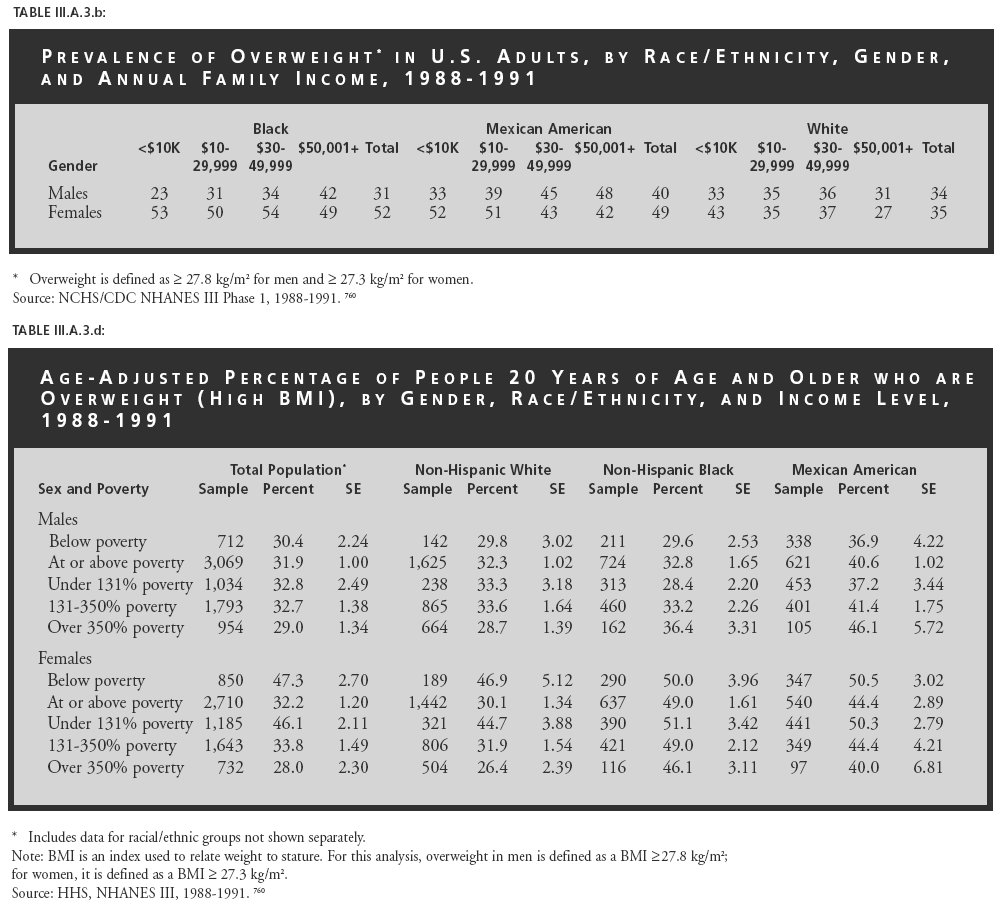
In Lassek and Gaulin’s study sample, the ethnic composition was: 38% white, 29% African-American, 28% Hispanic and 5% other (16,325 females, aged 0–90 years; mean age, 29.9±25.8 years). This is a problem because the dataset shows basically no relationship between SES and prevalence of obesity in African-American women and a weak relation in this regard among Hispanic women, and regardless of SES, these two groups have a high prevalence of overweight/obesity, especially in contrast to Scandinavian/Dutch white women.
The authors used the following measures of mental ability:
- The math and reading tests from the Wide Range Achievement Test—Revised, and the Digit Span and Block Design tests from the Wechsler Intelligence Scale for Children—Revised.; the Four Tests measure (sample ages 6-16 years)
- Years of education (sample ages 18-49).
- Serial Digit Learning Test and Serial Digit Substitution Test; the Two Tests measure (sample aged 18-49)
Years of education is a problematic measure of cognitive ability. Controlling for grade point average (GPA), a 4-year degree in chemistry requires greater intelligence than a 4-year degree in recreation studies. Additionally, affirmative action weakens the relationship between cognitive ability and education in African-American and Hispanic women.
In the table below, it can be seen that ethnicity is the strongest predictor of intelligence when tests more closely assessing it are used, but a weaker predictor of intelligence when years of education is used. Note that WHR is weakly related to cognitive ability.
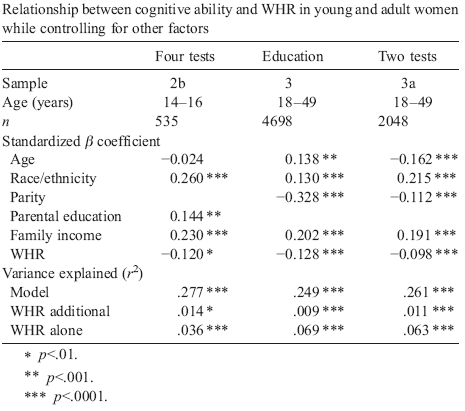
Controlling for mother’s age, both parents’ education, family income and ethnicity, WHR in women but not body mass index (BMI; a proxy for percentage body fat) was negatively related to their intelligence as well as that of their offspring; offspring intelligence is higher even if one adjusts for mother’s IQ. In a subset of the women that had no children, WHR explained 23% of the variance in total body fat and 28% of the variance in BMI, whereas BMI explained 89% of the variance in estimated body fat. So the author’s results indicate that the distribution of fat but not the amount of fat is related to intelligence in women and their offspring. This is a curious find, not consistent with the literature on obesity and intelligence that I have cited, and these citations are lacking in the paper. Hence, people should wait for this study to be replicated using a better sample (Scandinavian/Dutch white; useful because of a low prevalence of obesity) before drawing any conclusions. I am positive that better datasets will show that lower WHR is related to higher IQs to the extent that lower WHRs are corresponding to a normally feminine deposition of fat, i.e., minimal in the abdominal region and more so in the hips/upper thighs (gluetofemoral region). If it can be shown that even in normal weight women without excess abdominal fat, a lower WHR (more feminine in this case) corresponds to higher intelligence, then this would be impressive, but I doubt that this will be shown for reasons that I will describe next.
My anecdotal observations
My observations have been that the smartest women tend to be slim and somewhat masculinized. To compare my observations with women known to be/have been very intelligent, I decided to look at pictures of women who have won the highest awards in math (the Field Medal) and the physical sciences (Nobel Prize) in recent years. However, no woman has ever won the Field Medal. Also, no woman has won a Nobel Prize in the physical sciences (physics, chemistry) in recent years (last one was in 1964). Awards in recent years are important because earlier breakthroughs required lower intelligence than what is currently state of the art. So I decided to include all female Nobel laureates in the physical sciences, but there were only 4 women with 5 Nobels awarded, and three of them were received by a mother-daughter pair. So I decided to include all female Nobel Laureates in Physiology and Medicine, a field where given some luck and hardwork, someone with an IQ as low as the high 120s could come up with Nobel-worthy work, but what else I can do? Ideally, all pictures should have featured the women as young adults, but I wasn’t successful in obtaining them in some cases.
Nobel laureates in science; from top to bottom: Marie Sklodowska Curie (1903, Physics; 1911, chemistry), Irene Joliot-Curie (1935, chemistry), Maria Goeppert Mayer (1963, physics), Dorothy Crowfoot Hodgkin (1964, chemistry), Gerty Radnitz Cori (1947), Rosalyn Sussman Yalow (1977), Barbara McClintock (1983), Rita Levi-Montalcini (1986), Gertrude Elion (1988), Christiane Nusslein-Volhard (1995), Linda B. Buck (2004). Unless specified otherwise, the awards are for Physiology and Medicine.

On average, the Nobel laureates appear to be on the somewhat masculine side of the mean; none happened to be overweight/obese as young adults, and the great majority did not become obese as older women either. Using their examples is merely anecdotal and does not allows us to draw any reliable conclusions, but it should be noted that slim women will usually have WHRs below the average for the female population if the prevalence of overweight and obesity is high, as is true for many populations today. The average WHR of the top-50 high-fashion models as of March 30, 2007 was reported as 0.7, which is below average when compared to the general young adult female population, but one look at these models and it is clear that they have above average masculinization. So, if one wanted to address the relation between femininity and overall intelligence in women, one had better use a more comprehensive measure of femininity/fat distribution than WHR alone.
References
- Lassek, W. D., and Gaulin, S. J. C., Waist-hip ratio and cognitive ability: is gluteofemoral fat a privileged store of neurodevelopmental resources?, Evol Hum Behav, Epub (ahead of print); dx.doi.org/10.1016/j.evolhumbehav.2007.07.005 (2007).
- Sorensen, T. I., and Stunkard, A. J., Does obesity run in families because of genes? An adoption study using silhouettes as a measure of obesity, Acta Psychiatr Scand Suppl, 370, 67 (1993).
- Teasdale, T. W., and Sorensen, T. I., Educational attainment and social class in adoptees: genetic and environmental contributions, J Biosoc Sci, 15, 509 (1983).
- Stunkard, A. J., Socioeconomic status and obesity, Ciba Found Symp, 201, 174 (1996).
- Zhang, H., and Li, Y., [Harmfulness of obesity in children to their health], Zhonghua Yu Fang Yi Xue Za Zhi, 30, 77 (1996).
- Li, X., A study of intelligence and personality in children with simple obesity, Int J Obes Relat Metab Disord, 19, 355 (1995).
- Campos, A. L., Sigulem, D. M., Moraes, D. E., Escrivao, A. M., and Fisberg, M., [Intelligent quotient of obese children and adolescents by the Weschler scale], Rev Saude Publica, 30, 85 (1996).
- Cserjesi, R., Molnar, D., Luminet, O., and Lenard, L., Is there any relationship between obesity and mental flexibility in children?, Appetite, 49, 675 (2007).
- Karnehed, N., Rasmussen, F., Hemmingsson, T., and Tynelius, P., Obesity and attained education: cohort study of more than 700,000 Swedish men, Obesity (Silver Spring), 14, 1421 (2006).
- Chandola, T., Deary, I. J., Blane, D., and Batty, G. D., Childhood IQ in relation to obesity and weight gain in adult life: the National Child Development (1958) Study, Int J Obes (Lond), 30, 1422 (2006).
- Prentice, A., and Goldberg, G., Maternal obesity increases congenital malformations, Nutr Rev, 54, 146 (1996).
- Cnattingius, S., Bergstrom, R., Lipworth, L., and Kramer, M. S., Prepregnancy weight and the risk of adverse pregnancy outcomes, N Engl J Med, 338, 147 (1998).
- Kieser, J. A., Groeneveld, H. T., and Da Silva, P. C., Dental asymmetry, maternal obesity, and smoking, Am J Phys Anthropol, 102, 133 (1997).
- Johnson, S. R., Kolberg, B. H., Varner, M. W., and Railsback, L. D., Maternal obesity and pregnancy, Surg Gynecol Obstet, 164, 431 (1987).
- Silverman, B. L., Rizzo, T., Green, O. C., Cho, N. H., Winter, R. J., Ogata, E. S., Richards, G. E., and Metzger, B. E., Long-term prospective evaluation of offspring of diabetic mothers, Diabetes, 40 Suppl 2, 121 (1991).
- Yamashita, Y., Kawano, Y., Kuriya, N., Murakami, Y., Matsuishi, T., Yoshimatsu, K., and Kato, H., Intellectual development of offspring of diabetic mothers, Acta Paediatr, 85, 1192 (1996).
Comments
So wait, are you saying that the link between IQ and obesity is due to a sort of cognitive defecit that leads to one not being able to control such impulses or something? Or could this be due to poor medical care?
Either way, this largely seems dependent on that idea that IQ and income/SES status are strongly linked, which they aren't. There's low correlations overall. And, as I said in a previous thread, the greater hip size of intelligent women would simply seem to correspond to their greater brain size. Higher IQ individuals tend to be taller, due to their larger brain size creating a greater body mass to support such a brain- it's an indicator. The greater hip size would likely serve as a way to give birth to bigger-brained babies more easily.
Breakthroughs in recent years require more intelligence? That is highly suspect - once Einstein posited his theory of relativity, for example, others could learn, follow, attempt to refute it, etc. Figuring it out though - it would certainy be interesting to see who could do what (i.e., if Einstein could produce breakthroughs today, or if Stephen Hawking could have come up with relativity). I happen to believe that with more knowledge, more tools, and more communication, it is easier to produce breakthroughs now.
BPS:
What did you mean with support ?
Support in a literal (physical) sense ?
Lemme get this right :
1 - First it Was The Brain.
2 - The Brain was highly intelligent and Big, so it created a Big Hip for Himself.
3 - He saw that it was all Good, so He had a rest the 7th Day.
I don't think he's talking about hip size in absolute terms.
We are talking RATIOS here (WHR)
Do you get your science from the "Kosher Gestapo" ?
(Southern Poverty Law Center, ADL of B'nai B'rith, etc.)
Just wondering...
"What did you mean with support ?
Support in a literal (physical) sense ?"
Well, I'm not sure of the mechanism, but you do know how larger and/or more complex brains are more metabolically expensive, right? Look up the correlations between height and IQ.
"1 - First it Was The Brain.
2 - The Brain was highly intelligent and Big, so it created a Big Hip for Himself.
3 - He saw that it was all Good, so He had a rest the 7th Day. "
No- you see, since the link between IQ and brain size is pretty much firmly established (gains in IQ as well result in increased brain growth), a larger pelvis would be required to give birth to a larger brain baby, so...
Well, this isn't hard to understand.
"I don’t think he’s talking about hip size in absolute terms.
We are talking RATIOS here (WHR) "
It's the same thing, really.
"(Southern Poverty Law Center, ADL of B’nai B’rith, etc.)
Just wondering… "
Um, no. I admit, I don't know if that's the exact mechanism, but even before I read this, I've heard of how those with higher IQ's have greater WHRs/hip sizes, so it would seem to go in line with this.
BSP: I didn’t talk about problems with impulse control. There is less intelligence. The Danish adoption study makes it case about SES and intelligence in a dramatic manner. Whereas you may not like it, you can’t just dismiss it. Your notion about hip size is naïve. Like Der Wanderer said, we are talking about a ratio, not hip size. Take a good look at obese women. Large/wide hips are common among them, yet obesity is associated with lower intelligence in self and offspring among them. In any case, you need to consider the following: 1) wider hips in women are only partly related to the child birth function; 2) when fetuses with the genetics of large size develop in small women, their growth is somewhat decelerated in the womb and compensatorily accelerated after birth; and 3) for the same head size some people have thicker bones and lesser brains; contrast the the weaker correlation between head size and intelligence (0.19) with that between brain volume and intelligence (0.33). So your hypothesis is not very exciting.
Emperorjvl: You have it the other way around. Matters that are simpler to understand will be figured out first and figuring them out will require lower intelligence. There is a finite limit to what can be figured out. With time, the items still remaining to be figured out will be fewer and more difficult to unravel. You are right that figuring out relativity by oneself is more difficult that having it explained to you. Even the mighty intellect of Einstein couldn’t figure out relativity by itself and had to borrow the ideas from superior minds.
My observations have been that the smartest women tend to be slim and somewhat masculinized.
These are my anecdotal observations, also.
I just thought they were alluding to it being linked to poor impulse- I've seen that brought up in other discussions and studies about health and intelligence. Nevermind.
Are you also reffering to my contentions about IQ and SES? I don't know about the case of the economy in these countries, but this is still quite true.
And yes, I guess I did get confused about the ratio and the overall hip size, sorry. As for the link between brain size and hip size, whatever, it was just an assumption that jumped from what I once heard about the two being linked. It's never been something I've payed much heed to, so don't hammer me on that.
Well, after rereading what your summary said again, did they make any direct links to intelligence and obesity? At all? What do you think the mechanism is?
I respect your opinion because it's your opinion and you're at least attempting to express yourself eloquently.
But your site has one main flaw. While it is true that High-fashion models are the most "elite" it is also commonly known that they are by far not "mainstream". Commercial models and the like are much more popular not to mention pop stars/movie stars/etc.
What is "elite" exactly? Highest paid? Highest "respected? What does respect mean? How can we measure it? Through fashion magazines, through how much money one makes?
Even if we look at the amount of money they make, and it becomes evident that high fashion models receive much more money - that does not mean in any way that they are more idolized by the public. As you said, most people prefer feminine beauty and thus commercial models are much more "mainstream"...again, high fashion models only belong to a small elite but outside of those interested in high fashion (which I'm surprised you're as knowledgeable as you are seeing as you seem to despise that industry) most of the public won't know these high fashion models.. with the exception of the "superstars" such as Tyra Banks, Giselle, Adriana Lima, Heidi Klum, Naomi Campbell, etc.
I think we can all agree that feminine beauty is subjective and while you seem to agree at least on that, you seem to also claim that what is exactly "feminine" and "masculine" can be easily defined for everyone, in particular straight males. You cannot speak for all of us. As with sexuality, I believe it's all more on a scale rather than being easily defined. Thus masculinity/femininity can vary on a wide scale based on the person's overall features and package.
Men and women and everyone can disagree insanely in terms of who they find attractive EVEN when it comes to overwhelmingly "feminine" women who posess no masculine traits, so really how can one even attempt to approach some kind of supreme truth about "why fashion models look like adolescent boys" or even attempt to claim that so and so is too masculine for "most" straight men.
Even if you were to lay out 10 pictures of feminine girls you liked, and rounded up 50 of your so called-hardcore "straight" masculine men, not all of them would agree on the attractiveness level of all the girls you listed, regardless of how feminine they are.
I just wish that you would emphasize more on this site that it is opinion...but you phrase everything so eloquently that it almost seems like you're trying to make a scientific claim which in the case of this subject would be absurd.
I won't even comment on your theory about homosexual men and their pedophilic tendencies (not to mention the hardly "credible" sources you listed) because that's beyond ridiculous and low, and I'm sure you'll only judge me for thinking so and already have a response worked out for such comments.
Erik:
I find your assumption flawed, as regards to "intelligence": simple matters may be understood by the less intelligent, but the intellectual leap of discoveries, I think, must be normalized to the state-of-the-art (i.e. what could have Newton done with mathematics if he were born today - and was already taught calculus, differential equations and the like?).
BSP: All countries focused on in the article (USA, Scandinavian nations, Netherlands) are Western and have reasonably good economies. Read the paper for a description of one mechanism by which women with excess body fat in the abdominal region are not providing the optimal womb. Other mechanisms would involve disturbances and genetic transmission of low IQ genetics.
Um yeah...: What is more likely to constitute opinion, my empirical arguments or statements like the following?
Quote:
If you disagree, cite evidence to counter mine.
Top high-fashion models are the ones most in demand by fashion designers.
Masculinity-femininity can be assessed in an objective manner. Read more of this site, and you will encounter plenty of information. Yes, not all people agree 100% about who is beautiful, but most share a similar preference; start here for evidence.
Emperorjvl: You are still not addressing the right issue. In science there is a saying that one rests on the shoulder of giants, which is to say that prior discoveries pave the way for newer ones. However, this does not mean that it becomes increasingly easier for people of lower intelligence to come up with breakthroughs. The reverse is true. For instance, the development of trigonometry predates the development of non-linear differential equations. People who can handle non-linear differential equations can easily handle trigonometry, but the reverse is not necessarily true. Without the development of numbers and arithmetic, there would be no non-linear differential equations, but it should be obvious that the number of people who can be taught how to count and other arithmetic far exceed the number that can be made to understand non-linear differential equations. It takes increasingly higher intelligence to come up with cutting edge scientific and engineering work as these fields progress.
Isaac Newton was among the leading intellects of his time. If he were a middle aged man in the present, he would presumably be among the leading intellects of the world and would most likely have come up with some breakthroughs, but the breakthroughs that he would have come up with in the present could be understood by/independently arrived at by a smaller proportion of people than the proportion capable of understanding/independently arriving at Newtonian mechanics and basic calculus.
Odd post considering, and I was reluctant to say it on the pages themselves, but a fair number of the women Erik posted as attractive actually looked retarded (literally) to me.
Unaturally weak chins tend to make people look stupid, and a fair number (by no means all and I don't know if even a majority) of the women Erik has used as an example of feminine-looking are nearly chinless, which I find unattractive, even though I agree with his point on fashion models (a large number of the runway models have manly/boyish faces & figures).
But I don't think that means men find retarded-looking women attractive. I don't find women with *either* manly faces/figures *or* retarded-looking slack-jaws attractive, anymore than most women prolly don't find retarded-looking (and if anyone says that's discrimination, let me know about all the retarded people you've hooked up with).
Scientists explain this by saying that it could be hormones that are secreted from fats that could be damaging the cerebral cells and decreasing brain functions or that the brain arteries could be thickening and preventing blood from reaching the brain in time.
Women with lower waist to hip ratios may tend to be those with higher intelligence (and SES) because conscientiousness is positively correlated with IQ (and SES). Conscientious women are more likely to feel guilty or bad about overeating and so not overeat. Women with higher waist to hip ratios may tend to have less intelligent children largely because the fathers of their children are of below average IQ. Women themselves seem to believe that being overweight is very detrimental to their prospects in the marrage market.
It is hardly surprising that Nobel prize winners in Physiology and Medicine are somewhat masculine and non-overweight, a high degree of conscientiousness is needed for such success and the type of intelligence required i.e. spatial (mental rotation) is a particularly masculine trait. One might expect physique to reflect mental aptitudes.
Dingleberry the Third: I have had a complaint that a number of the women I have been showing within the context of feminine beauty had too strong chins. I had to explain that the women are mostly Northern Europeans and they have longer chins than many other populations as an ethnic trait. And you find many of them to have very weak chins. Maybe it’s just your preferences. You haven’t cited any examples either.
Baldie: When you bring conscientiousness into the picture, you appear to be suggesting that higher IQ women would not be slimmer were it not for their being more restrictive with their eating, but this is not correct. It appears that higher IQ women are less prone to developing obesity under ad libitum eating (eating in accordance with desire). Unmarried overweight white women realize very well that their chances of attracting a desirable man diminish sharply with increasing levels of excessive body fat, and you can be sure that except for a minority that has accepted the obesity, most are obese in spite of trying to lose excess body fat.
Among Northern Europeans at least, the association between low socioeconomic status and obesity is not just a contribution of the father but also of the mother.
A high degree of conscientiousness is not necessary for winning a Nobel Prize. Higher intelligence and luck can easily compensate for lack of hard work. Browse the link about Albert Einstein above; neither intelligence nor hardwork or any original discoveries were behind his Nobel Prize or other accolades.
Spatial ability, including mental rotation ability, is not a particularly masculine trait. Spatial ability refers to dealing with objects in space. The spatial ability comprising of memory for object location in space is better in women, on average, whereas mental rotation ability is better in men, on average. This is a feminist-proof way of stating the matter whereas your writing is fodder for feministing.
In the current edition of the satirical magazine Private Eye is a spoof article; "Germaine Greer's A--Z Of Handy Opinions" these are all wrong eg "Chairs: Who said chairs are somehow 'good' for sitting on...". Another entry is "Einstein, Albert: Lets not kid ourselves the guy didn't know the first thing about science..."
What is the point of citing such a controversial opinion as Moody's (interesting as his article is) in support of a less controvesial point of veiw, right or wrong you aren't going to win any converts with such arguments. It is not just ignorance, people whose qualifications in science are not inferior to Moody's own and who are no freinds of the Einstein cult disagree with him about the original work Einstein put in. Even William Peirce who was a physics professor said that although Einstein combined others work he had provided new explainations and for that deserves credit.
You say Einstein made up for conscientiousness/hard work with IQ how does this address my point that the Physiology and Medicine Nobels -- who you have said need luck and hard work to win if they lack high IQ while suggesting they do have low IQ compared to physical sciences Nobel winners -- had high conscientiousness which aided their acheivement
http://news.bbc.co.uk/1/hi/education/4183166.stm
The clear meaning of the paragraph above the Nobel photos is that these Nobel winners do not have sky high IQs. It actualy says "given some luck and hardwork". Maybe Einstein did make up for low conscientiousness with a very high IQ but he wasn't a non obese woman who won a Nobel for Physiology and Medicine.
Women who have won a Nobel for medicine will tend to have intellectual strengths that are untypical of women; some kind of non verbal intelligence. http://news.bbc.co.uk/1/hi/health/4406176.stm
rejoinder to first paragraph
With a lab rat "ad libitum" has special meaning; they can eat all they want or desire.
This is almost always the case for women in the modern west so I fail to see the relevance, you can't lock someone up and restrict their food intake like a rat; all human studies are ab libitum.
I don't understand how a high IQ (or anything else) would affect obesity unless it reduced calorie intake or increased calorie burning. If there is some other mechanism I would like to hear about it.
High IQ and conscientiousness women carry out their decision avoid accumulating excess bodyfat by eating less than they could; if thats what is meant then yes I agree, high IQ/conscientiousness women don't over eat and get fat. I think the high IQ correlates positively with non obesity and low Waist To Hip ratio because IQ correlates with conscientiousness. I think that conscientiousness would correlate to low WTH ratio a bit better than IQ but I don't deny high IQ women are less likely to be obese.
Of obese women the response says "they are overweight in spite of trying to lose the excess bodyfat". Depends whats meant by "trying", unsuccessfully trying to carry out ones intention is more accurately called "not really trying". Not really trying to lose (or never gain) excess bodyfat leaves then with reduced marrage prospects which tends to result in having lower IQ children. The main reason women successfully resist the desire for eating more food than their body needs to maintain a healthy level of bodyfat is their conscientiousness in my opinion.
Baldie: When it comes to citing materials, how controversial they are is less of an issue for me than how factual/correct they are. I had come across allegations of Einstein’s plagiarism a few years ago, but let the matter slip into the back of my mind because I just wasn’t interested enough to pursue it. Then I found out what Einstein had won a Nobel Prize in. It wasn’t relativity, and this struck me as very curious. The way Einstein is portrayed, his name is almost synonymous with relativity, but his Nobel was in something else and not for original work. Something didn’t sound right and I looked into the matter. Now I am convinced about his plagiarism and his relative worthlessness. The physics community people have invested too many resources into this demigod of theirs and would be extremely reluctant to acknowledge that the person they have been lionizing for so long is the most successful plagiarist in history. Then we also have the malicious physicists and their brethren in the mainstream media who pretend as if Einstein’s claims to his so-called achievements have never been challenged.
I could cite extensive materials, including physicists using foul debating techniques and refusing point blank to discuss Einstein’s plagiarism and his underserved laurels, but again, this issue is seriously off-topic for this site. I most suredly did not say that Einstein’s success was a result of high intelligence. He had higher intelligence than most humans but I would not place him among the great intellects of science or great intellects of any kind.
Regarding your link to the claim that women are more likely to put in sustained periods of hard work in intellectual endeavors, most female science Nobel Prize winners are in physiology and medicine, a field that doesn’t require very high IQs for success, and the ones in the physical sciences won their prize for simpler work than today’s more complex work. So how do you know what was the contribution of hard work, luck and higher intelligence behind the prizes?
I agree that “Women who have won a Nobel for medicine will tend to have intellectual strengths that are untypical of women,” but their intellectual strengths will also be atypical of men.
Ad libitum eating doesn’t mean that one can eat all one wants but that one actually eats all that one wants. Whereas the typical woman in the modern West can eat all that she wants, she does not necessarily eat all that she wants. All human studies are not ad libitum; I don’t suppose you have fraternized with [mostly white] sorority girls in the U.S. or their counterparts elsewhere.
I have clearly cited Scandinavian research showing that the socioeconomic gradient in obesity is not explained by education and lifestyle factors such as dietary practices, smoking and exercise. So what is the point of bringing in the conscientiousness issue or in the other words supposedly more restrictive eating on the part of higher IQ women?
You can’t understand how high IQ would affect obesity unless it reduced food intake or burned more calories? Why suppose that IQ is affecting obesity? How about obesity affecting IQ? How about a third factor affecting both body fat levels and IQ simultaneously, which is what the path analysis mentioned in the article has shown?
Use your imagination or brush up on your physiology and you will see plenty of potential contributory mechanisms, none necessarily of great importance, but together explaining the association between excess body fat and low IQ.
And you never know what other mechanisms there are.
Many obese individuals will be insulted by your claim that their unsuccessful attempts at losing excess body fat were instances of them not trying. Millions of them have tried everything from diets to exercise, and sincerely, but it didn’t work.
http://www.sciam.com/article.cfm?id=high aptitude-minds&print=true
Energy used by the brain is about 20% , but using lots would cteate a deficit and make one hungrier still. I think concientiousness is needed to resist this.
Bit of a fiasco there, sorry. http://www.sciam/article.cfm?id=high-aptitude-minds&print=true
If one uses energy one feels hungry therefore something is needed to resist hunger and this something also makes the best use of the IQ one happens to possess, the two things do tend to go together I admit.
IQ could be affected by insulin resistance ect., yes absolutely true but there are good Darwinian reasons to expect this not to be as important a factor as the IQ of the father. Babies tend to be protected from the fetal stress involved. (Pregnant women not eating enough is said to set the fetus' energy metabolism to expect low energy intake and be very damaging to the future adult's future health also.)
More mental illnessess are associated with overeating than anorexia; quite so and I take it that you don't associate these same mental illnessess with conscientiousness. In fact bulimia is associated with disinhibition of various kinds. Anorexic girls tend to come from achieving families, so if above average IQ correlates with low WTH an extreme amount could be partly responsible for their being vulnerable to the illness. However it should be remembered that the thing most characteristic of anorexics is they are perfectionists, I think this is a very telling piece of evidence in support of high conscientiousness' role in the etiology of anorexia.
Empathising with overweight women (or men) may gain their approval, I doubt it helps to understand the difficulties,or why it is that that some obese people do overcome them and lose their excess bodyfat. How they are helped to be able to succeed in losing weight has to do with coming to feel bad about overeating. I think weight loss groups (Weight Watchers) are successful at helping people by making them feel guilty about overeating. The leaders of these groups do not tell their clients who fail to stick to the progam "you really tried ".
The link was to an article in Scientific American called High Aptitude Minds google cache has it if anyone is interested. I dont want to risk failing a third time with a link.
Baldie: More energy expenditure will tend to create more hunger indeed, but you forgot to consider the state of tuning of physiological control that balances energy intake against energy expenditure, some elements of which start getting detuned as early as one’s early twenties. Now what will this detuning comprise of? More instances where energy intake exceeds energy expenditure rather than the other way around, and here, those with faster metabolisms are less likely to pack on excess pounds as far as aging of the energy regulatory system goes. So no need to bring in conscientiousness here.
The typical anorexic woman is not trying to be more conscientious with respect to eating; she has come to believe that attaining perfection in one field will make her problems go away and she is convinced that perfection lies in extreme thinness. There are other anorexics where body image is not an issue and neither is conscientiousness.
The most natural way to eat is to do so in accordance with desire, and if not restricted by availability of food, most people eat in this manner. So conscientiousness or prudence in dietary matters is not of great relevance in understanding the majority of variation behind individual differences in body fat levels.
I am not trying to empathize with obese individuals. Those weight watchers programs are generally not long-term effective notwithstanding some spectacular success stories. There is a very simple and guaranteed method of loosing excess body fat: stop eating till you reach the desired weight. However, the holy grail of weight loss is how to sustain a healthy body mass. This is where people fail. It is not difficult to motivate people to lose excess body fat, but much more difficult to use psychological manipulation to keep off the pounds in the long run, simply because will power/conscientiousness is hardly the culprit in the first place.
http://en.wikipedia.org/wiki/Conscientiousness
"It also includes the specific traits of rule conscientiousness and perfectionalism" (in Cattell's model)
(This is what I was talking about. I was not using conscientousness as an eccentric synonym for will power in the sense of self control)
Conscientiousness is associated with social rule following. In other words attention to social obligations as threats to wellbeing if not fulfilled. If some intelligent girls of very high conscientiousness corectly percieve that the prestigious fashion industry deems normal healthy female bodyfat as obese -- and they're not wrong about that -- in their own minds they may feel guilty for not following "the rules" and fulfilling social obligations. Anorexics are considered unusually obedient by parents and teachers in the following of rules. The personality dimension they have a lot of may tend to make conform with fashion's harmful bias; they then see half starved models as paragons of feminine beauty. Other factor(s) may well be more important but I think conscientiousness plays a part. This is close to what you are saying above, Some anorexics are less typical body image perfectionalists -- yes.
Low conscientiousness is associated with procastination (in Wiki), now correct me if this sounds wrong but obese people tend to put off going on a diet (or Banting as it is sometimes called) until tomorrow, which never comes of course.
I agree will power is not the answer but in joining a weight loss group one may be feel social obligations, and feel more guilty about not carrying out ones intention to lose weight.
Baldie: This conscientiousness thing is getting out of hand. Here is a simple consideration. What if I asked you to start eating less and suffer hunger pangs many times a day to lose weight? I am asking you to indulge in something very inconvenient and painful. If you wanted to put this off, regardless of your weight, what would be the most plausible reason, avoiding the suffering or lacking conscientiousness? Again, the most natural way of eating is to eat in accordance with desire. Those who gain body fat while eating in accordance with desire have a physiological make-up that makes them prone to obesity, and whereas these individuals will have individually varying levels of conscientiousness, lower levels of conscientiousness will hardly be responsible for the obesity-prone physiology, which is what matters in the article.
Erik,
Yes, I too have noticed that more masculine women SEEM to be more intelligent. However, you cannot assume that based only on your observations. I am a very feminine woman, and according to testing(however accurate standardized tests really are), I have above average intelligence. Is it extremely above average? No. It's closer to average than it is to "gifted" or genius. However, I know many feminine women that are extremely intelligent. You can call them "gifted".
You have to realize that your views paint a biased picture of yourself. I agree with many points presented by this website. You have a variety of informative and accurate arguments about femininity and attractiveness. However, people will ignore that because this is what they see:
A)References to the bible suggesting a strong "Christian" if not "fundamentalist Christian" outlook. (Hey I am a Christian as well, but I do not put bible references on any of my work. Nor do I tell people that their comments suggest lying, "and that is a sin".
B)You claim that Northern European women are more feminine on average and have more attractive qualities(rhinoplasty section). You probably do have adequate evidence to support this, but people don't care. All they see is a "racist" or "bigot". Perhaps if you had a page with good scholarly articles and all the evidence suggesting this it would shut some people up.
C)On a page I noticed you mentioned that you would vote for Sarah Palin. This suggests a very right-winged attitude and reinforces stereotypes associated with conservatives such as: white, fundamentalist Christian, racist/bigots, closed-minded, war mongers, etc. ( I was raised conservative, but now I lean more towards intermediate as I don't like politics and do not associate myself with either side. I am not fond of either side.)
D)Now take all three factors into consideration and this is what you look like to people:
You look like a white Nordic male who is conservative when it comes to politics. You have a bigot attitude and you use pseudo-science to support your bigot views. You like weak women and are intimidated by any woman showing any sign of:
a)intelligence
b)aggressiveness
c)strength
You hate homosexuals and will do anything in your power to portray them as sick individuals.
You wrote this yourself:
My observations have been that the smartest women tend to be slim and somewhat masculinized.
Now what does this say? You say that Nordic women are MORE feminine. Hmm... Now let me put A and B together. Are you saying that Nordic women are on average less intelligent than more masculinized women of other races? I find it quite the contrary.
Now this goes against me but it is the truth so I will state it:
It seems that besides Asian women, Northern European women have the highest IQs. Now I don't believe IQ tests to be accurate, but they are the only measure of intelligence we have. Lets focus strictly on Europeans however. Eastern European women whom you claim to be "less feminine" on average than Northern European women DO NOT have IQs as high as Northern European women. I am looking at the countries here. The Nordic countries have higher IQs than the Eastern European or Southern European countries. I am sure that in Eastern European countries (because I am more familiar with them) nutrition and lifestyle play a large part in the fact that they have lower IQ scores. However, I doubt that the more mascunilized Eastern European women would be more intelligent than Northern European women even with proper nutrition,education, and a more education oriented lifestyle. They would probably be equally intelligent at best.
Just look at Emily:
Although her arguments are weak (quotes Emily, "You are just jealous or not white!") look at her syntax, her writing style, her structure. English is her second language. Look at her vocabulary. She obviously has above average intelligence (which she could probably put to good use if she wasn't so smothered in her extreme,ignorant, and inaccurate ideas and views).
This is my experience with mose Northern European women:
They are very intelligent.
So...
The fact that you claim that Northern European women are more feminine on average... but then you turn around that mascunilized women are more intelligent on average...
It just looks wrong. We don't know enough about intelligence to honestly come to that conclusion. Neither do we have enough information to prove that Northern European women are on average more feminine. Although from my honest observation they are.
Might I add that this whole outlook, that more masculine women are more intelligent, more feminine women are more attractive, holds a large problem:
Should a man mate with a masculine women with the expectation that his daughter will be genetically more intelligent? Or should he mate with a more feminine women with the expectation that his daughter will be more feminine and attractive?
Don't we all want to have attractive and intelligent children?
If it were up to me I would opt for intelligence as I find it more useful in the long-run. You claim yourself that women are attractive from the range of ages 18-25. So my guess is that true attractiveness is very limited. However, an intelligent women will stay intelligent (especially if she keeps her mind sharp) long past the age of 25, through her middle age, and up until her elderly age where her intelligence and sharp mind may start to deteriorate.
Another issue:
Should a man mate with a feminine woman, one that he is attracted to, with the risk that his son will undoubtly be feminine? Or should he mate with a less attractive masculine woman with the assurance that his son will utlimatley be masculine?
You also go as far as to claim this:
My observations have been that the smartest women tend to be slim and somewhat masculinized
Then go to say:
Awards in recent years are important because earlier breakthroughs required lower intelligence than what is currently state of the art.
So you are saying that the only reason women won any awards is because "back then" high intelligence really wasn't that necessary for someone to win a nobel prize?
btw: Sorry if I did misunderstand the article. I did skim through it as I don't have that much time right now...
but please correct me if I am wrong, because I really hope I am wrong..
"Yes, I too have noticed that more masculine women SEEM to be more intelligent. However, you cannot assume that based only on your observations. I am a very feminine woman, and according to testing(however accurate standardized tests "
You SAY you are a very feminine woman, implying also that you are highly attractive. In my experience, those who are truly attractive don't repeat that ad nauseum, over and over, like you do.
"You have to realize that your views paint a biased picture of yourself. I agree with many points presented by this "
Talk about the pot calling the kettle black. Your views are biased, and lacking the evidence, there is the difference. As long as he can prove his theories he is not biased.
"You have a variety of informative and accurate arguments about femininity and attractiveness. However, people will ignore that because this is what they see:"
No, they won't. People will if they are not prepared to see the truth, however...
"B)You claim that Northern European women are more feminine on average and have more attractive qualities(rhinoplasty section). You probably do have adequate evidence to support this, but people don't care. All they see is a "racist" or "bigot". Perhaps if you had a page with good scholarly articles and all the evidence suggesting this it would shut some people up."
That's a ridiculous statement. They most certainly DO care. They care so much that some are going insane over it, cough, cough.
Genuine, mature people don't see racism where there is none, they see the evidence and where it leads them. Truth is not ever racism.
You have showed your hostility towards Nordic women here and this suggestion is very transparent. Of course you would prefer that he claimed that women of YOUR ethnic background are the most feminine and attractive. That is the only motive for your critisism. God, that is transparent. Had he praised Romanians we wouldn't have heard a sound from you on this.
"C)On a page I noticed you mentioned that you would vote for Sarah Palin. This suggests a very right-winged attitude and reinforces stereotypes associated with conservatives such as: white, fundamentalist Christian, racist/bigots, closed-minded, war mongers, etc. ( I was raised conservative, but now I lean more towards intermediate as I don't like politics and do not associate myself with either side. I am not fond of either side.)"
I agree that it is unnecessary to state political views here. It is totally off-topic, I think, and could make some people hostile and unwilling to consider the valid parts of this site.
"D)Now take all three factors into consideration and this is what you look like to people:
"You look like a white Nordic male who is conservative when it comes to politics. You have a bigot attitude and you use pseudo-science to support your bigot views. You like weak women and are intimidated by any woman showing any sign of:
a)intelligence
b)aggressiveness
c)strength"
Maybe he isn't intimidated. It is possible to dislike something without being a "bigot" or intimidated. Many men dislike the overly-aggressive, androgynous, vulgar and promiscuous "modern" woman. Most men appreciate a feminine, sweet, romantic and beautiful woman who is ALSO intelligent and an equal partner - without trying to totally wipe out traditional gender roles.
When you overdo things it usually has the opposite effect, you know.. Trying desperately to appear mature wil make you seem immature, for example.
"You hate homosexuals and will do anything in your power to portray them as sick individuals."
They have too much power when it comes to certain issues, such as creating false beauty ideals for women. That critisism is valid.
"This is my experience with mose Northern European women:
They are very intelligent.
So...
The fact that you claim that Northern European women are more feminine on average... but then you turn around that mascunilized women are more intelligent on average...
It just looks wrong. We don't know enough about intelligence to honestly come to that conclusion. Neither do we have enough information to prove that Northern European women are on average more feminine. Although from my honest observation they are."
Look, everything is relative. THE most masculine woman of all - the Aboriginal woman - should be the most intelligent one, if we only look for masculinity. Obviously, he is comparing women within their OWN SPECIFIC GROUP, or ethnic/racial type. An idiot understands this.
Look, everything is relative. THE most masculine woman of all - the Aboriginal woman - should be the most intelligent one, if we only look for masculinity. Obviously, he is comparing women within their OWN SPECIFIC GROUP, or ethnic/racial type. An idiot understands this
Ok, Emily. But I am refferring to Europeans which IS within the same group: Europeans. Besides, lets scope it down to specifically Northern Europeans. I have seen Northern European women that are extremely feminine that can be more intelligent than a masculine Northern European women. From my experience actually the more feminine one is the more intelligent. I'm not just saying this because I am feminine either...
Now, I haven't read the whole article. I just read a few lines. I mentioned this. Don't criticize me just yet, because it is obvious I haven't read the whole article. When I have more than 5 minutes at once to read the article (I only come on here during small breaks), I will write a more accurate comment.
Yes, masculine women seem to dominate the whole high IQ area, but I don't think it's safe to come to that conclusion just yet... and I'm not "favoring" feminine women, just stating my personal experience...
Northern Europeans - and Nordics - are not in the same sub-race group. They are generally more gracile, have finer facial features and are therefore more feminine than let's say many people found in Eastern European countries.
Comparing them to for example robust, coarse Slavs without any Nordic genes in them, saying Nordic women must be less intelligent since they are more feminine, is ridiculous. You should compare apples to apples. As for the article I haven't read it yet, either. I don't think one can say that just because someone is very feminine they must also be less intelligent. I don't think that is what Erik means, either.
Some men like to think of feminine women as dumb. Marilyn Monroe is that kind of stereotype. Childish, air-headed and not overly bright. Many men seem to like this image so it is there partly because men like it. That doesn't mean that Marilyn secretly didn't wish that she would be offered more serious roles and be taken more seriously (which she did), or that she was as dumb the way her roles made her seem.
Sometimes some women DO seem more naive and less mentally sharp than men. Keyword, "seem". I don't know if they truly are. However, we are, it seems, emotionally much more evolved than men, for example, who sometimes seem not far removed from the neanderthal level when it comes to feelings, empathy and compassion, things that are generally characteristic for immature children who are very self-centered. So it all depends on how you see things, I guess.
My first sentence could be misunderstood. I meant that Northern Europeans - and Nordics - are not in the same sub-race group as for example pure Slavic Eastern Europeans.
Saying that these women are less intelligent because they are more feminine, gracile and less coarse than the Slavs is just as dumb as saying that black and aboriginal women are more intelligent than white and asian women, who are more feminine. You have to compare women within the same ethnic group.
They are generally more gracile, have finer facial features and are therefore more feminine than let's say many people found in Eastern European countries.
Whatever, in all honesty I don't really have a response. I am kind of getting tired of all this. I personally have very fine and gracile facial features. Therefore, I don't really think that many Eastern Europeans ARE not gracile and many do have very fine facial features. Again, you assume that every Eastern European is the same... It's just not true and the majority don't even fit into the image you have in your mind.
Sometimes I feel like people like you just want everyone to worship the way you look,act, and think. You want everyone to see things the way you do and think the way you do. If they don't agree with you, they are automatically jealous or they have underlying motives behind every statement or comment. I have come to discover that people like you are like parasites that feed off other people's energy, anger, etc. I realized that no matter what points I make they will go over your head. In all honesty I don't care anymore whether you see my point or not, because it's obvious you will never see. You live your life with such a narrow view that you fail to see the beauty that lies outside of that. I am one that always goes for the underdog... If you say Asians are ugly, I will find their beauty. If you say Indians have hooked noses I will find beauty in that and I will also find beauty in their other features. If you say this, I'll say something against it. Therefore I feel we are both stubborn in our own way.
We just look at things differently, and you can have your views and I can have mine. However, with the way things are going right now it seems that I will have more doors opened for me because I see the good in people, and I can see their flaws as well, but I see the good in those flaws too. Emily, all you see are underage-prepubescent Asian girls that appeal to pedophiles, all you see are Romanians with ugly noses, Slavs with broad faces, etc. etc. You get the drift. Good luck honey, you are going to need it. The world is changing physically and spiritually... don't get left behind, open your mind.
Here we go again. When the arguments (if you ever had any) fail you turn the focus to the poster. Get a grip, godis. This site deals with LOOKS and BEAUTY - not inner qualities. When I speak of women's looks I see them in terms of their looks since that is what this site is about. Some women who don't look good at all might be wonderful and very special human beings, and OF COURSE that is what truly matters.
You nag over the fact that I don't like hooked noses but I can say that I think you are closed minded because you don't like washed out blondes. lol You are doing the same thing yourself that you don't accept in others, except it is ok for you to have preferences, but not for me.
Someone could easily appear shallow here since the almost only thing you speak about here is physical appearance. YOU look shallow when you write some of your comments here, and quite frankly full of yourself and of your own imaginary importance and imaginary righteousness. So open your own mind before thinking about the minds of others.
You have an extremely narrow and small picture of me since I prefer NOT to write about myself all the time, like you do, and yet you have me all figured out, don't you, just like you have Erik all figured out, even if he says almost nothing about himself. You appear to me to be extremely immature and full of air and no substance. You said somewhere that you are 20, I believe, but you come across as 15.
I don't want anyone to worship the way I look! Where on earth did you get that idea from? I'm not the one describing my own looks over, and over, and over..telling everyone here how feminine and attractive I am, now am I? Why don't I need to do that, do you think? On the other hand, who here does that ALL THE TIME? Hmmm? To me, you seem to be a case of someone who is frustrated because other types of women might be prettier in most people's eyes.
You seem extremely insecure, and the more you write the more insecure you seem. Men usually prefer Nordics and not Romanian girls with "Roman" noses, brown eyes and round faces, so what? Deal with it. Get a hobby. Grow a rose garden. Get a dog. Study arts, music, film and get deeper, genuine interests. This site does nothing good for you, in my opinion. It is turning into a fixation and your comments look more and more obsessive, quite frankly.
The only reason I mention that I am feminine and somewhat attractive is because I want you to understand that none of my comments come from "jealousy" as I have no honest reason to be jealous... This is why I mention this because if I didn't you would say:
Well, you are just masculine and you can't get over it. You are just jealous because you are ugly and you look like a man... like most Romanians.... etc. etc.
Hey look, you've already done it, and I have expected it from you. I am trying to be 100% honest and I am painting a picture of myself so you can understand that none of this is being said out of jealousy. None of it. However, obviously nothing I say works. You still "don't believe me". You still don't believe I am naturally blonde, even though I am. Even though I even admitted that I actually get blonde highlights over my natural dark blonde/light brown hair. You accuse me of not being white, then of being white but mixed with gypsy, then of being white but "not really" because Romanians don't have the desired "white" features. They are just swarthy with hooked noses right? I have to describe what I look like to show to you that none of this IS coming from jealousy or insecurity. All of this is coming from what I see and honesty. I can admit when someone, including myself, has a flaw. I have mentioned over and over again: yes I am feminine and attractive, but I am not perfect, nor do I come close to being an extremely gorgeous woman. I have only stated that: I am attractive, I like the way I look personally, and I am your average girl. You act like I am trying to paint this picture like I am Helen of Troy and I am soo beautiful every man should fight over me, but you can look at my past comments where I have stated I am just your average girl that is on the feminine side and I am happy with my looks...and also that this site has made me appreciate things I didn't like at first, such as my childish face that was always: cute, but never "sexy". You have this idea because I say I look Roman godesque: but you have to understand that even though they are beautiful art, roman godess statues never exactly depict an extremely attractive female. You never hear a guy that goes to Rome and sees these statues saying; "Damn! Look at that babe! They were hot back then man! I would bang her!"I have very many features that you see in Roman statues only more child like. That is all I am trying to say... I am just trying to describe to you what I look like. I have also stated exactly what my geneology is (from what I know, because who really knows 100% whats in their genes).
You always bring this, " you don't like washed out blondes". You assume that because I think blondes are washed out that I cannot possibly be blonde. Well I have a question for you: Do you wear eyeliner or makeup? Do you ever tan?
Exactly. Does this mean that you don't appreciate blonde hair? No. It just means you may not like a certain aspect of blonde hair. For example my hair is very fine and soft, so I have a hard time getting it to stay when I style it. I love blonde hair. I love the color, but.... I don't love that it is too fine and can get limp. I do however like that it is soft, however the softness causes it to be limp. Get it? I love the color of blonde hair, I don't like the whole package though. No one likes everything about everything. Yes, blondes often looked washed out. I often look washed out. This is why I put on sunless tanner, it gives me a nice glow while still retaining a fairly light color that goes with my features. I wear mascara because my eyelashes although not invisible, don't really stand out. I put mascara out and bam! my eyes pop... See? I am sure you do the same thing. Now don't tell me that I cannot possibly like blondes because I tan or wear mascara...
I find it very interesting that you mention I should study more indepth things. My favorite philosipher is: Kant.
I am currently interested in the Holographic Universe theory. One of my favorite theoretical phsycicist is Michio Kaku. He is the co-founder of string theory, which I find very interesting. I cannot say I accept any of these theories because I do not understand them on every level. Even many geniuses have a hard time understanding the math that goes along with String theory. However, I do understand Kant and agree with his ideas, especially morality, although I do believe his ideas on morals to be a bit rigid. I love to study religions, although I am Christian. Of course, I find Jesus' words to be the wisest among any human that has ever lived...
Looking back on this, I have to say that it depends on how you define intelligence and I would also like to say that hormones affect the development of the brain from before birth.
People who are exposed to more testosterone develop spatial, mathematical, athletic, and musical abilities. I am a living testimony to this actually. I am a good singer and excel in music, I am athletic, I scored off-the charts on a spatial intelligence test, and I can draw anything extremely realistically with ease. I never payed attention in math class as the concepts BORED me, however I excel in economics which is pretty common sense logic so I suppose that I have SOME logic.
On the other hand people who are exposed to higher estrogen levels excel in social behaviors or subjects like reading and even writing.
So it depends on what TYPE of intelligence you are referring to.
The funny thing is that although I excel at what I excel, I am extremely social and a very good salesman actually. I also score HIGHEST in the reading section of any test as I am generally a speed reader and can process information very quickly, although many times I skip too many paragraphs and miss important points.
So I think there is two types of intelligence, and then there are mixes, like myself.
I'd also like to add that I have read on wikipedia(I know not very reliable, but this still intrigues me) women with higher estrogen levels tend to have more unsymmetrical faces, as do men with higher testosterone levels. I find this interesting because today we are so spoiled by viewing on average "symmetrical" faces on magazines, in movies, on ads, etc. So, I wonder if this is why most people are turned off by Erik's "attractive women" section. Those women are more feminine however more unsymmetrical. Perhaps we are so used to symmetrical faces, that even a good looking woman will start to look less good if she does not have an unsymmetrical face. I personally believe a face should have SOME symmetry, but a significant amount is not absoulutley necessary. There are too many other factors that relate to attractiveness, and although symmetry is an extremely important one, it does not hold any monopoly on attractiveness whatsoever.
she does not have an unsymmetrical face
this should be:
she does not have a symmetrical* face
Sorry, I was doing 5 things while I was typing this. I think it is obvious.
Symmetry is a correlate to attractiveness according to many studies. Most assymetry comes with faces that are too masculine (in males), or too feminine (in females). Faces leaning toward slight (very slight) masculinization in women are almost always preferred. However, the site admin. disagrees and has presented facts in support of his opinions. Only because I have grown accustomed to my own preferences from my occupation, and the exposure I get to faces do I base my opinions. I believe that extreme masculinization in women is odd looking and not complimentary to their looks whatsoever, but some, even slight definition (which is masculinization to a degree) is still preferable.
Why? I just can't...fathom...
I read this entire page, this ENTIRE PAGE, from start to finish. Without interruption. Why did I do that? Why did I waste my time with this self-important, self-righteous, elitist drivel? WHY?
I read through all of the comments - from the early days of the epic Battle of Conscientiousness fought by Baldie and the poster, Erik, all the way through the Terror of the Temper Tantrums instigated (and PERPETUATED) by The Nightmare Child Godis ("God is"?), though See Emily Play quickly proved that she was perfectly capable of adding her own unique brand of insanity into the mix. The irony being that neither Godis nor Emily had even READ the article in it's entirety, the former having skimmed its contents during a "five-minute break" (wasting your company's valuable time and resources by starting highly personal and emotionally-charged arguments on www.femininebeauty.info, perhaps?), and the latter admitting that she hadn't read ANY of it. But they sure had something to say about it, by Jove!
Five months passed, and all was silent again...or was it? Emily, it seemed, had found some other possibly greater purpose to sustain herself and had moved on, but Godis aka "The Frodis Caper" aka "Mickey Dolenz" aka "Northern European Women Have Strong Chins Like Mickey Dolenz" (it's possible that I'm stretching the truth here a bit) was still going strong, fighting the good fight and righting wrongs throughout the world when she came across them on www.femininebeauty.info. Kicking crass and taking names.
Then, in a sudden turn of events, unfortunate but not entirely unpredictable, this page was assaulted by a triad of spambots, and though not a word I heard could I relate, the story was quite clear. What had started as a mere hypothesis on the possible correlation between the waist-to-hip ratios of women and their levels of intelligence had spun wildly out of control, devolving into primordial hoots and grunts, followed by unspeakable acts of brutality and extreme violence, the likes of which www.femininebeauty.info had never seen. Countless patronising comments were made, ultimately resulting in mutual cannibalism between all parties involved. The remaining fragile thread of humanity, glistening like gossamer in the flickering light of the computer monitor of the world, was cut in twain by ruthless Internet Ninjas, and the online page was reclaimed by our Lord and Master, ‘He Who Has Many Names But Whom We Shall Refer To Here As Bill Gates’.
Upon completion of this comment, I fully intend to listen to some Erik (no relation, clearly) Satie, toss The Beatles in there, continue the psych with The 13th Floor Elevators, try a little something smoove with M.I.A., cool down and expand my mind a bit with the nightmarish paranoia and surreal beauty of “At The Mountains Of Madness” from HP LOVECRAFT II (the band, man, that’s the bag I’m in) and get simultaneously unbelievably happy and soul-crushingly depressed with my man Robyn Hitchcock and his Egyptians or maybe his Soft Boys. Depending on how that goes, I'll consider watching "Jack Of All Trades", because Bruce Campbell may be my only hope for a much-needed return to NORMALCY (or is it normality, Erik? I JUST DON'T KNOW ANYMORE) after this ego-induced freakout.
P.S. I was put through a barrage of tests in elementary school when I was twelve, and it was determined that my IQ is 135. DOES THAT MEAN I CAN BE COOL WITH YOU GUYS? ERIK? I’M SMART NOW, RIGHT? DO YOU THINK I CAN BE LIKE MARIE CURIE AND WIN A NOBEL PRIZE WITH AN IQ THAT’S JUST ABOVE THE HIGH 120S? MAYBE WITH SOME LUCK AND HARDWORK I CAN INVENT AN ELECTRONIC BRAINWAVE SENSORY APPARATUS (DOES THIS MAKE SENSE, ERIK?) THAT ENABLES DOLPHINS TO COMMUNICATE WITH US LIKE DARWIN IN SEAQUEST DSV AND 2032. THAT WOULD BE AWSUM.
IT WOULD BE THE SCIENTIFIC BREAK-THROUGH OF THE MILLENIALS. MILLENIUMS. MILLS TODDNER. MILLER LIGHT. THE UNBEARABLE LIGHTNESS OF BEING. BEING FOR THE BENEFIT OF MR. KITE. HIGH AS A KITE. LIGHTNING. HURDY GURDY MAN. BERT JANSCH. ONION. COFFIN. PALEOLITHIC. ENGINEER. EGYPTIAN. PRIDE. SEAMUS. KILLING. PREJUDICE. FALLACY. CRIMEWAVE. NUMBERS. IMPORTANT. FELLOW. GENIUS. PANTHER. MOMENT. BREAKFAST. TIGHTROPE. CANCER. VIOLET. PASSING. VENUS. STAMP. BRIGHT. TRACK. TALL. BANSHEE. PALTRY. VICIOUS. LOU REED. DIABOLICAL. WHAM. NO MIRRORS. CHOCOLATE. STREAM OF THOUGHT. STREAM OF CONSCIOUSNESS. STREAM OF WATER. A STREAM. I SING THE BODY ELECTRIC. SKULL. THE EXTERMINATING ANGEL. UN CHIEN ANDALOU. GOLD. LUIS BUÑUEL SALVADOR DALI MAN RAY ANDY WARHOL ROY LICHTENSTEIN TATI FELLINI CHAPLIN KEATON JAMES JOYCE TERROR MARK PANEL SHIFT CULT PREMONITION TELL-TALE THING IN THE DARK WHERE YOU LEFT IT BUT YOU HOPED TO GOD IT WOULDN’T BE THERE WHEN YOU LOOKED AGAIN HOW’S THIS FOR IQ. THESE INDIVIDUAL WORDS AND PHRASES SAY MORE ABOUT ME THAN ANY STANDARDIZED TEST EVER COULD, AND WITH DEAD ACCURACY, IF YOU KNOW HOW TO READ THEM. BUT I CAN TELL YOU NOW THAT YOU COULDN’T POSSIBLY, CONSIDERING THAT YOU’VE NEVER MET ME. IT’S CLEAR TO ME THAT OUR TWO MINDS MUST BE IN DIRECT CONTACT WITH EACH OTHER FOR THERE TO BE ANY KIND OF REAL UNDERSTANDING BETWEEN US, AS IS TRUE FOR ALL HUMAN BEINGS.
ON AN UNRELATED NOTE, THESE CAPITAL LETTERS ARE BEGINNING TO MAKE ME SICK.
Erik, grab a trash can for me, will you?