This article addresses the latest literature review on drugs that have been documented to improve the health and appearance of aged or photodamaged skin.(1, pdf)
By far the best preventive skin application comprises of sunscreens, but if the skin has already aged, then the consumer will be confronted with a bewildering array of beauty products claimed to combat skin aging, most unproven. Here is a list of drugs that work.
Idebenone
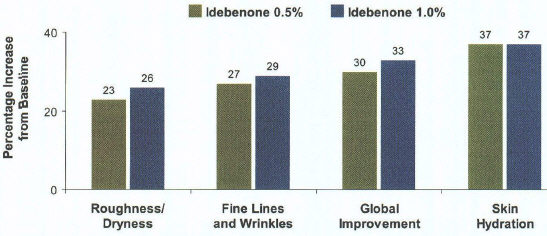
Idebenone is an antioxidant that may be prescribed in 0.5% and 1.0% strengths. A few weeks of application result in improvement in how rough/dry the skin is, fine lines and wrinkles, and skin hydration (intrinsic moisture in the skin), as shown in Fig. 1.
Fig 1. The improvement after 6 weeks of twice-daily application is similar with both strengths, but the shortcoming is that the study did not have controls, i.e., follow-up on participants who received a placebo. McDaniel DH, et al. J Cosmet Dermatol. 2005;4:167-173.
Copper Zinc Malonate
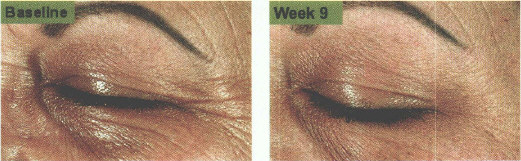
The following image shows the results of application of 0.25g of the product, twice daily, around the eyes, for 8 weeks.
Fig 2. Copper Zinc Malonate application reduces wrinkles and improves skin elasticity and skin hydration. Mille TF, Batra RS, Ramirez J. Poster presented at: American Academy of Dermatology 65th Annual Meeting; Feb. 2-6, 2007; Washington, DC.
Tretinoin or stabilized retinol product in conjunction with hydroquinone
Aged skin has a tendency to become spotty or mottled. Hydroquinones suppress pigment production and can take care of the spots, but they tend to cause skin reddening, scaling, burning and stinging. Vitamin A derivates such as tretinoin and retinol have proven benefits with respect to wrinkles.
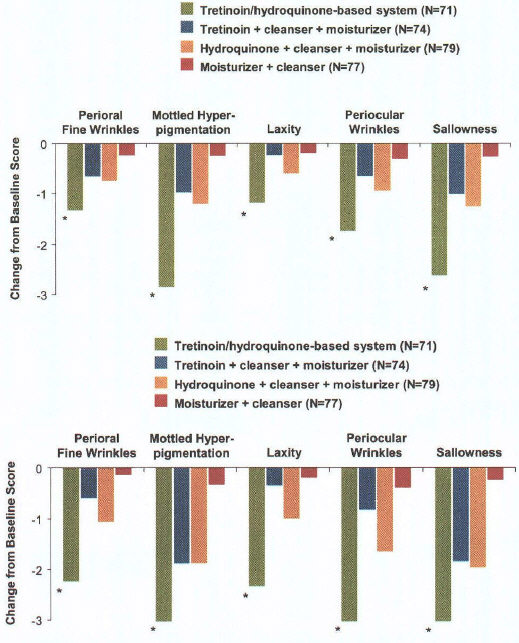
The following study compared the outcomes resulting from 4 regimens after 12 weeks and 24 weeks. The drugs were 0.1% tretinoin, 4% hydroquinone, cleanser and moisturizer. The applications were twice daily. When tretinoin and hydroquinone were combined, hydroquinone was applied twice daily and tretinoin once daily, and when tretinoin and hydroquinone were used independently, then the application of these drugs was once daily and the second application comprised of cleanser and moisturizer. In the graph below, perioral means around mouth, periocular means around eyes, laxity refers to looseness and sallowness refers to yellowish tone.
Fig 3. Improvement of skin variables after 12 weeks and 24 weeks of topical application of various drug combinations. The asterisks imply that the results are significantly different from the other outcomes. Cosmetic Dermatology. 2006;19(4):255-261.
Tretinoin may irritate the skin, and hence 0.3% stabilized retinol may be used instead.
So these are the proven drugs that help. They can be described as cosmeceuticals since they combine the therapeutic properties of pharmaceuticals and the aesthetic improvement resulting from cosmetics. The article mentions some other potentially promising topical applications based on Vitamin C, Vitamin E and green tea extracts (antioxidants). But the reader is advised to stick to proven therapies.
References
- Bruce, S., Cosmeceuticals for the attenuation of extrinsic and intrinsic dermal aging, J Drugs Dermatol, 7, s17 (2008).
Comments
ummmmm... in lamens terms (http://skinhealthtoday.com/?utm_source=blog)? What types of products have these chemicals/drugs in them? Interesting post, though. Interesting how one product could solve almost any aging problem, from pigment to wrinkles and lines.
Erin: Topical applications containing these products will advertise the ingredients prominently, and none of the drugs above are prescription drugs, i.e., you can get them over the counter. If you want me to recommend brand names that contain these drugs, then here are some problems for me:
Quote:
Here is an illustration of risks. Hydroquinone is suited to white individuals, among whom it can be used to target spots on the face or hands, but because it suppresses pigmentation, many Africans, Latinos and Asians use it to lighten their skin, and they apply it all over, sometimes resulting in disastrous outcomes. Look at some outcomes in Africans using 2% hydroquinone (with you never know what else was packed into the cream):
Many cheap alternatives from Third World nations pack hydroquinone with corticosteroids. Corticosteroids counteract the skin itching side effect that may result from hydroquinone application, and dark individuals attempting to lighten their skin need this since they are applying hydroquinone all over and in excessive amounts. Corticosteroids are naturally produced in the body as hormones that are, among other things, especially used to combat stress in the long term. One of the effects of corticosteroids is mobilization of fat from adipose tissue and preferential deposition of fat into the abdominal region. Corticosteroids also have a mild suppressive effect on the immune response system. Look at this case study of a 28-year-old woman that had been using a skin lightening formulation containing corticosteroids for 7 years; she went to a physician with a complaint of weight gain and being unable to get pregnant in spite of menstruating regularly, and she denied taking any illegal or prescription drugs:
Quote:
Using a hydroquinone plus corticosteroid system for a few weeks and for its intended use (to combat age-related spots) is highly unlikely to be harmful, but you get the point. Do some research before buying products to get good quality products for cheap and minimize negative effects. In some cases you can obtain raw products and build your own anti-aging beauty products, as described here for a copper zinc malonate preparation.
You mentioned a skin health site. There are many sites like that, and since this is the kind of topic they specialize in, the people behind these sites should be able to help you with brand names.
I came across another promising drug to improve aged skin: pyratine 6. Here is the study –
Quote:
The reason I have used the word promising is that the study did not have controls and two of the authors are consultants with the companies promoting the product.
Regarding the reduction in sallowness, is this referring to spots, or a general reduction?
Also, is sallowness a charactertic of white skin -- meaning otherwise white-skinned people can develop sallowness -- or does it refer to a general, permanent, light pigmentation?
Observer: Sallowness refers to yellow skin tone. Whereas there can be multiple sources of yellow skin tone, the reference here is to the contribution of keratin, a yellow protein in the superficial layer of the skin knows as the epithelium. A thicker epithelium means more of keratin and hence a stronger yellow tone. Since sun-induced aging increases the thickness of the top layer of the skin, it will tend to make the skin look yellower. Normal white skin that has little to no sun exposure does not have a visually discernible yellow tone.
If you're looking for an excellent ingredient to aid in the prevention of aging, Spintrap is rad. More effective than L-Ascorbic Acid (stabilized vitamin C).
The combination of 2% 4-hydroxyanisole (mequinol) and 0.01% tertinoin to tackle skin spots related to sun-induced aging
This is another useful combination, and is suitable for dark-skinned populations. It is sold as Solagé (Barrier Therapeutics, Princeton, NJ), and there may be other versions. Read the following.
Quote:
Iron chelators may help prevent photoaging?
I came across this article, and it is definitely interesting. Iron in the cells is normally largely sequestered by some iron-binding proteins, but exposure to the sun, specifically ultraviolet radiation, releases some of this iron, and then the iron is free to facilitate some cellular reactions that increase oxidative damage (via reactive oxygen species; ROS) and hence contribute to aging.
A possible solution to the problem is to use topical iron chelators (basically, they reduce the availability of iron for catalyzing the reaction leading to ROS). This article is 4 years old and there may be updated finds by now, but it mentioned the following three iron chelators that have been successfully used in studies involving hairless mice exposed to ultraviolet radiation:
Quote:
The article mentioned that Kojic acid (5-hydroxy-2-(hydroxymethyl)-4-pyrone), which is widely used for skin whitening in Japan, has an iron-chelating function. Kojic acid has been shown to have anti-wrinkle properties in hairless mice exposed to ultraviolet radiation.
Kitazawa M, Iwasaki K, Sakamoto K. Iron chelators may help prevent photoaging. J Cosmet Dermatol. 2006 Sep;5(3):210-7.
Micheal Ristow's work suggests ROS production is countered by the mitohormetic effect. Toxic radicals induce an endogenous response culminating in increased defence capacity. Antoxidants are begining to be seen as deleterious to health. Vitamin D by damping down inflamation is the most powerful anti (unnecessary) ROS agent.
Copper Zinc malonate sounds promising.
Oilatum Scalp Treatment contains Ciclopirox it is an iron chelator I believe