One possible explanation of the typical heavy masculinization seen among the female models in mainstream fashion magazines -- such as Elle -- is that these magazines do not cater to men. The implication is that women -- at least the ones who patronize the magazines -- are apparently interested in masculinized models, and the publishers are simply using models with looks that appease magazine buyers and maximize sales. Is this the case?
This question is best answered in light of research on what constitutes attractiveness in women. As documented below, there is overwhelming evidence that in the absence of physical defects, somewhat above average feminine looks happen to be the most important correlate of beauty in women, as rated by both men and women. This has been shown regardless of whether facial femininity is actually measured, facial photographs are simply rated, people are allowed to construct a female face they find very attractive using a computer, people are allowed to manipulate the femininity of a face on a computer, or facial composites based on very attractive women and ordinary women are compared. It is also the case that in these studies inter-rater agreement is usually excellent, and men and women rate attractiveness similarly.
Therefore, it is certainly not the case that the typical heavy masculinization seen among the female models in mainstream fashion magazines is a response to public demand, especially that of women. If the female models were feminine and attractive, one would expect fashion magazine sales to increase because more men will browse/buy the magazines, just to look at the women. So why are feminine models uncommon in mainstream fashion magazines? Well, the editors of these magazines have to cater to the preferences of their unofficial bosses, i.e., the fashion designers who happen to be the major reason for the existence of these magazines, and the top-ranked fashion designers, who happen to be disproportionately gay, undoubtedly care more about what they find aesthetically appealing than magazine sales, and it is well known that what these gays find aesthetically appealing are looks approximating those of adolescent boys.
It could be pointed out that using feminine and attractive women to model fashion products will diminish sales among feminists, but feminists are not the women targeted by fashion magazines. Additionally, as in the case of the excessive skinniness of fashion models in general, something that most people, including women, find aesthetically unacceptable, the aesthetically unacceptable level of masculinization [for most people] in most high-fashion models does not diminish fashion merchandize sales among women because of the high desirability of designer clothing, which gives fashion designers a broad license as to what kind of models they can use.
Now, on to the studies.
Table 1 shows the effect of facial femininity on attractiveness ratings of women in individual studies used by Gillian Rhodes in a meta-analysis.(1, pdf) The effect of femininity on attractiveness is reported in terms of r, a correlation statistic. The interpretation of r is described below.
The correlation coefficient, r, can range from -1 (perfectly negative) to 0 (none) to 1 (perfectly positive).
Let there be a large sample of women that are rated as either attractive or plain on the one hand, and either feminine or normal on the other hand. If r = 0.65 (can also be described as r = 65%), then if n% of women rated as normal are also rated as attractive, then n+65% of women rated as feminine will also be rated as attractive. Similarly, if r = 0.71 and 20% of women rated as plain are also rated as feminine, then 20+71% = 91% of women rated as attractive will also be rated as feminine.
The average r value summed over these studies, and also including the effect of femininity on attractiveness ratings of men, was about 0.64 (Table 2; details for men shown here), which is a high value and shows that femininity is a strong correlate of attractiveness in women.
Table 1. Effect size estimates (r and Zr) for the association between sexual dimorphism and attractiveness in women. Positive values indicate positive associations between femininity and female attractiveness. N = number of faces. Where a single sex-continuum was used, N =1. Degrees of freedom are listed for effect sizes not based on number of faces.(1) |
||||||||||
Study |
Year |
Sexual Dimorphism |
Ethnicity |
Type of Face |
Sex of Attr Rater |
Independence |
r |
N |
df |
Zr |
Dunklecunn & Francis |
1990 |
rated |
|
normal |
comb |
y |
0.78 |
6 |
|
1.05 |
Johnston & Franklin |
1993 |
manipulated |
white |
manipulated |
comb |
y |
0.81 |
80 |
|
1.13 |
Bruce et al |
1994 |
rated |
|
normal |
|
n |
0.74 |
86 |
|
0.95 |
Bruce et al |
1994 |
rated |
|
normal profile |
|
n |
0.82 |
86 |
|
1.16 |
O'Toole et al |
1998 |
rated |
white |
normal |
comb |
n |
0.88 |
76 |
|
1.38 |
Perrett et al |
1998 |
manipulated |
white |
manipulated |
comb |
y |
0.74 |
1 |
49 |
0.95 |
Perrett et al |
1998 |
manipulated |
Japanese |
manipulated |
comb |
y |
0.31 |
1 |
49 |
0.32 |
Perrett et al |
1998 |
manipulated |
white |
manipulated |
comb |
y |
0.57 |
1 |
41 |
0.65 |
Perrett et al |
1998 |
manipulated |
Japanese |
manipulated |
comb |
y |
0.76 |
1 |
41 |
1.00 |
Rhodes et al |
2000 |
manipulated |
white |
manipulated |
comb |
y |
0.39 |
1 |
96 |
0.41 |
Rhodes et al |
2000 |
manipulated |
Chinese |
manipulated |
comb |
y |
0.76 |
1 |
96 |
1.00 |
Johnston et al |
2001 |
manipulated |
white |
manipulated |
same |
y |
0.79 |
1 |
29 |
1.07 |
Rhodes et al |
2003 |
rated |
various |
normal |
|
y |
0.53 |
156 |
|
0.59 |
Ishi et al |
2004 |
manipulated |
Japanese |
manipulated |
comb |
y |
0.25 |
21 |
|
0.26 |
Koehler et al |
2004 |
rated |
|
normal |
|
y |
0.78 |
100 |
|
1.05 |
Koehler et al |
2004 |
rated |
|
normal |
|
y |
0.37 |
100 |
|
0.39 |
Koehler et al |
2004 |
measured |
|
normal |
|
y |
0.30 |
100 |
|
0.31 |
Koehler et al |
2004 |
measured |
|
normal |
|
y |
0.78 |
100 |
|
-0.14 |
In Gillian Rhodes’ meta-analysis, femininity emerged as the most powerful correlate of beauty (Table 2). The r values in Table 2 are based on Zr values, as in the last column of Table 1; Zr values refer to the z-transformed effect size correlations, which are obtained using the following formula.
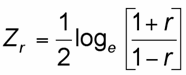
The Z-transformation is useful for computing the average effect over several studies (meta-analysis) because the more the r value of a population is away from zero, the more the distribution of r values sampled from that population becomes skewed; the Z-transformation helps normalize the distribution.
Table 2. Summary of effect size (r) statistics for the attractiveness of averageness, symmetry, and sexual dimorphism in the face. All calculations were conducted on Zr’s.(1) |
||||
|
Attractiveness and averageness |
Attractiveness and symmetry |
Attractiveness and femininity |
Attractiveness and masculinity |
All faces |
|
|
|
|
Mean effect size (ES) |
0.52 |
0.25 |
0.64 |
−0.12 |
Standard deviation |
0.41 |
0.34 |
0.39 |
0.55 |
95% Confidence interval |
0.42–0.61 |
0.16–0.33 |
0.51–0.74 |
−0.35–0.14 |
Number of studies |
20 |
23 |
10 |
15 |
Number of face samples |
45 |
63 |
18 |
22 |
Mean weighted ES (by N faces) |
0.54 |
0.23 |
0.61 |
0.16
|
Normal faces only |
|
|
|
|
Mean ES |
0.40 |
0.23 |
0.64 |
0.35 |
Standard deviation |
0.33 |
0.23 |
0.45 |
0.20 |
95% Confidence interval |
0.29–0.51 |
0.17–0.30 |
0.41–79 |
0.23–0.45 |
Number of distinct face samples |
27 |
42 |
9 |
10 |
Mean weighted ES (by N faces) |
0.40 |
0.24 |
0.58 |
0.27 |
Let us consider two studies where facial femininity was manipulated on a computer to see what effect it had on the attractiveness ratings.
In the following manipulation by Rhodes et al. (2000), the femininity of the average face on the left has been exaggerated by 50% on the right, but neither of these faces was rated as better looking.
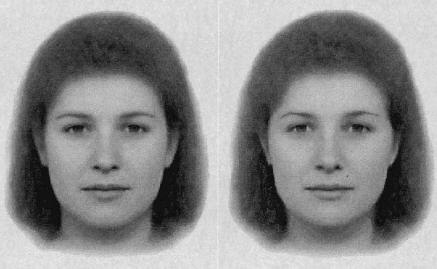
Fig 1. From Rhodes et al. (2000).
Rhodes et al. (2000) then came up with the following series of manipulations of an average face, and in both cases, feminine exaggeration corresponded to highest attractiveness ratings (raters were 48 white males and 48 white females).
The highest attractiveness rating in the two series below was for 36% feminine exaggeration in women. Women assigned the highest attractiveness rating to a more feminine face than men (42% exaggeration vs. 29% exaggeration). The most attractive Chinese face corresponded to a greater feminine exaggeration (52% vs. 19%) than the most attractive white face. Higher attractiveness ratings were also assigned to somewhat more feminized male faces.
Click the two images below for larger views.
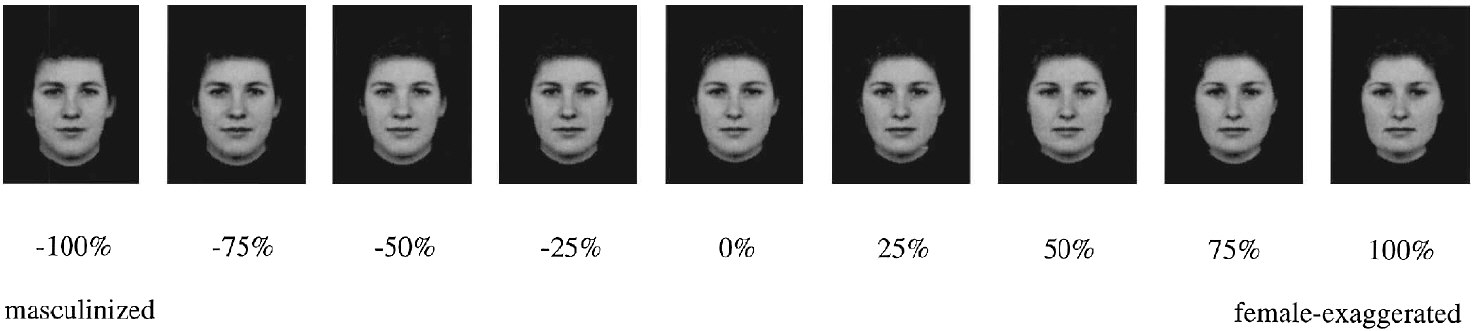
Fig 2. Manipulation of an average white female face. From Rhodes et al. (2000).
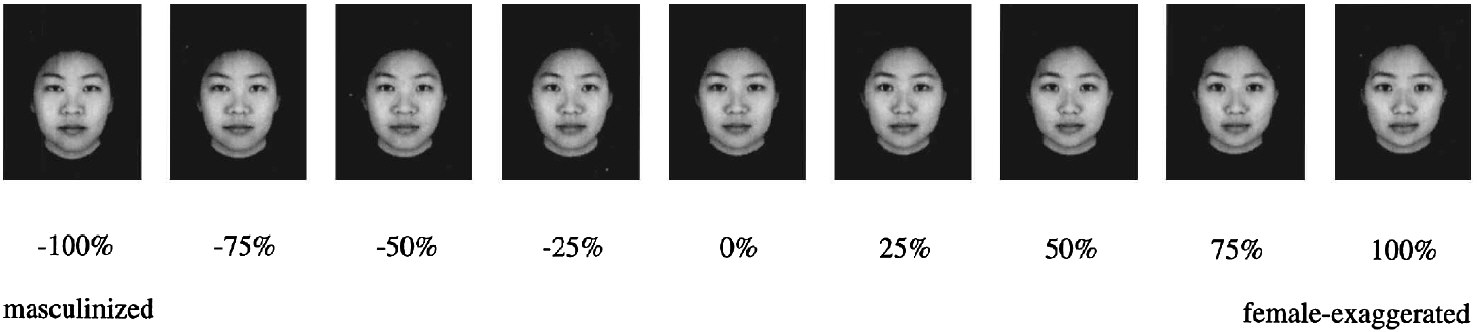
Fig 3. Manipulation of an average Chinese female face. From Rhodes et al. (2000).
Fig 4 shows average (composite) white and Japanese faces used by Perrett et al. (1998).
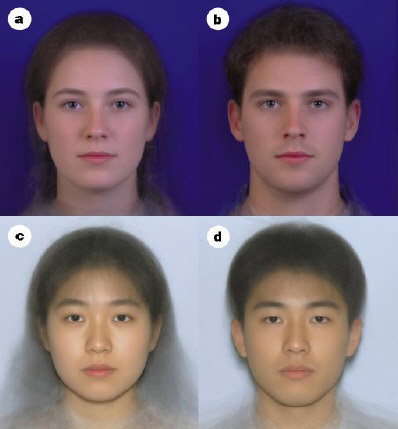
Fig 4. Composite white and Japanese faces. From Perrett et al. (1998).
Fig 5 shows average (composite) white and Japanese faces that were 50% feminized (left) and 50% masculinized (right) by Perrett et al. (1998). Raters were shown faces that continuously ranged between the two extremes and asked to pick the most attractive face.
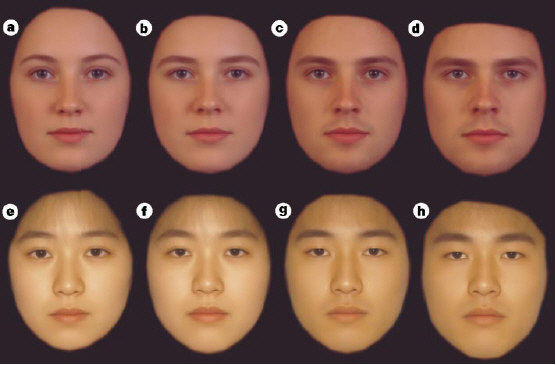
Fig 5. Feminized and masculinized white and Japanese faces. From Perrett et al. (1998).
Fig 6 shows that more feminine faces were preferred for both men and women.
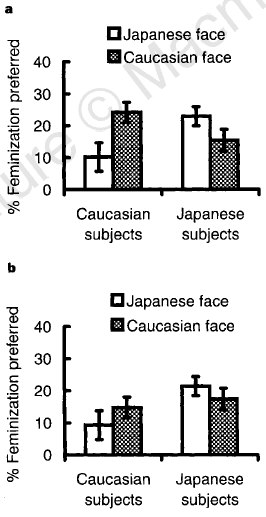
Fig 6. The effect of feminization of face shape on judgments of female and male attractiveness. a, Female stimuli; b, male stimuli. Overall, subjects preferred a feminine face shape to an average shape both within and between populations. The degree of feminization preferred was greater within than between populations for female faces. From Perrett et al. (1998).
There are newer studies that have also shown the importance of femininity to attractiveness in women, as assessed by both men and women. One of these studies showing a higher attractiveness rating of more feminine faces in women has been mentioned at this site previously. Another such study is briefly described below.
In a study investigating the relation between voice pitch, femininity of face and attractiveness rating, women with a more feminine voice (high pitch) also had a more feminine face and were rated as better looking (Fig 7).(2)
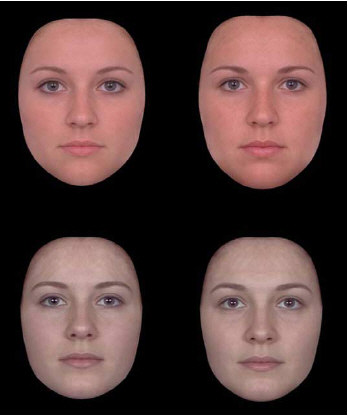
Fig 7. Facial prototypes constructed from women with high- and low-pitched voices. Top row: faces from Canadian sample; bottom row: faces from UK sample; left column: faces constructed from women with high-pitched voices; right column: faces constructed from women with low-pitched voices.(2)
And, one should not forget the body, too. Assume that the following 12 series of images were shown to a large number of people selected at random, and the people were asked to pick the most attractive woman (labeled 1 to 12, starting from top). Which one would it be?
All images shown below can be clicked for larger versions.
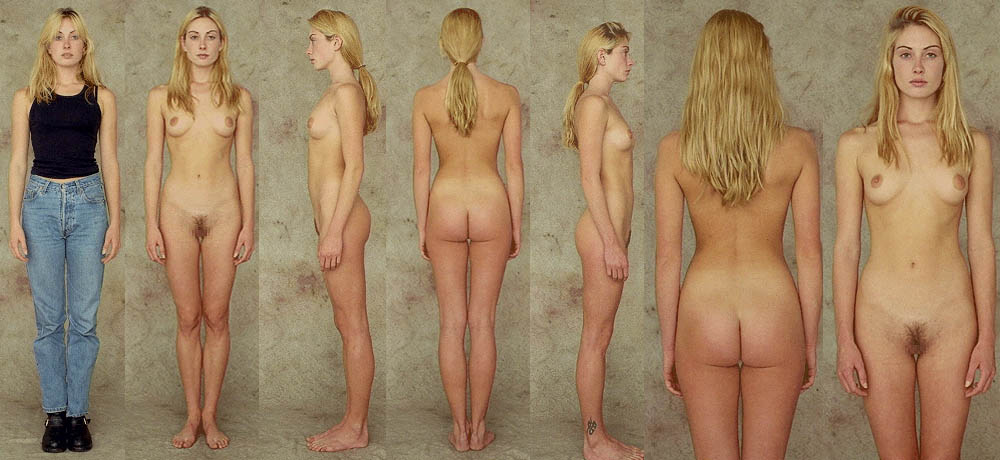
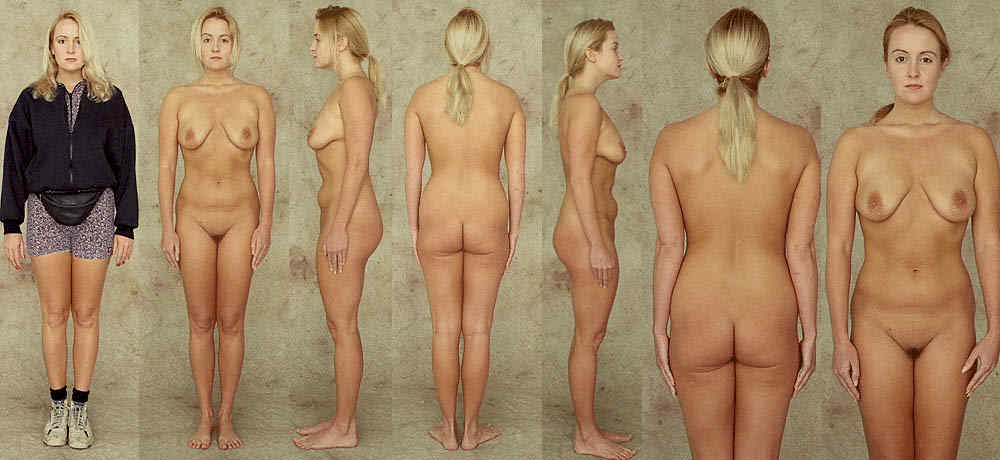
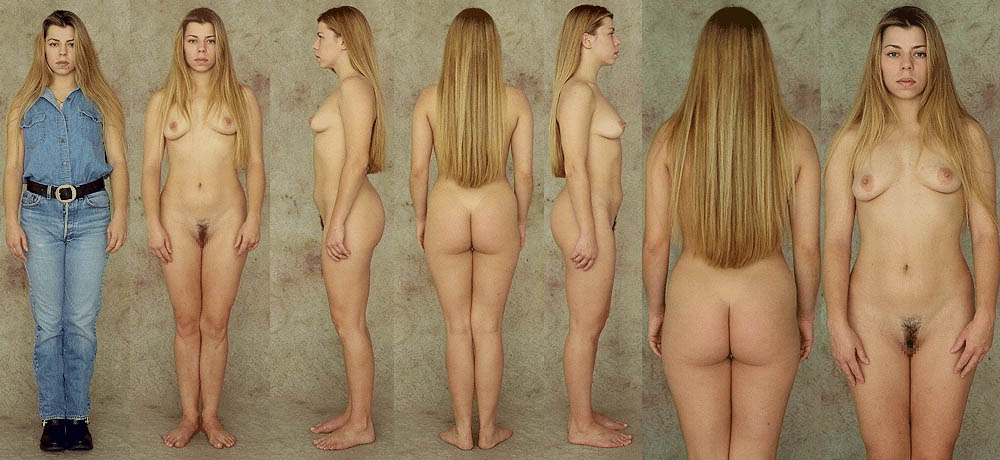
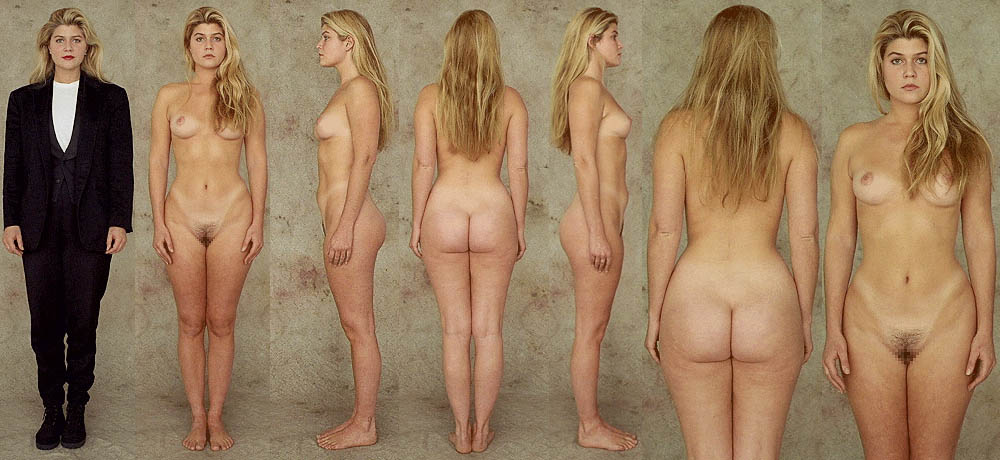
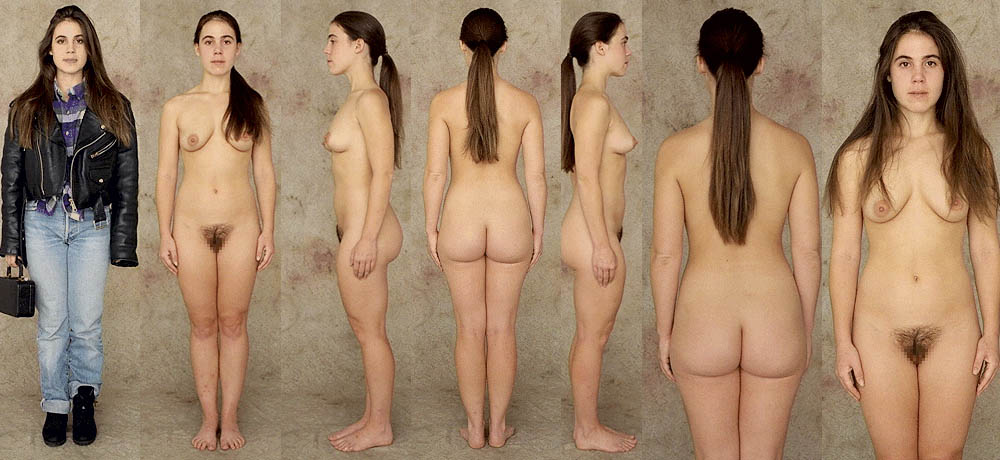
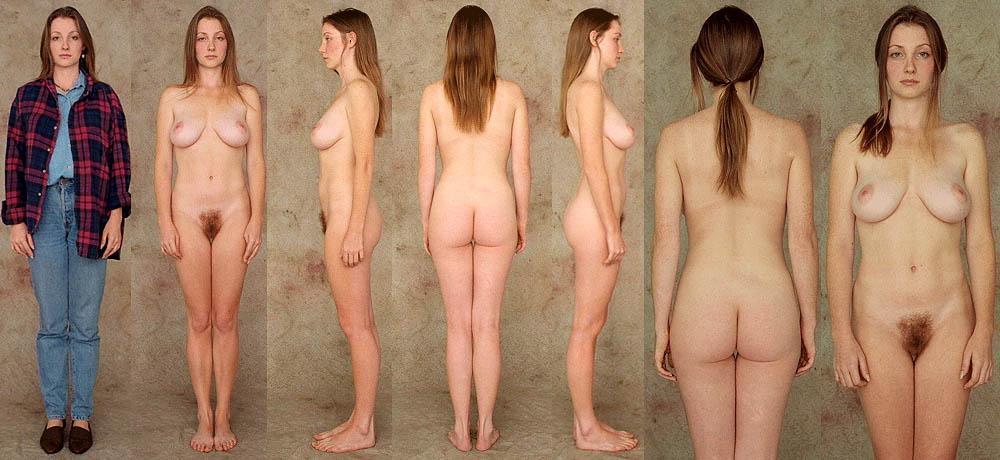
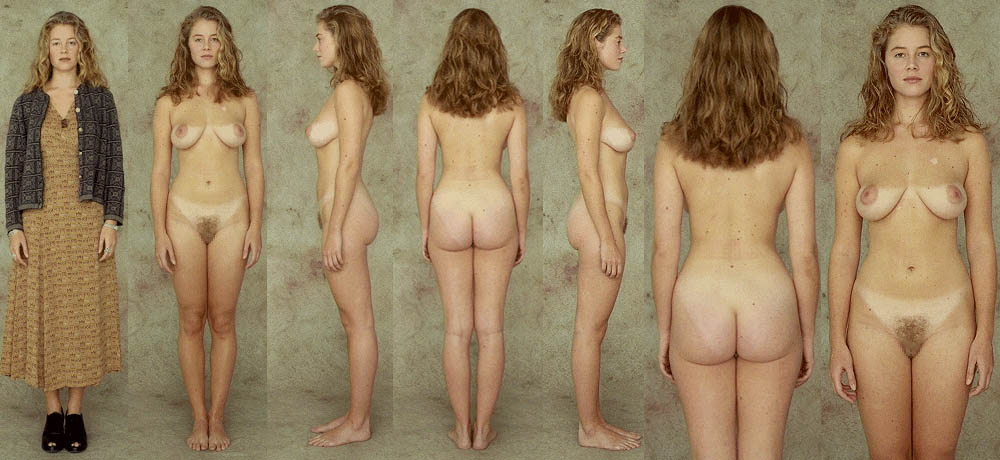
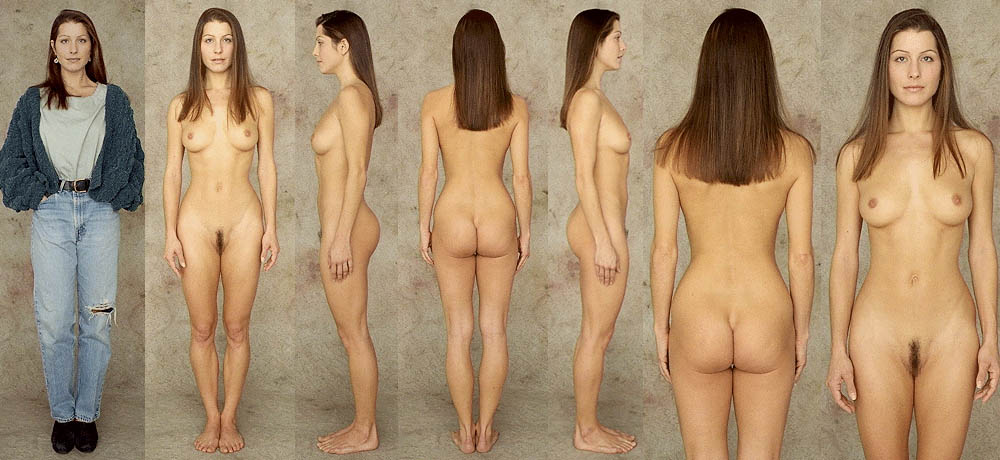
Most people would undoubtedly pick woman number 7 as the most attractive. Now, which of these 12 women also happens to be the most feminine?
More can be said about the importance of femininity to beauty in women, but this will be in future additions to this site.
References
- Rhodes, G., The evolutionary psychology of facial beauty, Annu Rev Psychol, 57, 199 (2006).
- Feinberg, D. R., Jones, B. C., DeBruine, L. M., Moore, F. R., Smith, M. J. L., Cornwell, R. E., Tiddeman, B. P., Boothroyd, L. G., and Perrett, D. I., The voice and face of woman: one ornament that signals quality?, Evol Hum Behav, 25, 398 (2005).
List of all studies used by Gillian Rhodes to examine the relationship between masculinity-femininity and facial attractiveness in men and women:
- Bruce V, Burton A, Dench N. 1994. What's distinctive about a distinctive face? Q. J. Exp. Psychol. A. 47A: 119 - 41
Cunningham MR, Barbee AP, Pike CL. 1990. - What do women want? Facialmetric assessment of multiple motives in the perception of male facial physical attractiveness. J. Pers. Soc. Psychol. 59: 61 - 72.
- Dunkle JH, Francis PL. 1990. The role of facial masculinity/femininity in the attribution of homosexuality. Sex Roles 23: 157 - 67.
- Ishi H, Gyoba J, Kamachi M, Mukaida S, Akamatsu S. 2004. Analyses of facial attractiveness on feminised and juvenilised faces. Perception 33: 135-45.
- Johnston VS, Franklin M. 1993. Is beauty in the eye of the beholder? Ethol. Sociobiol. 14: 183 - 99.
- Johnston VS, Hagel R, Franklin M, Fink B, Grammer K. 2001. Male facial attractiveness: evidence for hormone-mediated adaptive design. Evol. Hum. Behav. 22: 251 - 67.
- Koehler N, Simmons LW, Rhodes G, Peters M. 2004. The relationship between sexual dimorphism in human faces and fluctuating asymmetry. Proc. R. Soc. Ser. B - Bio. (Suppl.) 271: S233 - S6.
- Little AC, Burt DM, Penton-Voak IS, Perrett DI. 2001. Self-perceived attractiveness influences human female preferences for sexual dimorphism and symmetry in male faces. Proc. R. Soc. Ser. B - Bio. 268: 39-44.
- Little AC, Hancock PJB. 2002. The role of masculinity and distinctiveness in judgments of human male facial attractiveness. Br. J. Psychol. 93: 451-64.
- Neave N, Laing S, Fink B, Manning JT. 2003. Second to fourth digit ratio, testosterone and perceived male dominance. Proc. R. Soc. Ser. B - Bio. 270: 2167-72.
- O'Toole AJ, Deffenbacher KA, Valentin D, McKee K, Huff D, Abdi H. 1998. The perception of face gender: the role of stimulus structure in recognition and classification. Mem. Cognit. 26: 146-60.
- Penton-Voak IS, Jones BC, Little AC, Baker S, Tiddeman B, et al.2001. Symmetry, sexual dimorphism in facial proportions and male facial attractiveness. Proc. R. Soc. Ser. B - Bio. 268: 1617-23.
- Perrett DI, Lee KJ, Penton-Voak I, Rowland D, Yoshikawa S, et al. 1998. Effects of sexual dimorphism on facial attractiveness. Nature 394: 884-7.
- Rhodes G, Chan J, Zebrowitz LA, Simmons LW. 2003. Does sexual dimorphism in human faces signal health? Proc. R. Soc. Ser. B - Bio. 270: S93-S5.
- Rhodes G, Hickford C, Jeffery L. 2000. Sex-typicality and attractiveness: are supermale and superfemale faces super-attractive. Br. J. Psychol. 91: 125-40.
- Scheib JE, Gangestad SW, Thornhill R. 1999. Facial attractiveness, symmetry and cues of good genes. Proc. R. Soc. Ser. B - Bio. 266: 1913-7.
- Swaddle JP, Reierson GW. 2002. Testosterone increases perceived dominance but not attractiveness in human males. Proc. R. Soc. Ser. B - Bio. 269: 2285-9
Comments
I think #8 and #4 are more feminine than #7, but that's me.
Anonymous Visitor: Compared to women 4 and 8, woman 7 has relatively larger buttocks and breasts, a relatively smaller rib cage and a more feminine face. Woman 7 also has more feminine feet than woman 8 and a more slender skeletal build than woman 4, which tends to go with greater femininity. Therefore, between these three women, woman 7 is the most feminine.
I would say that no. 1 is the most attractive, followed by number 8. Number 7 has oblong wall-eyed boobs and a tired, droopy face (she looks like someone's mother) and is also freckly. I chose 1 and 8 because they have T and A but their Ts aren't sprawly or out of control. Both have nicely shaped breasts, though 8's are nicer. They also have a decent (1) to good (8)waist-to-hip ratio. They also have smooth, clear skin, which cannot be said of 7. Both have fine facial features, but 1's are a bit softer, but 8 has very nice shiny hair. Both also groom their pubes. I'm not a fan of the thundermuff. I think 8 has the best body but I prefer 1's face, and I feel the face is the most important thing. I've agreed with everything you've said on your site up to this point; I do not think 7 is obviously the most attractive woman of this line-up. I am a woman and I would not want to trade places with her.
Poopsicle: There is broad but not universal agreement in the general population as to what constitutes attractiveness. Your preference for the physiques of #1 and #8 over the physique of #7 is unlikely to be that of the general public, especially heterosexual males, since #7 is more feminine and also adequately feminine. Pubic hair is not an issue. Face details are not relevant since the pictures are small and not clear enough to assess the extent of freckles and how droopy the face is, though it appears that #7 does not have a very attractive face. #7 does not have the physique of a woman that has given birth. Your comment about the face being most important suggests that you have placed a strong emphasis on the faces of these women, whereas faces are discussed prior to the image series, and it is the bodies of these women that need to be evaluated.
Women #6 is the best looking.
Hello
Wouldn't it be better or to compare individual body parts rather than the whole package? Woman 4 seems to have the largest (relative) hips compared to woman 7, yet as you mantioned, woman 7 has a more slender skeletal build.
To compare women, one will have to compare individual parts, but it all needs to be seen in reference to whole body appearance since sex hormones only partly shape the physique and factors not contributing to sexual dimorphism could contribute to a masculine or feminine appearance of an individual body part.
I actually prefer number 1 also. She is just hot.
No, the author is right. #7 is the most attractive.
hi,
I have a face that is if to be compared on the line up you provided would be most like the one with u exaggeration towards female features....what was that face rated? plain? how attractive is it...I am a Mediterranean, it seems females there are more feminine looking than preferred in the west...but I am living in USA.
Layla: I am not sure what level of feminine exaggeration in Fig. 2 your face comes closest to, but it appears to be 75% in your comment. The most attractive ratings were for faces with 25-50% feminine exaggeration. 75% feminine exaggeration was still rated as reasonably attractive. I do not know what you mean by women in the Mediterranean region looking more feminine than what is preferred in the West.
Personally speaking, I find woman # 1 to be the most sexually and aesthetically appealing with reference towards both her body and face alike.
Despite your (unsubstantiated but opiniated) claim, I personally feel #7 is "undoubtedly" the most attractive of the group.
Just curious, what is the overall motive of this site? To expose the gay fashionista? To make sure men understand what they should be attracted to ? Or to get some plus (I'm sorry, feminine) models jobs?
What do you mean despite my claim? I, too, find woman #7 to have the best-looking physique among the bunch. Read the FAQ to understand this site’s purpose. The site’s purpose is not to make sure men understand what they should be attracted to. Men already know what they are attracted to, but those misled by the use of airbrushing, breast implants and posing tricks into believing that some masculinized models and beauty pageant contestants are feminine women need an education. As far as getting feminine women proper fashion modeling jobs goes, this is not happening as long as the fashion business remains gay-dominated. One will have to set up an alternative fashion industry, but a mainstream outlet for feminine beauty appreciation (not this site) needs to be set up first.
It's interesting how beautiful the buttocks are on the women above, much better than any fashion model. This is the body part women seem to worry about most, but it's generally more beautiful on the average woman than the supermodel.
I think 1 and 8 are the over all best looking females. If I had to look like one of the 12 women, I'd pick one of those.
I'll evaluate based on visual to emotional judgements. FYI, I'm young male from USA.
1) Nice from the back. Little flat breasts. Face looks like she has an attitude.
2) Droopy T&A. Wide shoulders. Face looks like a "nice person"
3) Uneven small breasts. Lower face is not attractive.
4) Same breasts as #1, but hips are too wide. Face looks average
5) Nipples don't line up. Face is not attractive.Masculine?
6) Nice breasts. Ok bottom. Feminine attractive face.
7) Nice breasts. Bottom little wide compared to shoulders. Ok face.
8) Long body. The space near the top of the butt looks weird. Face looks above average. unfair smiling.
9) Nice breasts. Weight shows on body. Face looks "rural"
10) Too skinny. Face not attractive. eyebrows too high in the middle
11) Average overall. Face looks "angry"
12) Nice breasts. Hips little wide near bottom. Face looks above average.
Conclusion: no one is highly attractive.
In my experience, here is the breakdown of female attractiveness:
Face - 70% (eyes are the focal point)
Breasts - 30%
Butt - 20%
If someone has a beautiful face, then that person can be considered attractive despite lack of feminine body.
Face is what generates deep emotions from guys. Body is only for sexual attraction.
Breasts: "perky" and "fullness" over size.
Butt: "roundness" over pyramid shape or flatness.
Tan helps a lot.
Most guys are NOT attractive to super skinny supermodels. Guys only date supermodels for status not for looks.
Guys like HOT females in the sack. But the most ideal for relationship would be glamour/beauty females.
There needs to be a better control. If we want to discern on body type, then Face should be covered, everyone should have same color of skin. Photos should be calibrated for color. It looks like the background in the photograph varies a lot so some women above are given "redish" skin tones which is not attractive as a more ideal skin tone for some photos due to light exposure.
The leading fashion industry has always tried to be different than the norm. They do not signify society's ideal. They signify what is unusual hoping that it is uncommon in a positive way. Just like the ridiculous stuff displayed on runways by models doesn't symbolize what people really want to wear.
This is all part of being "trendy". Masculine face worn by models will go away soon replace by something else, just like whatever that was fasionable in the 1970s is defnitely NOT fashionable today just because it once was.
I don't think the fashion industry is influencing the girls to look more masculine. That is against human nature. In fact, the opposite is happening with teenagers nowadays look more slutty than ever before. In high school, the popular girls are still the most femine girls not lesbian female jocks.
Fashionistas like Versace stands to fame by being unusual. But people buy Versace for quality and fit....most of Versace's customers get custom made clothes. People in fame business do anything to get attention and they certainly play the extreme characters just like atheletes play certain parts, actors play certain parts. But in private lives as human, you can't ignore the natural wiring which has chosen attractive people as mates more so than unattractive people over thousands of years.
I predict that in 20-30 years in time, due to rising power of East Asia, Asian beauty (younger, slimer, cuter) will dominate over current gay fashion ideals. Then the masculine looks will be out of style.
Random viewer: With respect to the nude women, judgments based on assumed personality characteristics are not relevant here, and neither is the face, which you assign the greatest value. The women’s faces are not shown clearly enough to be rated. In a scientific study of the attractiveness of physiques, the faces would be covered, the backgrounds would be the same, etc., but displaying the pictures above is not part of a scientific study.
Gay fashion designers do not chose their models to “signify what is unusual hoping that it is uncommon in a positive way,” but because they find them aesthetically appealing. Nobody is arguing that “the fashion industry is influencing the girls to look more masculine;” its influence is in the form of increasing the desirability of skinniness in a number of girls and women. It is unlikely that the fashion norm will shift toward East Asians eventually; there are only two East Asian women among the top-50 high-fashion models (total sample size of 60 because some women tied with the same ranking) currently ranked at models.com. Norms are not a straightforward result of cultural domination. There was a time when Roman soldiers brought in Northern European slave women, and notwithstanding their slave status, the men lusted after them, and the women were envious and tried to make themselves more Nordic-looking. The skinny and masculine norm among high-fashion models is not changing as long as the fashion business is dominated by homosexual men, which is not to say that one couldn’t come up with an alternative fashion industry.
I would go with 8 & 1. 76531 are ok.
I don't think this shows anything except that I prefer younger, fitter women, being 20 myself.
It makes sense to me that femininity would be tied to beauty though, but as simply true by definition. Hell, why would I want my woman to look like a man?
The thing that I'm a bit confused on is this sense of being more feminine. Having, say, larger breasts means you have more of a feminine characteristic, but I'm don't think I'm comfortable saying that just because they have more of x that they are then more feminine. Recognize the slight twist?
For demonstration sake, an example of a nude model I find very attractive (albeit a bit skinny):
Erik,
I prefer #8, and nothing you say about her body or face type will change that. #1 would be my second choice.
I do not understand why you're all "up in arms" about what women look like in magazines. It really sounds like you've got an agenda that you're trying to enforce on others. Oh, and I just love how you equate people's sexual preferences to their selection of female shapes!
I prefer the athletic, slightly hourglass female form. So does a lesbian friend of mine. What does that tell you?
Everyone has their own likes and dislikes in the body shapes and facial features of others.
If you want a true measure of whether people prefer "your" ideal female body shape, why don't you publish your own magazine or web site with "your" choice of female body types, and then we'll see how many people go to your site or buy your publication over others that contain "masculine" women...
I go to websites (MET-ART, Karups, etc.) based on the types of women I LIKE TO LOOK AT -- you seem to prefer the playboy body type with a very soft face. Those are simply our individual preferences.
It sounds like you want there to be JUST ONE model in every magazine -- YOUR favorite body and face type. Boy, that would be boring. "Variety is the spice of life".
The bottom line is that people buy magazines and go to web sites that present the style of women that they prefer. If the type of women shown at Victoria's Secret was "wrong" as you seem to think, then why are they selling so much lingerie?
PS -- I don't care how many references you site, or how many studies you cite. You're still simply pushing your own agenda. Perhaps you should see a psychologist.
Also look at the 95% confidence limits. people DO have a range of what they prefer, even just in face types!
The standard deviation is half or more per rating, too, which says that the data has a lot of scatter.
Gee... I'd be willing to bet that you are the same Erik Holland that wrote these homophobic pieces:
http://www.alligator.org/edit/issues/00-fall/000921/c02column21.htm
and
http://alligator.org/edit/issues/00-fall/000926/c01column26.htm
Am I right?
Kyle-
Wow, you just pwned him.
It's kind of funny how he feels justified in promoting a beauty standard which is even more impossible to achieve than the current beauty standard in fashion modelling. Way to go! Corsets are so passe, Erik, so passe.
Kyle Morgan: This site does not exist to change people’s preferences, including yours. This entry is pointing out the central tendency of the masculinity-femininity of face shape preferred by people, and regardless of your preferences, the fact remains that people strongly and overwhelmingly prefer above average femininity in the face shape of women, as the data cited above show, notwithstanding individual variation in likes and dislikes. The physique pictures are just an addendum/trivial addition, not the meat of this entry.
Of course, I have an agendum as far as this website is concerned, and I have explicitly stated it on the home page, namely the promotion of feminine beauty among models and beauty pageant contestants. This agendum is not being forced on others. You are under no obligation to browse this site and agree with it. I have never argued that I would like to see feminine and attractive women replace all other types of models and beauty pageant contestants. I believe that there should be a competing feminine beauty standard in the limelight. Setting up this competing standard will not be an easy task and will take a while; this site is merely an educational resource that will go toward bringing more feminine and attractive women in the limelight in mainstream settings, not nude modeling. An educational resource is poorly described as an “up in arms” approach. When there is a feminine beauty alternative in the limelight, it will become clear what most people prefer.
Sexual orientation is obviously related to preferred shape. For instance, “-R” above elsewhere identified herself as a lesbian with a preference for masculinized women and shares her preference with your lesbian friend. The person posting as “Jordan” left a comment under a different [male name] alias where he described his preference for skinny women but did not describe his sexual orientation in spite of my asking him. Lifetime-exclusive heterosexual individuals are the least likely to prefer masculinization in the looks of women, but this does not imply that the subtlety of sexual preferences can be precisely assessed by preferred shape.
No, I don’t prefer Playboy centerfold types.
I have already explained why homosexual fashion designers can get away with using masculinized models to sell clothing items notwithstanding discordant preferences on the part of most buyers, namely their domination of the fashion business. There are hardly any comparable alternatives, and the public will surely not reduce its consumption of designer clothing or other clothing items because the models used to market them are typically unattractive from the perspective of most people.
Your comment about a range of preferences is uncalled for since I prepared the entry above and am obviously aware of the variability of preferences in the population, but it is clear that with respect to a preference pertaining to masculinity-femininity, the scatter is overwhelmingly on the feminine side of average.
Citing two articles written by me as a student seven years ago does nothing to undermine the arguments on this page or this site. The first article expressed opposition to hate crimes legislation and there is nothing “homophobic” about it. The allegedly “homophobic” reference in it is the sexual abuse and murder of a 13-year-old boy, Jesse Dirkhising, by a male homosexual couple, which was ignored by the mainstream media, in contrast to the drug-fueled robbery-cum-beating of Matthew Shepard by petty criminals, one a bisexual, which eventually led to Shepard’s death, making “martyr Shepard” a victim of a horrendous “hate crime.” I stand by what I wrote. On the other hand, the second article was an angry piece defending the Boy Scouts, which I wrote at a time when I knew little about homosexuality. I am embarrassed that I wrote this article; there are things in it that are incorrect. I do not stand by this article, but I will say this, namely that there was a passage in the original submission that the editors did not publish, which, to my chagrin, made the article look like a conspiracy, and I could not subsequently clarify it because I was banned from the paper. The omitted passage argued against a conspiracy. Anyway, the only part of the second article that has anything to do with this site is the domination of the fashion business by homosexual men, which is a fact. If you still hold either article against me as far as this site is concerned, all I have to say is get lost!
8D: Corsets will not render your physique normally feminine. They make the waist look cartoonishly small, and do nothing about a large rib cage, even if the lower ribs are surgically removed. I am not promoting a feminine beauty standard because of the impossibility of achieving it but because of its aesthetic appeal to myself and many others and also its utility in counteracting the negative impact of the high status of high-fashion models. Besides, if you wanted a standard for high-fashion modeling that would convey both exclusivity and would also be something that cannot be acquired by negative health behaviors, then feminine beauty would be the way to go.
Erik, I appreciate the candor of your reply.
By the way, I am heterosexual, if it matters... and while I don't prefer the appearance of most fashion models, I do prefer the athletic-build on women, in person and in pictures. I wonder how much of that is learned and how much of the preferences are "genetic", if you will.
Erik,
I think you should do a "study" of hetero vs homosexual porn sites.
Also - inquiring minds want to know: How many times did you snap a root while "researching"?
Best,
D. Gray
Erik,
I've got to hand it to you!
The guy puts his spank bank online & calls it research. F'ing genius, man.
You've inspired me to do a study of what I believe is a general decline in labia tautness amongst the modern female population...and since my schlong's diameter has remained remarkably constant throughout the years, I think it is the perfect vehicle with which to measure the labial elasticity.
Is it me or do more & more chicks out there have cooches like mayonnaise jars? I'm going to find out!
Best,
Ron
Kyle Morgan: The social environment obviously plays a role in shaping what appeals to people, but its impact varies across individuals. The example of a number of girls and women ending up believing that attractiveness lies in the typical skinniness of high-fashion models is a prominent example of the influence of the social environment within this site. For additional examples, see this entry addressing “cultural differences and beauty” and the issue of obesity that follows it.
Dorian Gray / Ron / The Hedgehog: Do not leave silly comments, let alone comments completely unrelated to an entry.
Erik, you are doing nothing but taking women backwards. Did you ever think that maybe a man LOVES his woman and doesn't care if her fucking ribs are small enough? or does it make him gay to be attracted to her based on her large ribs?
this is the most arbitrary conclusion ever.
Kyle Morgan is right. Beauty is opinion and personal preference. Just because a man likes athletic women does not make him gay or anything near it.
On top of that, 'feminine and attractive" is not definable. And just because women don't fit your specific type doesn't make them unnattractive. It sure as hell doesn't make them un-feminine either, cuz they're WOMEN. That's what women look like.
Would it be possible to post the entire series of female line-up photos? I have been searching for a photo study like this for an animation database. I found this on an image hunt.
Interesting site.
Pisham: What do you mean I am “taking women backwards”? I agree that a man in love with a woman doesn’t give a rat’s about her rib cage, and being attracted to a woman with a large rib cage doesn’t imply anything about the sexual orientation of a man. Yes, people do have their opinions and personal preferences regarding beauty, but in most cases these are similar. I also agree that being attracted to an athletic-looking woman does not imply that a man is gay or close. I disagree that “feminine and attractive” is not definable. Femininity can be assessed in detail (see the feminine vs. masculine page), and the numerical data above tell us about various correlates of beauty; more here. The latter does not imply that one could define feminine beauty with high precision, but it is not undefinable. Of course, women that I am not attracted to are not necessarily unattractive to others, and I have not implied that these women must be un-feminine.
DAGraphix: More of the line-up photos can be obtained here.
femininity may exist but to imply from that that iut is a correlate of beauty and so beauty exists is an assumption because one may agree someone looks or is feminine but it doesnt necesserily follow tjhat they believe that person looks beautifull, Beauty doesnt exist its merely an illusion.
Joe: Are most humans under an illusion that beauty exists? What a remarkable illusion in that most see the same illusion (e.g., Table 2 above) and this illusion can be quantified to some extent and described anatomically in some detail! Anyway, this site does not delve into philosophy.
I'd fuck all those chicks!
The first one is feintley the most attractive by far outof all of them.
belly dance costume | clothing plus size woman | clothing plus size womens | costume rental | dance costume | dress plus size wedding | halloween costume | lingerie plus size | mardi gras costume | pirate costume | plus size swim wear | renaissance costume
Most atracttive girls are 1 and 8.
I think #1 is the most attractive and #7 could be second easily. Another thing that would make adifference would be which one has the most soothing voice.
I feel that many feel the most attractive would be 1 and 8 based not on how feminine but on how physically fit. A woman that looks physically fit will automatically look the most attractive. Different ethnic groups feel that there are different indications of health and so different variations of attractiveness.
Also, the woman deemed as "feminine" were evaluated at my local high school and college as "unattractive" in general while some "masculine" woman were ranked higher. I think the "masculine" woman are more attractive because they are healthier and not for being masculine.
#7 No competition.
Here's a trick for FireFox users:
Open two enlarged images for comparison on different Tabs (Mouse Wheel Click)
and switch rapidly between them with Control + (Page UP & DOWN)
It's amusing. For instance:
Try that with #1 & #7
Her boobs seem to grow! LOL =)
And you can tell apart very subtle differences, like the position of the shoulders (#1 is more "martial") etc.
BTW, #8 has manly shaped buttocks (rounded)
It's like the buttocks of a man hanging from a woman's hips.
EW... xp
BEAUTIFUL AND SEXY ARE TWO DIFFERENT THINGS TO WOMEN.
MOST WOMEN FIND MORE FEMININE WOMEN MORE BEAUTIFUL.
MOST WOMEN FIND MORE ANDROGYNOUS WOMEN SEXIER.
Straight men do not understand this because to straight men, beautiful = sexy.
WHAT KIND OF WOMAN FIND OTHER WOMAN SEXY AT ALL?
Even if I would it would be in terms of wanting some sexy traits for myself,and those would never be androgynous.
"WHAT KIND OF WOMAN FIND OTHER WOMAN SEXY AT ALL?"
Arousal and attraction are two different things. Most women are attracted primarily or exclusively to men, yet even women who who have no desire for actual sexual contact with other women can still be aroused, either consciously or unconsciously, by looking at women.
Most women are primarily or exclusively attracted to masculinity, so most women feel subconscious, subliminal arousal when they look at attractive androgynous women, but not when they look at attractive feminine women.
Whipped Honey :
I have something to say about that, I posted my comment in
Karl “models have skinny bones” Lagerfeld rejects three models for being too skinny! entry, if you are interested.
You say most will "undoubtedly" pick #7. I think #1 and #8 have (by far) the most attractive bodies, and most agree that #7 isn't the best. Yet instead of realizing that few of *your* readers prefer her, you're using excuses and reasons as to why someone is biased or incorrect.
It makes me wonder what research you've used when even your readers/commenters aren't agreeing with it.
Bored surfer: Several thousand people have read this article and the vast majority of them have not left a comment. Hence it doesn't follow that most disagree that #7 has the best looking physique. As noted above, a reader who disagreed, “-R”, elsewhere identified herself as a lesbian with a preference for masculinized women and the person posting as “Jordan” left a comment under a different [male name] alias where he described his preference for skinny women but did not describe his sexual orientation in spite of my asking him. People who disagree may be more likely to leave a comment.
Whipped honey: Slight masculinization is a correlate of the sexiness of women to men. Hetersoexual men do not necessarily confound beauty with sexiness. The assertion that "most women feel subconscious, subliminal arousal when they look at attractive androgynous women" has not been proven. I will respond to your detailed argument in this regard where it appears.
Long time reader, first time poster... No one thinks #12 is a hottie? It could be her enhanced sense of fashion and sense of buying clothes that fit her. Or it could be her ever slightly so sly smirk. Every one else looks like their mothers just died. She has the best all around.
Number 8 IMO has the better body, at least from the front, mainly 'cause I don't like saggy bosums (I prefer "perky" to "large and saggy"), slender waist and rounded hips. I also prefer dark hair, so that biases me some, since hair isn't really part of the analysis I guess (I don't like women to have exceptionally short hair). But, yes, her face is manly, her bum isn't very rounded but I also don't like saggy butts so I don't mind that much.
Number 7 has a much nicer face, better bum, and a decent figure thuogh her waist is, IMO, somewhat robust despite being (good) noticably narrower than her rounded hips. She has the best face of the bunch and seems from appearance (poor judge I know) that she'd be nice to talk to.
From the front, #8 has the better figure, though. Not as much from the sides or back, admittedly.
Number 1 is ok and I can see why people like her, but her face seems somewhat stern, plus her figure isn't as good as #7 & #8. Perhaps it's because gentlemen prefer golden blondes. It would have been interesting to see people's responses if her hair was a different colour (impossible now 'cause they've made their choice and may claim hair colour has nothing to do with it).
"Several thousand people have read this article and the vast majority of them have not left a comment. Hence it doesn’t follow that most disagree that #7 has the best looking physique."
This is such flawed logic. I disagree and was not going to comment until this was said.
They all look great! You just have to get the peel off ...
I agree Number 1 and 8 are most attractive. How's that for statistics!
I assume these are old photos. The high waisted jeans made me laugh and took me back to my childhood circa late 80's early nineties. No.1 looks a bit like a cross between Meryl Streep and Faye Dunaway. She's a bonny lassie probably a disgruntled dirvorcee in her 40's now. No.3 looks like Mariah Carey's sister(if she has one).
No.7 does look like a housewife (perhaps trying for a family) and actually looks better naked than she does clothed. No.12 has a nice 'rack' as does no.7. You would have to get them naked to assess their 'attractiveness' as I would have ducked no.7 on account of the appaulingly mumsy outfit she had on (can't get an idea of the goods love). No.4 looks like a cross between Alison Moyet and 80's Daryl Hall. No.11 looks very pissed off. Also white jeans, bumbags and basketball shoes with visable black socks..it was acceptable in the ei-ties..it was acceptable at the time (but why?)..
#1 and #8 would look really nice with a brazilian wax
"Several thousand people have read this article and the vast majority of them have not left a comment. Hence it doesn’t follow that most disagree that #7 has the best looking physique."
whats wrong with you, btw i prefer 1. the most clearly, wouldnt have bothered to comment, if not reading the above,
ps pathetic site
As far as body goes, Number 8 looks pretty hot to me and Number 1 seems overall most desirable (okay, so I can't help looking at her face as well; I'm only human).
Their breasts are not so full, but one has to be naive to imagine that big breasts will contain more milk than small ones. Okay, so there are lots of naive people in the world, is that my fault?
Number 7 is a bit saggy und baggy in several places. What will she be like in another ten years? One has to think about these things, you know...
Anyway, keep up the good work, Erik.
But you know, everyone is deficient in some aspect or other of their genetic make-up; so even though we might judge someone as beautiful by the standards of the greater group of humans in which we live and rub shoulders with, when it comes down to the personal level of whom should we mate with, we often look to those who complement our deficiencies to some extent. For example, some men have lower than average levels of masculine genes and may be attracted to women with a bit extra masculine genes to make up the difference, just in case their DNA should mix and produce offspring. Conversely, we may want to preserve in our offspring a particular desirable trait which we have in abundance and are of proud of (tallness, intelligence, facial beauty, etc); we might in that case seek a mate with similar characteristics in those areas. All of this can take place consciously and unconsciously and also physiologically, when people check each other out and then get the hots for each other, as it were. Evidence of this interesting process of genetic augmentation and complementation tends to get averaged out and ignored when average data for preferences of beauty and attractivenes are considered, yet it may be fundamental to understanding peoples preferences. Just my $2 worth.
General comment for individuals mentioning which of the physiques they prefer most
Some researchers showed the nude line-ups shown above plus others like it to judges in a study and then analyzed how women’s shape alters with increasing attractiveness. I have addressed this study in an article on women’s attractiveness as shape. If you look at the study, it should be obvious that #7 among the 12 women shown in the article comes closest to the most attractive physique shape, as rated by the judges in general. #8 has an edge on #7 by having more upright breasts, according to the study results, but #7 has larger breasts and has an edge on #8 on this count, and so breasts would be an issue of debate among those who debate the physiques of these two women, but the study results show that I wasn’t mistaken about which of the physiques shown in the article will be found most appealing by most people.
Again, I would like to emphasize that no conclusions about general preferences can be drawn from the comments left by people because most people that have browsed this page have not left a comment. This article has been online for about two and a half years. I don’t have a count of how many times it has been viewed, but since moving this site to a new system, the number of times each page within this site has been viewed is being kept track of. So from July 1, 2008 to Sept 2, 2008 (around 12:46 AM) this article has been viewed 5238 times. Even if half this number represents unique visitors, the number of comments left in 2.5 years is a small fraction of the unique individuals that have browsed the article in just two months.
I made a mistake by posting the pictures of the women in full. I should have cut out the faces.
Smiley Banana: When you are asked to rate the attractiveness of people, the question is how do they look right now. No point in rating their present looks by guessing how they will look in ten years.
Studies that assess attractiveness ratings do not ignore variation or trait distribution. They are documented, and reasons for the variation are sometimes addressed though several evolutionary psychologists seem to be hardly interested in outlier preferences.
There is a difference between seeking a mate to help reduce the likelihood of passing undesirable features to one’s children and seeking a mate that one finds more attractive. For instance, a short man may prefer women who are 1 to 5 inches shorter than him but if he has the choice between a woman taller than him and a shorter woman, and both women are otherwise well-matched, he may go for the tall woman to reduce the likelihood of his sons dealing with height problems. This decision is not based on attractiveness but other considerations that this site is not concerned with, which is not to say that they don’t matter. There are well-known problems associated with selecting a mate for producing desired children, and those falling under the category of sexually antagonistic selection have been discussed within this site.
"When you are asked to rate the attractiveness of people, the question is how do they look right now. No point in rating their present looks by guessing how they will look in ten years.""
Erik, I would like to know your definition of "present looks". Actually, I was rating their "present attractiveness", ie to me personally, not how I thought other people might rate those girls; because you already indicated how other people would be expected to rate them. So I was commenting on something a little deeper, beyond the obvious.
As I indicated (though somewhat in jest), my perception of how attractive a woman is, to me personally, is definitely affected by my sense of how they might look in the future, when I may still be having to look at them on a daily basis.....
People do take such things into consideration, in real time, when assessing attractiveness, not to mention thinking about physical and genetic compatibility....people are often heard expressing these type of thoughts in candid discussions about physical beauty.
Anyway, thanks for the pics and thought provoking comments. I will bid you adieu now and continue on my way. :>
The tendency is clear. People do NOT agree with Erik, and do not find number 7 to be the most attractive woman since she is NOT physically FIT. Many prefer number 1 since she is more slim and toned. Number 7 has a sagging and too large backside and she lacks the overall grace of number 1. Funnily enough number 1 is also the one who looks more like a model!
I am sure that this trend would be the same had there been a real, large poll. This disproves this site's own claim that men prefer small, out of shape lolita girls with immature faces without any definition to them, and with an extreme hourglass figure. A type of looks that fade by the age of 25-30. Men in general want feminine, tall, fit, slim, feline, graceful women, preferably blonde- or reddish-blonde haired. This poll would have continued to prove that, I'm sure.
You must try to understand that people in 2008 do not appreciate the Victorian ideal of a sloppy, pasty, semi-fat and short figure, with stumpy and short legs and a very immature and adolescent face, no matter what hip- and breast size she has. Hourglass figure is EASILY outmatched by physical fitness! People like a feminine face BUT with character and defined features, and that comes with adulthood and maturity. You continue to confuse that with masculinity.
By your standards virtually all women by the age of 25-30 are semi-masculine!
Grown men who find immature, adolescent girls sexy are NOT in the majority, whether you like it or not. They are the ones getting arrested for possession of pornographic images of under-age girls. lol
A woman, not adolescent girl like you prefer, but WOMAN, should be fit. That is now the most important criteria.
If she is not fit people prefer her to be slim, not over-weight, or with too much bodyfat. The pictures you choose show young girls who are out of shape, not fit. Therefore they are not so attractive to most men. Most men today prefer a tall, fit and slender woman with refined and graceful features, long legs, breasts that are not too big nor too small, a rounded, not too protruding backside, and an oval face, NOT a round and broad one, as in many slavic women who are too robust, which you seem to prefer. The forehead should not be too tiny, which is something you miss sometimes when you choose pictures. A large forehead has been a sign of beauty since the beginning of time.
This picture shows a great example of a modern and feminine woman who is universally admired for her great beauty and grace. She is the opposite of Erik's ideal. The look on that man's face says it all. She is Nicole Kidman.
http://s411.photobucket.com/albums/pp197/pictalbum/?action=view¤t=NK1.jpg
"Kyle Morgan is right. Beauty is opinion and personal preference. Just because a man likes athletic women does not make him gay or anything near it.
On top of that, 'feminine and attractive" is not definable. And just because women don't fit your specific type doesn't make them unnattractive. It sure as hell doesn't make them un-feminine either, cuz they're WOMEN. That's what women look like."
Now, THAT is an example of a true "lifetime exclusive heterosexual" male. He finds beauty and femininity in all women, and love and desire them. Shape, size, torso shape..who the hell cares? No heterosexual male, anyway. THAT is a true heterosexual, warmblooded male.
Erik is probably nothing more than a misogynist who is afraid of women and likes to view them alla Victoriana. That what it seems like. Anyone reading the rantings here would doubt Erik's heterosexuality..or rather...they would doubt that he is a very sexual person.
Gays have an intolerant, narrow-minded beauty ideal, and do not have a straight man's generosity and versatility when it comes to beauty and attraction in women. Are you sure you are even heterosexual, Erik?
Maybe you are projecting. You show a "gay" intolerance, and a prejudiced and warped view of what constitutes femininity.
Smiley banana: “Present looks” means as seen currently.
Mark: What tendency is clear? I left a clear note about problems with statistical inference based on the comments left, and cited a study based on the nude images where it was noted that the most attractive shape was overall closer to #7 than #1. No where have I claimed that men prefer small, out of shape Lolita girls with immature faces lacking definition and with extreme hourglass figures. I haven’t generally been showing women with extreme hourglass figures, and some of the women I have described as attractive do not have hourglass figures. I cited literature showing that over a very broad range of height men generally do not have a height preference in women (http://www.femininebeauty.info/height-and-appeal-of-women ). And, non-masculine facial features are not the same as undefined immature girlish faces.
I haven’t been passing off semi-fat women as attractive; I have featured numerous slender women in the context of attractive and/or feminine women (http://www.femininebeauty.info/taxonomy/term/14 ). I have shown few pasty women, but whites are naturally pasty without enough sun exposure. If by my standards all women by the age of 25-30 are semi-masculine, then why would I add 33-year-old Luciana Vendramini and similar-aged Maria Sheriff to the attractive women section? And why would I show a picture of a 52-year-old woman to make the case that feminine women retain feminine faces as old women also (http://www.femininebeauty.info/maria-mcbane )?
Nicole Kidman is not feminine but I find her attractive though she appears to have undergone numerous cosmetic surgery procedures and is thereby not a good example for discussion.
If beauty is opinion and personal preference, then most people have the same opinion and similar personal preference, which you apparently don’t share and hence shouldn’t be wasting your time browsing this site. I have not said that men are gay if they like athletic women. Feminine and attractive are definable; example: http://www.femininebeauty.info/beauty-as-shape (the shape variables can be described as points in n-dimensional space, and it is not possible to describe this as a prejudiced or warped view of femininity/attractiveness). Women who do not fit my physical type are indeed unattractive to me, but this of course does not mean that they are necessarily unattractive to others or necessarily unfeminine (so your relevant statements are pointless).
If a lifetime-exclusive heterosexual is one who finds beauty and femininity in all women then either no such man exists or he would be a very rare find. You are the one who is ranting here, not me. You have nothing to say about the scientific literature cited in the article, bring in the pseudo-science of projection in psychoanalysis, and have resorted to insults/ad hominem. What misogynist would come up with a site like this? Begone!
Mark: What tendency is clear?
The tendency that people here prefer other types of women than you do..
You tried to tell people to choose number 7, and most of them did not agree.
I left a clear note about problems with statistical inference based on the comments left, and cited a study based on the nude images where it was noted that the most attractive shape was overall closer to #7 than #1.
And obviously people did not agree, and neither do I.
No where have I claimed that men prefer small, out of shape Lolita girls with immature faces lacking definition and with extreme hourglass figures.
Give me a break. That's the sole purpose of this site. To pick on elegant and adult women, and to promote those whose looks clearly are inferior in most people's minds. The example of number one and seven is telling.
This site is literally full of horribly looking, cheap, sloppy, prostitute-like very young girls, and we are told to prefer them to elegant, mature, refined women, who are slim, tall and fit, have long legs, and refined and well-defined facial features and oval-shaped faces. You don't succeed, and most comments here show that.
I haven’t generally been showing women with extreme hourglass figures, and some of the women I have described as
That is your ideal, and yes you do show them and promote them, and they are fat and ugly, pasty, have short, stumpy legs, fat backsides, and look like young teens apart from having large breasts. You are a breast man. That is ok. Not everyone is, and that doesn't make us gay.
attractive do not have hourglass figures. I cited literature showing that over a very broad range of height men generally do not have a height preference in women (http://www.femininebeauty.info/height-and-appeal-of-women ). And, non-masculine facial features are not the same as undefined immature girlish faces.
I agree. Try to understand that yourself. You continue to confuse that concept. Stop promoting adolescent girls with immature, poorly defined facial features lacking any refinement which comes with adulthood. Round girly-faces and puppy fat on the cheeks are not a feminine ideal to strive for. See beauty and femininity in adult women for a change. Those over 25 are suitable as examples.
Regarding height most men prefer tall women to short women with short, stumpy legs, like the ones you like to promote.
I haven’t been passing off semi-fat women as attractive;
Ha ha, that's a good one. Everyone has seen your cheap, pornograpic-type "models", and they are not in shape, not fit, have excess body fat by modern standards, lolita faces and stupid looks, and they are even downright disgusting in many instances.
I have featured numerous slender women in the context of attractive and/or feminine women
Slender..well, slender to you means to have a lot of body fat. The women you consistently choose have lots of baby/body fat. That is an OLD, Victorian ideal. That is exactly why no one takes you seriously, and why people are often appalled or amused when they see this site.
You refuse to understand that this is not the ideal anymore. People, men and women, prefer toned bodies, a healthy fit body with some body fat, but not like a vulgar model suitable for a pornographic publication. Men typically would not choose them over Nicole Kidman, for example. They would masturbate to their pictures, or visit them at the local brothel, and that's all. They would not choose them over an adult, slim, fit and elegant woman as dating- or wife material, and they don't view elegant women as any less feminine if they don't have huge breasts and backsides, only less cheap than the others. That is the truth.
(http://www.femininebeauty.info/taxonomy/term/14 ). I have shown few pasty women, but whites are naturally pasty without enough sun exposure. If by my standards all women by the age of 25-30 are semi-masculine, then why would I
add 33-year-old Luciana Vendramini and similar-aged Maria Sheriff to the attractive women section? And why would I show a picture of a 52-year-old woman to make the case that feminine women retain feminine faces as old women also (http://www.femininebeauty.info/maria-mcbane )?
You can always pick a few examples to prove your point. The general message of this site remains the same, however. Immature, poorly defined, adolescent faces lacking refined facial features and any sign of adult womanhood are the most feminine, according to you. Adult, well-defined and refined faces without the baby fat on the cheeks are masculine, or more masculine than the round puppy faces of the slavic 18-year-olds. This is a dangerous path to walk. What is next? A sweet, childlike 15-year-old who has those innocent blue puppy eyes? She must surely be even more feminine by your standards..
"Nicole Kidman is not feminine but I find her attractive though she appears to have undergone numerous cosmetic surgery procedures and is thereby not a good example for discussion."
Of course she is not feminine (rolls eyes). She is an adult, she is elegant, tall, in shape and is gorgeous but not like someone who is still little more than a teen. She is classy. She doesn't look like her IQ is under 50, and she has refined facial features, a classic, beautiful nordic face I would say, and long, absolutely gorgeous legs. She is extremely feminine. You don't even see femininity unless it meets your own narrow, intolerant definition.
The irony is that you are so extremely gay in this ridiculous intolerance and lack of understanding of what femininity means that you are exactly the same as the very people you condemn here (gays). You have your narrow standard, and they have theirs. That is the ONLY difference, and that makes you alike. A heterosexual male sees femininity in many types of women. You don't and that's sad.
If beauty is opinion and personal preference, then most people have the same opinion and similar personal preference, which you apparently don’t share
The point is that you don't share most heterosexual men's view of what is feminine. You still mistakenly said that we must find number 7 the most feminine and attractive and people here disagree, and so do I. It seems you are in the minority. Conclusion, you don't speak for most people. Most people would think your ideal woman (7) is over-weight and out of shape. Number one was not and she was the favorite.
You don't seem to understand that more body fat and larger breasts and a sagging and big backside (7) is not more feminine and attractive. More is not always better. It could be argued that a more slender and fit woman evokes romantic feelings whereas the semi-fat one suggests sexual intercourse and not much more. To many men femininity is also linked to romantic, tender feelings, not to vulgarity.
and hence shouldn’t be wasting your time browsing this site. I have not said that men are gay if they like athletic women. Feminine and attractive are definable; example: http://www.femininebeauty.info/beauty-as-shape (the shape
You suggestvariables can be described as points in n-dimensional space, and it is not possible to describe this as a prejudiced or warped view of femininity/attractiveness). Women who do not fit my physical type are indeed unattractive to me, but this of course does not mean that they are necessarily unattractive to others or necessarily unfeminine (so your relevant statements are pointless).
They are not. Your site is pointless, however, since you don't promote the message that you are giving here. You instead try to sell your own subjective opinion on femininity as the only one which is valid, and you say straight out that men who prefer less feminine women (according to YOUR standard) are not true, lifetime exclusive heterosexuals. Do you even understand how ridiculous you are?
Actually, these women who many of you complain of are natural beauties. If they had the type of money Nicole Kidman had they would look better than her.
Mark: Leave this site alone. If this site is pointless, there is no need for you to be commenting here. I do not wish to entertain comments by people like you, and let me explain why further.
Again, you refuse to address the note about statistical inference, namely the comments left vs. the number of people that have browsed this page, and other issues that I explained in my previous comments such as comments left by malicious individuals or nonheterosexuals. In response to the statistical note and the study involving the photos, your response has been, “And obviously people did not agree, and neither do I.” But no one left a comment on this page about these two specific issues after the comment where they appear, and saying I disagree is meaningless. You must challenge the statistical inference issues and show why the study’s results are not in agreement with my expectation. Also, I did not try to tell people to choose #7. Neither did I say that people must find #7 the most feminine and attractive nor that she is my ideal. I said that the majority will find her physique most appealing among the women shown. You must not bring up these two issues again unless you are willing to address the statistical inference issue and the follow-up study in a manner that befits reasoned debate.
You portray fashion models as “elegant adult women,” and “elegant, mature, refined women, who are slim, tall and fit, have long legs, and refined and well-defined facial features and oval-shaped faces.” You address the glamour models as “horribly looking, cheap, sloppy, prostitute-like very young girls,” “stupid look” and other insults. Such terminology is useless for debate, whereas how masculine these groups are is an objective assessment. What the general public finds more appealing is an objective assessment also. Adjectives are not up for debate.
You have also described glamour models as “fat and ugly, pasty, have short, stumpy legs, fat backsides, and look like young teens apart from having large breasts.” What is all this? All women in the attractive women section are within a subset of the healthy weight range, above average height on average, several are long-legged and several have small breasts. I have very few pictures showing pasty skin, but whites are naturally pasty without enough sun exposure. Have you not seen plenty of pasty white high-fashion models? Don’t waste my time with childish insults.
Again, I have never said that men not attracted to large breasts are gay. For instance, I am largely indifferent to breast size, but am very particular about the waist-hip-buttocks region. Heterosexual men who don’t care about a woman’s breast size will usually be into feminine waist-hip proportions or a feminine backside, not indifferent to femininity everywhere.
You want me to understand my own statement, “non-masculine facial features are not the same as undefined immature girlish faces,” but why would I write this if I didn’t understand it?
You have ignored literature that I cited showing that men generally do not prefer tall to short women; over a broad range of height, men don’t care how tall a woman is.
The women that I have been showing are 18-plus and you keep calling them adolescent. You can’t even come up with consistent insults. You accuse me of focusing on adolescent types but also focusing on extreme hourglass types. How adolescent is an extreme hourglass figure? On the other hand, the fashion industry is known to have a preference for adolescent girl models. The industry recruits girls in their early- to mid-teens and stops using most of them when they reach their twenties. The industry would primarily use girls in their early teens if it were not for the public image or public pressure issues.
You must not bring up accusations of ridiculous intolerance and lack of understanding of [physical] femininity on my part unless you refute or point out the shortcomings of the anthropological literature that I have cited.
You replied “They are not” to my comment that your relevant arguments are pointless, but your relevant arguments are indeed pointless. You think I am naïve enough to believe that if I don’t find a woman to be attractive then she is unattractive to others also? Similarly, I have never portrayed attractiveness as having a 1-to-1 correspondence with femininity and hence it does not follow that I have argued or believe that women who are unattractive to me are unfeminine.
Where have I said that men who prefer less feminine women than I do are not true lifetime-exclusive heterosexuals? Here is a relevant passage addressing top-ranked sexy models:
The majority group in the passage is a reference to lifetime-exclusive heterosexual men (see context: http://www.femininebeauty.info/sexy-fashion-models ), and it is clear that I have no problems with the concept of a small minority of them having a preference for somewhat masculinized women. On the same page, I have mentioned slight masculinization as a correlate of the sexiness of women to heterosexual men.
Your comment also does not readily distinguish my writing from your response. You should have used quotation marks.
Don’t repeat childish insults, ignore scientific literature or engage in foul debating techniques. Do something better with your time than browsing this site.
Leave this site alone. If this site is pointless, there is no need for you to be commenting here. I do not wish to entertain comments by people like you, and let me explain why further.
Yes, there is a need to stand up for adult, elegant and feminine women, and to stand up for heterosexual men, who are being told what to find feminine and attractive by someone who uses statistics and science to try to prove what is feminine or not, when this is not up to you to decide, nor can it be proven by statistics.
The fact that many people find your examples of adolescent girls to be less than attractive, and in many cases revolting, is proof that this is not working for you.
You may like to surf porn sites, and you may prefer those girls to beautiful, elegant and adult women, but not everyone does. In fact, you are in a minority. Most men prefer most elegant, adult fashion models to vulgar porn models. The case of number 1 and 7 shows that.
Again, you refuse to address the note about statistical inference, namely the comments left vs. the number of people
I refuse to turn this into a quasi-scientific debate, that is correct. You continue to use such methods to "prove" that your subjective standard of femininity is the only valid one, and that the rest of us are not true heterosexual males since we find femininity and beauty in lots of different types of women. One might wonder who is straight and who is not. I will not allow you to do that with me.
that have browsed this page, and other issues that I explained in my previous comments such as comments left by malicious individuals or nonheterosexuals. In response to the statistical note and the study involving the photos, your response has been, “And obviously people did not agree, and neither do I.” But no one left a comment on this page about these two specific issues after the comment where they appear, and saying I disagree is meaningless. You must challenge the statistical inference issues and show why the study’s results are not in agreement with my
If things could be proven using only statistics and science the bumblebee wouldn't have been able to fly...did you know that? Since he isn't aware of this he does it anyway. ;)
I "must" do nothing of the sort. I am free to have my own opinion. It so happens that it is shared by the majority of sane, normal men browsing this site, evidently. I have read many of the comments here. We refuse to be labeled as anything other than true heterosexuals just because we might not find the horrible examples you have in your "attractive women" section and elsewhere here feminine and attractive. You see, many don't find vulgarity attractive or feminine.
Many don't find adolescent, immature, non defined girly-faces, without any fine or defined facial features like you say they have, to be feminine and attractive. I would say that most of those girls, not women, are laughable as any kind of standard of beauty of women. They are not even the slightest attractive in many cases!
The girls you show are out of shape, semi fat, have short ugly legs, round faces without anything interesting to them. This has been said here over and over by others too, so to continue to select ugly, adolescent slavic girls as examples of supreme beauty and femininity serves absolutely no purpose.
People just don't take you seriously. A piece of advice, pick an adult woman with a fit, SLIM body as an example of femininity if you want credibility. Sagging behinds and oversized breasts won't do. Not on the level you try to put them on. Those girls have their place, for sure. And it seems obvious by browsing the links where you found their pictures on what level these poor girls belong.
I will leave you alone as you wish, and I will leave you to your narrow, strict and highly subjective ideal that is no longer valid, or even interesting to most people. Also, keep in mind one very important thing, Erik. To prove your point, that some high-fashion models are not feminine, which is true for some people, don't go too far on the other end of the scale. You went overboard in the other direction. Find a good middle-ground if you wish to be taken seriously, and find a realistic, genuine standard (which you seem to be so fond of) that appeals to men of today, not of those who lived 100 years ago. :)
The girl that is called number 1 is the one coming closest to that ideal, in my view. However, I highly doubt you will see that any time soon. Also, your ideal here would by most men be defined as exclusively a wanking-ideal, not as a beauty-ideal. Please, try to see and grasp the difference.
Mark: Again, I am not telling heterosexual men what to find feminine and attractive. I am describing how masculinization and feminization transform physical appearance and what most people find attractive. This description requires citation of scientific literature and statistics; there is no other way.
Again you accuse me of using as examples adolescent girls when they are clearly young adult women, and ignore the fashion industry’s penchant for adolescent girls, which is so well-documented that no one can deny it.
You have no valid arguments and hence must resort to insults. There is no porn within this site, and whereas I have gotten some of the pictures from porn sites, I have spent far greater time obtaining, organizing and synthesizing scientific literature, yet you say that I like to surf porn sites, not that I like to read scientific journals.
You try to make it look like you refuse to turn this into a quasi-scientific debate because of my subjective standard of beauty, but the description is clearly objective. Again, you obviously have no valid counter arguments.
I have made no argument about men not being truly heterosexual if they find femininity and beauty in lots of different types of women. You said that you will not allow me to guess whether you are straight or not. It is not within your power to prevent me from doing so, but I haven’t written anything about your probable sexual orientation whereas you have repeatedly accused me of being a homosexual.
You said that you must do nothing of the sort in reference to challenging the statistical inference issue and showing why the study’s results are not in agreement with my expectation, and then went on to say that you have a right to your opinion and that it is shared by the majority of sane, normal men browsing this site. Of course you have a right to your opinion, but how do you know that your opinion is shared by the majority of men browsing this site? The note about statistical inference makes it clear that this cannot be known from the comments left, but you refuse to address this! No debate is possible if this is the kind of argument you are going to come up with.
The great majority of women in the attractive women section are not Slavic or round faced. And I haven’t gone too far “on the other end of the scale.” And what is “the other end of the scale” and being away from the middle ground? It appears that you are acknowledging that fashion models are generally masculinized.
It is clear that you are unwilling to indulge in fair discussion. So don’t leave more comments here.
The hilarity of this debate can be seen in Mark's love for Nicole Kidman and criticism of Erik's taste in women from the 1800's.
The irony of this website is that Erik is not a woman....this is a let down.
Let me just respond to this statement here posted by RandomViewer2 a year ago...
"I predict that in 20-30 years in time, due to rising power of East Asia, Asian beauty (younger, slimer, cuter) will dominate over current gay fashion ideals. Then the masculine looks will be out of style."
I've noticed Asian women have a culture wide physical lack in variety of looks, (input Erik's statistics). These looks are the very physical traits that are so powerful in that of white women in western culture.....Perhaps it is because of the large uniformed culture of Eastern Asia, or the hundreds of years of little variety of diet in these regions...or even the gay fashion designers' invasions into the east, but I highly doubt that the 'general' Asian beauty that we perceive here in the West would headline Western fashion at all. The first impression of Asian women (basically what we see on the internet and Japanese TV Shows) is that they are very youthful, and even very cute, but they most certainly don't have what it takes. They don't have that 'classic beauty' that is held by the superior white race...(or any other race for that matter)......Of course, classic beauty in this case is referring to the defined physical features that women develop through maturity and individuality with their looks, a proponent of beauty ,which, the far east is very lacking in.
didn't you say looking like a child also constitute to beauty? I think overly feminine can look maternally.
I also find #1 more attractive than #7, and #8 closely trailing #7 in third place, along with #4.
I'm sorry Erik but despite some very good observations, your argument fails. I think the problem is that you have confused femininity with human female attractiveness. They are not the same thing! Yes, the studies show that more feminine women are generally more attractive than masculine women, and that makes sense after all, but that doesn't mean that the -most- feminine woman is the most attractive, not at all! It would be fallacious to make this conclusion.
In fact, it makes sense that a certain degree of masculinity, certainly not excessive but nonetheless well marked, a number of harmonizing masculine features would be seen as attractive in women... and viceversa! After all, mothers that are -too- feminine would beget male children that are too feminine, while fathers that are -too- masculine would beget female children that are too masculine. The two extremes are not desirable! Parents are looking to beget children -of both sexes- that are primarily healthy, but also attractive, meaning sexually desirable, and because of the mixture of features from -both- parents, because of the very nature of the exchange, a -balanced- set of features is bound to become the most sought after. No super-masculine men, and no super-feminine women, but overall masculine men with a few soft touches, and overall feminine women with a few sharp features. That's the true ideal of beauty! What's interesting is that you yourself touch upon this in your discussion on "antagonistic selection", but you failed to realize how your very own correct, rational, common sense expectations contradict the main premise of the whole site!
I think you have let your personal preferences get in the way of your reasoning. It's fine if you prefer extra "feminine" women to sharp featured, more lean and athletic model types, but you should realize that your preference has absolutely no bearing on the general, popular attractiveness or -true- femininity of these women! It is simply your personal preference. Contrary to what you might have incorrectly inferred from proper scientific studies...
Beyond masculine and feminine, there's actually an encompassing, -human- beauty ideal. And this is the one that matters most. Symmetry, fitness, a healthy degree of diversity, all these and others are much more important factors, when it comes to human attractiveness, than sheer masculinity and femininity. I'm sorry Erik, not only is your argument ultimately incorrect, but your aesthetic sense seems very eschewed, and lacking. Or at best unrefined.
Moonface: I did not say that looking like a child is a correlate of beauty in women. With increasing femininity, attractiveness will start diminishing beyond some point.
paerarru: Your comment is centered on the following:
The data cited in the article that you are commenting on clearly do not equate femininity to female attractiveness or argue that the most feminine woman is the most attractive. So I don’t see how you can assign the interpretation in your quote to me.
Hi Erik,
I've visited your site for a while and you present an interesting case. I was recently diagnosed with polycystic ovarian syndrome, a condition where women have higher than normal male hormones. In retrospect I look back and see many parts of my personality - my rigorous lack of sentimentality in debate, my ability to detach and not take intellectual matters (like your website) personally, my higher than average sex drive and a preoccupation with sex - as evidence of high androgens.
I am considered attractive, though, since many men do like cheekbones when combined with a small chin, nose and large eyes. I approve of your aim to show how unrealistic the fashion model is to emulate, however I have a few suggestions. A lot of quant guys aren't great at PR, so I suggest that you soften your language a bit. Instead of calling certain women "masculine" (unless they really do resemble linebackers) you might call them "relatively masculine". Instead of saying a woman "is not feminine" you could say she "is not particularly feminine". Instead of saying "she is feminine" you could say "she is extremely feminine". I know that it seems like splitting hairs, but if you want to persuade people you must to a certain extent cater to their sensibilities or you simply preach to the choir.
The lack of non-white women in the attractive women file is definitely a sore point for some visitors, and I suggest you create a section for non-white beauties. Even if you aren't attracted to non-white women (and I am not criticizing you if that's the case) your criteria is objective and could easily be applied in comparing non-white women to each other as you did with Zuleyka Rivera Mendoza and Natalia Cruze.
Finally, you argue that many outwardly straight men in the fashion world have been intimate with men and thus like the looks of relatively mannish women. Models like Adriana Lima and Alessandra Ambrosio are very popular with men in all walks of life and to say that men who like them are gay or bi (and saying they aren't "lifetime exclusive heterosexuals" is unconvincing euphemism that placates no one) will not endear your arguments to them. It's a very minimal part of your theory and I suggest you stop writing about it. The multicultural fashion industry will not take you seriously if you cannot produce feminine women of different races, and its straight men will not appreciate you questioning their sexuality. Still, the fashion world needs to showcase all types of beauty so your perspective would be helpful if you were a bit more diplomatic.
The fashion industry is overwhelmingly dominated by white models so he's right in focusing on white women here. His main goal seems to be to change men's perception of what is attractive in white women, and to put pressure on the fashion industry. He has never said his goal was to show all kinds of women. You can use one type in order to show a general problem. If you think a car model looks bad you don't have to show that car in all colors available. You will still get the point.
The truth is that you have to step on some toes when you want to change attitudes. Diplomacy can sometimes come across as weakness. If he thinks a model is masculine he should say so. They often are. Being direct sometimes makes you seem less "nice" but it's easier to disregard someone who tries to be a crowd-pleaser. The truth is that fashion designers prefer masculine, VERY thin models without any curves or natural body fat. Slender or slim to them is seriously the same thing as being fat! They seem to want to avoid feminine, healthy models at all costs, and that's not normal or acceptable.
Men have been bombarded with masculine models for so long, and they are told that they should desire them, so they begin to actually prefer them, UNTIL they see the difference when you start comparing them to more normal and feminine women.
If you repeat a lie often enough it becomes the truth, it seems. The fashion industry is doing exactly that. I think it's propaganda, and the goal is to make the differences between feminine and masculine - women and men - smaller and less clear. It's anyone's guess why they do it. The fact is though, that men within the fashion industry are often not heterosexual, and more often than not homosexual.
"The truth is that you have to step on some toes when you want to change attitudes. Diplomacy can sometimes come across as weakness."
To change attitudes you have to walk on the fine line between sycophancy and offensive directness. Everyone to an extent dismisses negativity and criticism as jealousy and it's hard to imagine people in the fashion industry judging this as the work of a hater.
"Men have been bombarded with masculine models for so long, and they are told that they should desire them, so they begin to actually prefer them, UNTIL they see the difference when you start comparing them to more normal and feminine women."
We are not the first era to have an androgynized aesthetic for women.
There was no mass media in ancient Egypt and Ancient Rome, and only newspapers in the mid 1800s when the pre-Raphaelite painters were active, yet the androgynized and masculinized women they portrayed were considered quite beautiful, as were the feminine boys. Androgyny is a constant theme in western art that goes in and out of fashion. Androgynous beauty is certainly not the only kind, which is why Erik's site is useful, but to posit that it's current popularity is solely the result of conspiracy and sheeplike men blindly following the mass media is simply ahistorical.
"To change attitudes you have to walk on the fine line between sycophancy and offensive directness. Everyone to an extent dismisses negativity and criticism as jealousy and it's hard to imagine people in the fashion industry judging this as the work of a hater."
No one who has an interest in the truth would dismiss criticism when it is being corroborated by facts. If you dismiss it in spite of the existing evidence you have no interest in the truth to begin with, for whatever reason.
The directness is only offensive to those who are part of the problem, or to those who have other issues - for example a general dislike and envy of white women. I see a lot of envy here from non-whites who dislike the fact that Erik wants to use white models - even though the vast majority of models within the fashion industry happen to be white, and need corresponding, white, healthy comparisons who are not anorexic and not overtly masculine.
These people often use vulgar language and personal attacks since they lack real arguments. I don't see any offensive language or offensive directness here whatsoever coming from Erik. On the contrary. I see truthfulness and a healthy straightforwardness. He takes a direct and honest look at a real problem in our society - the unhealthy fashion model with the sick, ugly and unrealistic beauty ideal she promotes.
Some men who read this site don't like the idea that they are being manipulated by homosexual men. Sometimes they lash out at Erik, and that's only natural. When you are faced with an embarrassing truth the first defense is aggression and denial. Only later there will be acceptance and the realization that this is an ongoing problem that is very much real.
There are also some women who are insecure and envious of feminine women, and who for that reason will prefer to see this masculine, unsexy and therefore unthreatening ideal preserved. These women have lost sight of what is important, and they would rather see anorexic models without any curves whatsoever, as long as it makes them feel better about themselves. Selfishness, in other words. A feminine, sexy and slim model would be threatening and is therefore not acceptable.
Regarding sculpture and art in general, the problem of homosexual domination and masculinity in women is not a new one. Greek and Roman sculpture, for example, is dominated by homosexual interpretations of beauty in women. The problem with the anorexic, self-starving and the almost ridiculous masculinity seen in modern models is not less real or serious simply because there may have been homosexual influences within art throughout history. That doesn't make it right or healthy.
that is stupid, you should at least cover the faces to have a meaningful comparison, a face interfers so much with attractiveness that renders the body insignificant, and all that subconsciously.
I've read a lot of comments above. I wonder if I'm the only one that found #3 as my first pick? This was before I read about #7 and other people's comments. It's because she has nice soft skin, a nice butt, and I actually like her face (I'm heterosexual male), although her breasts are lopsided I don't really care. The lesson here to be learned is that while beauty can be generalized it really is in the eye of the beholder...
Erik---- why are you going with the name Emily now? Are you hoping to avoid outbursts from frustration since people are less likely to be aggressive towards a woman who is criticizing other women? This is silly and cowardly. Hopefully, at some point you will realize the chasms between your points of reason. Your site draws followers like a moth to a flame; its so absurd, one can't help but keep reading.
You claim your site is about feminine beauty but it is really on northern European women. I applaud for your including the Brazilian woman in the feminine beauty section--- at least she is Mediterranean! I have yet to determine why Sofia Vergara is not included. Her breasts are real---she is a friend of the family. Her face is feminine, her figure is legendary! Shakira is athletic but clearly curvy small waist, bigger bum, curved hips) Yes, she has a "broad nose" but it is much smaller than the typical man of her origin--Columbian/Lebanese. FYI--most Columbians are mixed w/ Black, Indigenious, and Spanish. Some investigation into her her past--which her original hair,skin color, and height (under 5ft) would confirm she is not white, explaining her nose.
Have you thought of incorporating more celebrities? Leighton Meester is definitely curvy with cutesy, femme face. Why no old pics of Iman? She is African and has a great figure!! Kim Kardashian is Middle Eastern. While her face is not to your liking, she is clearly not a man and possesses an outstanding figure. Please reply as your true gender, Erik/Emiy.
(ignoring any and all comments left previously)
I'm transfixed at the images of the women (the "line up"), because they're all more normal than what I see in any Victoria's Secret catalog or fashion magazine. No. 7 is indeed beautifully feminine, but far from today's "hot" standard where women have small rib cages, narrower hips and large and round breasts.
The issue I do have is the general hypothesis that women are masculinized in magazines. What I do notice is that models of women in men's and women's magazines send very different messages. Men want to see women who are projecting being easy and available. Women's magazines focus on what the women are wearing and a more subdued sexuality. Personally, I don't understand how extremely thin women show off clothes in the manner of a clothes-rack (according to the fashion industry). But that *is* what is largely carried out in the these fashion and later interpreted by the audience as a desirable beauty standard.
After I saw this it proved even more i was unattractive. It is true that the face is more important than the body. People tell me i have a great body but i wasn't blessed with a great face. All my siblings and relatives and friends are beautiful except me. I was always the ugly duckling. Yesterday a guy sad to my face she looks like a girl from far away. I pretended that i didn't hear that. I really hate my face because it looks manly everyone tells me i do and no one treats very kindly because of it even with the people i work with because i don't look like a normal girl. I get jealous of other pretty girls and my sisters. They are always getting complemented for having gorgeous faces. Even my brother. I even started hating people for it. There was a guy in my high school who said" who would want to marry someone like you". I wanted to cry so badly but i kept inside. i have been suffering so long and went to my doctor and she said there couldn't be anything done. I was wondering if anyone knows a way for me to look feminine or what what can i do to fix myself. I don't have enough money and i have a part time job now. I wonder if i can fix my face if i don't really have a budget or find a way i can have surgery for my face.
You are most likely a plain looking women like the "feminine women" you post up and you are jealous of the real feminine women getting more guys which are victoria's secret models and other women who are also attractive. Or perhaps you are such an effeminate male that you need to believe other feminine women are masculine to help you feel like you are not the feminine one.
Don't let this site bring you down. Everyone knows it's full of bullshit. Everyone has their own unique look. You can try to get a make over. You can read up on them online.
I would like to see the first woman spread her legs. It would be much easier to masturbate.
Femininity is the most powerful factor behind the beauty of women. That is why feminine women are more attractive.
http://spiritofnature99.blogspot.com/
"I am not promoting a feminine beauty standard because of the impossibility of achieving it but because of its aesthetic appeal to myself".
Yes, Erick, we know now. We know you like white, Nordic women with narrow noses, narrow faces and light skin.
There was a time when Roman soldiers brought in Northern European slave women, and notwithstanding their slave status, the men lusted after them, and the women were envious and tried to make themselves more Nordic-looking.
Yes, Erick. We already know that. You've already posted this 5 times in other topics. You like white, Nordic women. They, to you are the most attractive women on this whole entire planet. You want to preserve this race, as you see race mixing with either blacks, asians, or hispanics as the downfall of the white race. We know.